The Story of the Vulture, the Cat, and the Birds
The Story of the Vulture, the Cat, and the Birds: Source: Hitopadesha | Type: Hitopadesha | Country: India | Language: English On the banks of the Ganges there
Origin and Attribution
This tale is drawn from the Hitopadesha (Hitopadeśa), compiled by the Sanskrit scholar Narayana Pandita in approximately the twelfth century CE, most likely at the court of King Dhavalachandra of Bengal. The story belongs to Book I: Mitralabha (“The Gaining of Friends”), which opens the text by examining how alliances are formed — and how false candidates for alliance use the appearance of virtue to gain proximity to the vulnerable. The tale also parallels the Panchatantra’s second book, Mitra-bheda (Separation of Friends), in which a seemingly holy figure exploits the trust of a community. A closely related Jātaka tale (no. 128, the Mahiṃsajātaka) features a predatory ascetic who uses religious disguise to hunt animals who have sought his protection. The recurring presence of this motif across Buddhist and Brahmanical narrative traditions points to its deep cultural resonance as a warning against the seductive authority of performed holiness.
“Dharma-veṣa-dharaṃ pāpam — viśvāsāt pāti mānavān.”
“Evil clothed in the garments of righteousness destroys those who trust in it.” — Hitopadesha I
Beat I — The Blind Vulture and the Colony
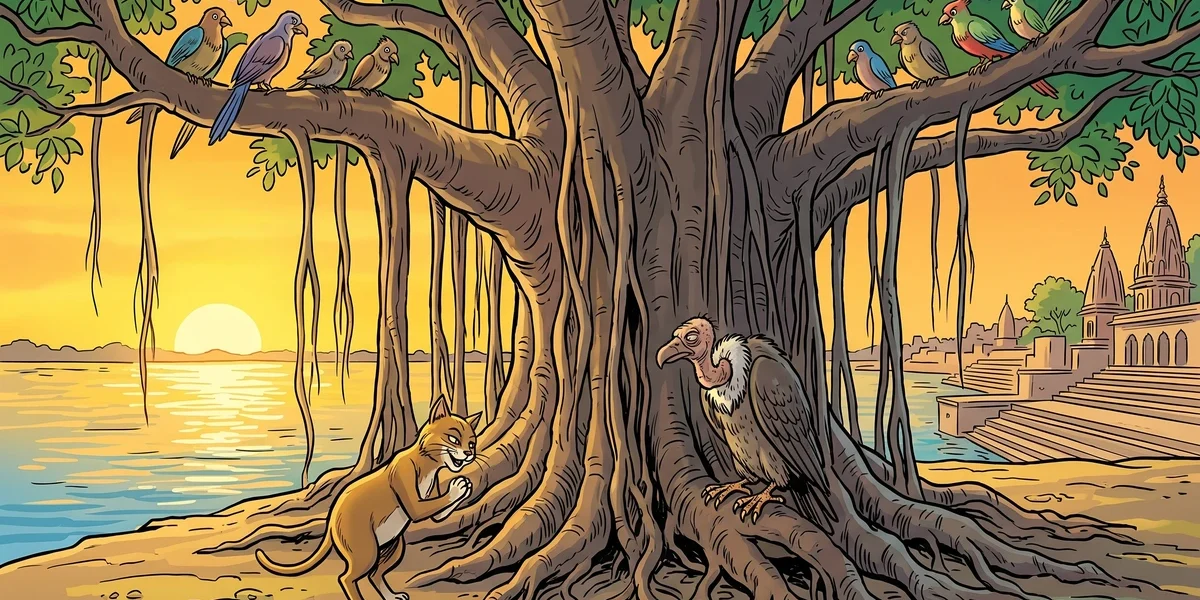
In the hollow of a great banyan tree beside a river lived a Vulture, old and blind. The birds of that tree — doves, sparrows, mynas, parakeets — had lived beside the Vulture for so long that they considered him a resident elder. His blindness made him harmless; his age gave him an air of wisdom. The birds, moved by a mixture of compassion and habit, would bring him scraps of food each day, and in exchange the Vulture would stay near the trunk and keep a kind of honorary watch over the tree.
It was a community built on familiarity rather than genuine examination — the kind of arrangement the Hitopadesha regards with particular wariness. The birds had decided the Vulture was trustworthy not because they had tested him, but because he had always been there and appeared too old and infirm to cause harm. Into this arrangement came a visitor who would expose the community’s complacency.
Beat II — The Cat’s Devotion and the Massacre
A Cat arrived at the foot of the banyan tree. Now, a cat is a natural predator of small birds, and when the birds saw the Cat they raised an immediate alarm. The Cat, however, was prepared. It stood very still, adopted a posture of meditative calm, closed its eyes, and spoke in a soft, philosophically elevated voice. It claimed to be a reformed creature, a practitioner of ahimsā (non-violence), who had renounced meat-eating entirely and sought only the company of the holy. It praised the birds’ beauty and the tree’s sacred atmosphere. It positioned itself, in short, as a pilgrim and ascetic who had come to learn from the community’s wisdom.
The birds were uncertain. But the blind old Vulture, perhaps flattered by the Cat’s praise of the community he had overseen for so long, vouched for it. “This creature speaks the language of dharma,” the Vulture said. “Let it stay.” With the Vulture’s endorsement, the birds’ resistance crumbled. The Cat was permitted to live at the base of the tree.
What followed was gradual and deliberate. The Cat spent weeks establishing its reputation for restraint and piety. Then, one by one, it began disappearing with young birds at the edges of the colony — always at night, always without witnesses. The missing birds were attributed to hawks, to illness, to misadventure. By the time the birds began to suspect, the Cat had consumed a substantial portion of the colony. When the remaining birds finally tracked feathers and bones back to the Cat’s resting place, the horror of what had happened under the Vulture’s watch became clear. The Vulture, whose authority had given the Cat its foothold, was driven from the tree in fury and grief.
Beat III — Analysis Through the Lens of Nītiśāstra
The Hitopadesha places this story at the opening of its inquiry into alliances because it illustrates the most dangerous category of failure in that inquiry: the endorsement of an unverified stranger by a trusted figure whose authority rests on status rather than active discernment. The Vulture was not malicious. He was simply old, comfortable, and susceptible to flattery. His vouching for the Cat transformed the community’s reasonable suspicion into misplaced trust — a dynamic the text calls pratāraṇā by proxy, deception enabled through an intermediary whose credibility is borrowed to legitimise the deceiver.
The Cat’s strategy is a textbook deployment of what the Arthaśāstra of Kautilya classifies under upajāpa — the sowing of false confidence through simulated virtue. Kautilya notes in Book XIII that an agent who can successfully portray renunciation and religious discipline is among the most effective instruments of infiltration, because communities organised around trust in shared values are especially vulnerable to actors who perform those values convincingly. The Cat does not overpower the birds — it disarms them culturally, then destroys them incrementally.
The tragedy of the Vulture’s fate — expelled for his role in the disaster — raises a further teaching: authority carries responsibility for those who shelter under it. The Vulture’s endorsement was not offered as a casual opinion. It carried the weight of his long-standing position in the community. To deploy that weight without investigation was a form of negligence that the Hitopadesha does not excuse, however unintentional the harm.
Beat IV — The Moral and Its Living Relevance
The story’s central warning is one of the most practically important in the entire Hitopadesha: that the appearance of piety, philosophy, and moral elevation is precisely the costume that the most dangerous actors are most motivated to wear. Those who genuinely embody virtue rarely need to announce it. It is the actor who needs to be believed who most elaborately performs the part. The birds’ community was undone not by a show of force but by a show of devotion — and by their willingness to accept that show as evidence of character.
The contemporary relevance is broad. Organisations, communities, and individuals are routinely approached by those who present impressive philosophical or moral credentials — in professional settings, in social movements, in spiritual communities — whose actual behaviour, if tracked carefully over time, would tell a very different story. The Hitopadesha’s counsel is not to assume everyone is the Cat, but to ensure that the mechanisms for tracking actual behaviour remain active and are not suspended simply because an elder has offered their endorsement.
Moral: Appearances of piety and wisdom are the most dangerous disguises; judge those who seek your trust by their deeds and past record, never by their professed virtue.
For more Hitopadesha tales about judging character by conduct, compare The Story of the Terrible Bell, The Story of the Prince and the Procuress, and The Story of the Jackal, Deer, and Crow.
Why This Story Has Lasted
The Vulture and the Cat story has retained its power across centuries because it works simultaneously as a moral fable, a political lesson, and a psychological portrait. The Cat’s performance of asceticism is rendered with enough detail to feel recognisable — and the Vulture’s failure of discernment is made sympathetic enough that readers see themselves in it rather than dismissing it. The story does not present the birds as fools; it presents them as a normally functioning community that encountered an adversary specifically calibrated to exploit their norms. This realism is what keeps the tale alive in oral tradition, in children’s literature, and in contemporary ethical discussion across South Asian cultures.
About the Hitopadesha
The Hitopadesha (“Beneficial Instruction”) was composed by Narayana Pandita in Sanskrit, likely in the twelfth century CE. It is organised as a frame narrative in which a teacher instructs a king’s sons through animal fables drawn from the Panchatantra and other Sanskrit didactic traditions. The four books of the Hitopadesha address friendship, separation of friends, war, and peace — corresponding to the four strategic aims of classical Indian statecraft. The text was among the first Sanskrit works translated into English (by Sir Charles Wilkins, 1787) and has shaped global fable traditions through its influence on later European story collections.
You May Also Like
 Hitopadesha
Ages 3-5
Hitopadesha
Ages 3-5
The Story of the Faithful Rajpoot
The Story of the Faithful Rajpoot: Source: Hitopadesha | Type: Hitopadesha | Country: India | Language: English In the country of Rajputana there lived a
 Hitopadesha
Ages 6-8
Hitopadesha
Ages 6-8
The Story of the Jackal, Deer, and Crow
The Story of the Jackal, Deer, and Crow: Source: Hitopadesha | Type: Hitopadesha | Country: India | Language: English In a certain forest there once lived a
 Hitopadesha
Ages 6-8
Hitopadesha
Ages 6-8
The Story of the Lion and the Old Hare
The Story of the Lion and the Old Hare: Source: Hitopadesha | Type: Hitopadesha | Country: India | Language: English In a certain forest there dwelt a Lion