The Story of the Terrible Bell
The Story of the Terrible Bell: Source: Hitopadesha | Type: Hitopadesha | Country: India | Language: English In a certain monastery there hung a large bell

“Apaśyato mithyā-bhayaṁ — naśyati darśanān naraḥ, tasmāt paśyet prayatnena — bhayasya kāraṇaṁ sadā.”
“False fear belongs to the one who does not look; it is dissolved by looking. Therefore always examine carefully the cause of fear.” — Hitopadeśa II, proverbial verse on the discipline of inquiry.
Beat I — The Bell That Rang Without a Hand
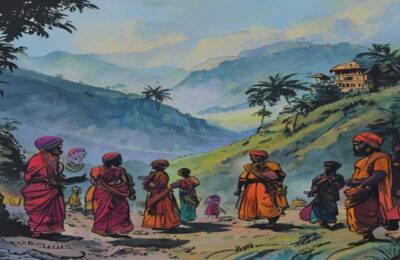
In a prosperous town at the edge of a great forest, there lived a community of merchants and householders whose lives ran along well-worn paths: caravans came and went, the temple bells sounded the watches of the day, and the forest at the town’s edge was a familiar presence rather than a feared one. One season a merchant’s caravan, returning from a long trade route, was attacked at the forest’s edge by a tiger. The merchant escaped with most of his men; the merchant’s mule, however, was wounded in the attack and bolted in panic into the depths of the trees. Across its withers hung the goods it had been carrying, and at its neck swung a large brass bell, cast by the merchant’s grandfather, whose sound the muleteers had used for half a century to keep the caravan together in mountain mist. The mule ran until its strength gave out, lay down, and died beneath a sal tree some distance into the forest. The bell, dislodged from its strap by the long fall, came to rest in the leaf-litter at the mule’s side.
Some weeks later a troop of monkeys, foraging through that part of the forest, discovered the bell. As monkeys will, they were captivated by it. They picked it up by its bronze tongue, they swung it from a low branch, they fought over it, they passed it from hand to hand, and the forest, which had been silent for as long as anyone could remember, began to ring with the irregular, hollow, somehow plaintive sound of a large brass bell tolling among the trees.
The sound carried to the town. The hour was wrong — bells did not ring at that hour. The direction was wrong — no temple stood in that quarter of the forest. The character of the ringing was wrong — no human hand made a bell sound like that, with that arrhythmic stuttering pulse, with those long silences and sudden bursts. The townspeople listened from their doorways and from the parapets of their houses. They asked one another what could be happening. None could account for it. And in the absence of an account, the community began, very quickly, to supply one.
Beat II — The Manufacture of a Demon
By the end of the first week, the prevailing theory in the town was that a bhūta — a malign forest spirit — had taken up residence in that quarter of the trees and was ringing a phantom bell to announce its arrival. By the end of the second week, the bhūta had acquired biographical details: it was the ghost of a Brahmin who had been wronged in a previous generation; it was the avatar of a forgotten goddess who had been deprived of her temple; it was, in the most lurid recension circulating among the children, a rākṣasa with a brass bell hung from each of its many necks, and any traveller it could lure within reach of the sound would be devoured at once and absorbed into its retinue. By the end of the third week, the merchants’ routes had been formally diverted. Caravans paid the substantial cost of an additional two-day journey around the forest rather than approach the bell. The town’s firewood-gatherers refused to enter the woods at all. Tax collectors found their forest revenues halved within a single quarter, and a delegation of householders petitioned the local rājā to dispatch ritual specialists.
The specialists arrived. Brahmins were paid to chant protective mantras; tantric exorcists were retained at significant expense to mark the boundary of the forest with iron nails and red thread; the temple performed a costly śānti ritual to placate whatever entity might be involved. None of these measures was tested against the bell — they were performed at a respectful distance from it — and so none of them had any effect. The bell continued to ring whenever the monkeys felt playful, which was often, and each fresh peal renewed the town’s terror and confirmed, in the minds of the alarmed, that the entity had not been propitiated yet and required further offerings. A whole protective economy grew up around the bell that no one had yet attempted to see.
This is the moment the Hitopadeśa identifies as the structural failure of the community. When fear has generated an explanatory apparatus more elaborate than the apparatus required for investigation, the explanatory work becomes its own justification, and investigation comes to seem not merely unnecessary but actively dangerous — because investigation might expose the entire elaborated structure as needless and shame the people who built it. The community had reached the point at which preserving the fear was institutionally easier than dissolving it. Sanskrit didactic literature gives this state a precise name: mithyā-bhaya-pratisthā, “the establishment of false fear,” a condition in which the structures built around a fear become indistinguishable from the fear itself.
Beat III — The Widow Who Walked into the Forest
There lived in the town a widow — the Hitopadeśa identifies her as a woman of practical intelligence, sharp tongue and notable contempt for collective panic — whose late husband had been a forest-trader and who had spent her own girlhood crossing those very trees on her father’s caravan. She had listened, with mounting irritation, to three weeks of theological speculation, four exorcisms, an emergency town council, and the ruinous diversion of the trade road. She concluded that the community had taken leave of its senses, and she resolved to put the matter back on a rational footing. She told her servants she was going for a walk and, carrying only a stick and a small lamp, she entered the forest in the direction from which the ringing came.
What she found, after an hour’s walk, was a clearing in which a troop of perhaps fifteen monkeys was playing with a large brass bell. One monkey held the rope; two more swung from the bell’s body; the rest crowded around in the standard way of monkeys when an interesting object has been produced. The widow watched for several minutes from the cover of a tree, confirming what she was looking at. She then waited until the monkeys, distracted by some movement in the canopy, dropped the bell and scrambled upward into the higher branches. She walked into the clearing, retrieved the bell, examined the dead mule’s bones lying nearby, understood at once what had happened, and walked back to town with the bell under her arm and a small enigmatic smile on her face.
She entered the town square, set the bell on the ground in front of the assembled and outraged townspeople, and explained in three sentences exactly what they had been afraid of for three weeks. The bell rang once when she set it down. The crowd, which had been preparing to chastise her for her recklessness, fell silent. Then the silence broke into laughter — first nervous, then full — as the children in the square ran to the bell and rang it themselves, and the entire elaborated mythology of the forest-bhūta dissolved in an afternoon. The bell was returned to the merchant who had lost it. The trade road was reopened. The exorcists were paid off and politely shown to the town gate.
Beat IV — The Nitishastra Reading: Why This Tale Sits in Suhrid-Bheda
It may seem strange that the Hitopadeśa places a story about a community’s collective fear in the book on the separation of friends. The placement is precise and instructive. Nārāyaṇa Paṇḍita understood — following Kauṭilya’s Arthaśāstra on mantra-yuddha, “war by counsel” or psychological warfare — that the most reliable way to break the cohesion of a prosperous community is not direct attack but the cultivation of unexplained fear. A community that has been frightened by something it has not investigated becomes, by stages, isolated from its trading partners (whose caravans take other routes), separated from its forest resources (whose access is now ritually prohibited), and divided internally between those who profit from the fear (the ritual specialists, the alternative-route brokers) and those who suffer from it (the ordinary merchants, the firewood-gatherers, the women who must walk further to find water). The bell, in other words, separates the town from its friends as effectively as any human enemy could have done, and at a cost the town pays voluntarily.
The tale also functions as a meditation on adhyāsa — superimposition — which the later Advaita Vedānta tradition formalises as the mechanism by which ignorance compounds itself. The bell in the forest is, ontologically, a neutral bronze object with a mechanical cause. The community’s ignorance projects onto that neutral object a series of imagined qualities — spirit, demon, rakshāsa, vengeful goddess — each of which is then defended by elaborate protective behaviour, and each of which makes the original object harder to perceive. Śaṅkaraācārya’s commentaries on the Brahma-Sūtras use exactly this structure to explain how the unenlightened self projects unreal qualities onto the real self and then defends the projections rather than the underlying reality. The widow’s walk into the forest is, in this reading, an act of jñāna — direct knowledge — that dissolves the superimposition at a stroke.
The tale’s third teaching concerns the social phenomenology of courage. The widow is not braver, in any heroic sense, than the men of the town. She walks an hour and she carries a small lamp. What distinguishes her is her unwillingness to be governed by an explanation she has not herself tested. The Hitopadeśa implies, characteristically, that such individuals always exist within a community in panic, and that their value vastly exceeds their ordinary social recognition; the texts of nītiśāstra warn rulers always to identify and consult such persons in advance of a crisis, because in the crisis the entire community will be looking to the rulers and the rulers will have nowhere else to turn.
Moral: Fear that is not investigated leads to decisions that destroy what it claimed to protect; a single inquiry replaces a thousand remedies conceived in panic.
For other Hitopadesha lessons about investigating fear and deception, compare The Story of the Prince and the Procuress, The Story of the Jackal, Deer, and Crow, and The Story of the Tiger and the Traveller.
Why This Story Has Lasted
The Terrible Bell has lasted because its narrative structure maps with unusual precision onto a permanent feature of human collective behaviour: the tendency, when confronted with an inexplicable phenomenon, to elaborate explanations rather than to investigate, and to find in the elaboration itself a perverse satisfaction that makes investigation feel both redundant and dangerous. Few classical fables identify this dynamic so cleanly, and fewer still propose a remedy so direct. The story has been cited continuously in the Sanskrit philosophical commentaries as a paradigm of adhyāsa; it appears in the Indian political-science tradition as a textbook illustration of the cost of unexamined panic; it survives in folk performance across South Asia as a comic story about a sensible woman who dissolves the foolishness of an entire town in an afternoon. The combination of philosophical depth and comic populist energy is rare in any tradition, and it is the chief reason the bell keeps ringing across the centuries: every generation produces its own forests and its own brass bells, and every generation must produce its own widow to walk in and look.
The contemporary applications are immediate. Market panics that paralyse rational investors; institutional paralysis in the face of ambiguous threats; social-media panics whose elaborated mythology grows more frightening the less anyone investigates the original source; the corporate fear of a competitor whose actual capabilities have never been studied; the diplomatic standoff sustained by inherited animosities that no one has reviewed in a generation — all of these are iterations of the Terrible Bell. The widow’s walk into the forest is not a heroic gesture; it is the most basic possible discipline of inquiry, and the Hitopadeśa’s point is precisely that it is the absence of this basic discipline, not the absence of heroism, that allows communities to be paralysed by their own elaborations.
About the Hitopadeśa
The Hitopadeśa (“Beneficial Instruction”) was compiled in Sanskrit by Nārāyaṇa Paṇḍita at the court of King Dhavalachandra of Gauḍa (Bengal), conventionally dated c. 1373 CE with some scholars favouring an earlier 12th-century recension. Drawing principally on the older Pañcatantra of Viṣṇu Śarman, on Kauṭilya’s Arthaśāstra, and on the Sanskrit nītiśāstra tradition descending from Cāṇakya, its four books treat in turn Mitra-Lābha (the acquisition of friends), Suhṛd-Bheda (the separation of friends), Vigraha (war), and Saṁdhi (peace). Sir Charles Wilkins’s 1787 English translation was among the first Sanskrit works published in Europe; Sir Edwin Arnold’s 1861 Book of Good Counsels popularised the tales for the Victorian reader; Chandra Rajan’s Penguin Classics rendering brought them to modern global circulation. The text continues to be the standard introduction to Sanskrit didactic prose in Indian university curricula.
You May Also Like
 Hitopadesha
Ages 6-8
Hitopadesha
Ages 6-8
The Story of the Frogs and the Old Serpent
The Story of the Frogs and the Old Serpent: Source: Hitopadesha | Type: Hitopadesha | Country: India | Language: English In a certain pond there lived many
 Hitopadesha
Ages 6-8
Hitopadesha
Ages 6-8
The Duel of the Giants
The Duel of the Giants: Source: Hitopadesha | Type: Hitopadesha | Country: India | Language: English In a certain country there were two giants who were
 Hitopadesha
Ages 3-5
Hitopadesha
Ages 3-5
The Story of the Tortoise and the Geese
The Story of the Tortoise and the Geese: Source: Hitopadesha | Type: Hitopadesha | Country: India | Language: English In a certain lake there lived a Tortoise