The Story of the Herons and the Mongoose
The Story of the Herons and the Mongoose: Source: Hitopadesha | Type: Hitopadesha | Country: India | Language: English In a certain pond there lived many
Origin and Attribution
This story is drawn from the Hitopadesha (Hitopadeśa), compiled by the Sanskrit scholar Narayana Pandita in approximately the twelfth century CE at the court of King Dhavalachandra of Bengal. It is placed within Book III: Vigraha (“Discord”), which examines conflict strategy — including the critical question of how parties under attack choose their allies, and what those choices cost them. The tale of the Herons and the Mongoose engages the most seductive principle in conflict strategy: that the enemy of one’s enemy must be one’s friend. The Hitopadesha treats this principle with deep suspicion, examining precisely the conditions under which it leads parties to introduce, into their own community, a force whose ultimate effect is more destructive than the original threat it was invited to address. Related narrative patterns appear in the Panchatantra of Vishnu Sharma and in the political philosophy of the Arthaśāstra, where the principle of ari-mitra (enemy-friend) is examined at length as one of the most analytically complex categories in the mandala theory of statecraft.
“Śatrur api hito bhāti — śatroh śatrutvam āgatam, tat-saṃgena tu naśyanti — baka-pakṣī yathā kramāt.”
“Even an enemy appears beneficial when he has become the enemy of one’s enemy — but through association with such a one, the herons perished one by one.” — Hitopadesha III
Beat I — The Snake and the Decision
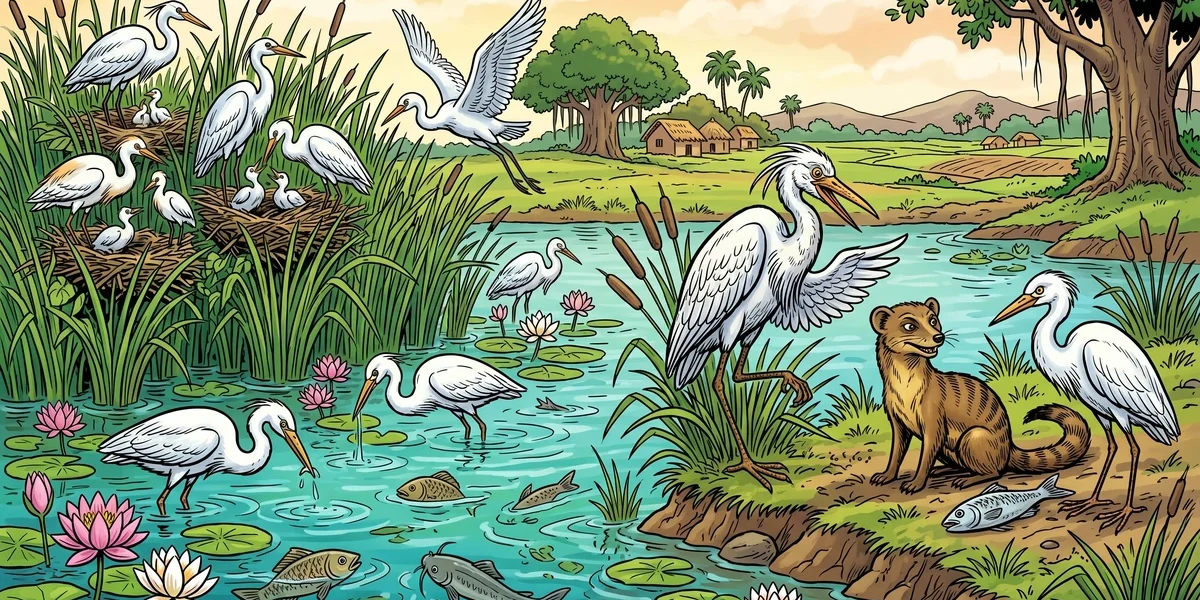
A colony of Herons nested in a great tree beside a lake. For seasons, they had been tormented by a Black Snake that lived in a hollow at the tree’s base and ate their eggs and chicks each nesting season. The Herons grieved, relocated their nests within the tree, returned to find the Snake had found them again. Their efforts to drive it away directly had failed — it was too large and too aggressive for any individual Heron to challenge. Their colony was slowly being depleted.
A clever old Heron proposed a solution. Not far from the tree lived a Mongoose — a natural and deadly predator of snakes. If the Herons could establish a path of fish from the mongoose’s burrow to the tree’s base, the Mongoose would follow the trail, discover the Snake, and kill it. The other Herons, desperate for relief from the Snake’s predation, agreed to the plan. They laid out the trail of fish from the Mongoose’s burrow to the tree, and the Mongoose followed it exactly as predicted — found the Snake, fought it, and killed it.
Beat II — The Price of the Solution
The Herons celebrated. The Snake was gone. The relief was real and immediate. But the Mongoose had not come to the tree as a visitor — it had come following a trail of food that led to a tree full of birds. Having killed the Snake, it looked up. The tree was full of Herons, their eggs, their chicks. The Mongoose was a predator. The Herons had invited a predator into their tree in order to remove a different predator — and the Mongoose, having dispatched the Snake, turned its attention to the community that had unknowingly established itself as the Mongoose’s next and readily available food source.
The Hitopadesha relates that the Mongoose began to work through the Heron colony systematically. The original Snake had taken eggs and chicks. The Mongoose took everything within reach. The Herons’ solution to their problem had introduced a threat more comprehensive and more capable than the one they had eliminated. The colony that had been slowly depleted by the Snake was now rapidly destroyed by the ally it had recruited to destroy the Snake.
Beat III — Analysis Through the Lens of Nītiśāstra
The Hitopadesha‘s analysis of this episode is one of its most politically sophisticated passages. The Herons made a rational calculation in the terms available to them: they needed the Snake removed; the Mongoose was capable of removing it; therefore the Mongoose should be invited. What the analysis missed — and what the text identifies as the critical error — was the failure to model what the Mongoose would do after the Snake was gone. The Mongoose’s interest was not in the Herons’ welfare; it was in food. The Snake removal was incidental to that interest. Once the Snake was gone, the Mongoose’s interest and the Herons’ interest were no longer aligned — and had, in fact, always been aligned only in that single narrow transaction.
Kautilya’s Arthaśāstra addresses this failure explicitly in its analysis of the ṣāḍguṇya (six policies) and the maṇḍala (circle) theory of interstate relations. The principle that an enemy’s enemy may be an ally is valid in Kautilya’s system, but it comes with a precise analytical requirement: the alignment of interests must extend beyond the immediate common threat to the post-threat environment. An ally whose interest is purely the elimination of a shared enemy will, once that enemy is gone, resume evaluating its own interests independently — and those interests may or may not align with yours. The Herons failed to perform this second-order analysis, and the Mongoose performed exactly the first-order role they had assigned it, then moved immediately to serve its own independent interest.
The story also illustrates the principle of parīkṣita-mitra — the tested ally — which the nītiśāstra tradition holds as the gold standard of alliance. The Mongoose was not a tested ally; it was a recruited instrument for a specific task. The Herons treated it as an ally because it helped them, not because its interest in their welfare had been established over time and through evidence. This confusion — between an instrument and an ally — is one the Hitopadesha identifies as among the most dangerous errors in conflict management.
Beat IV — The Moral and Its Living Relevance
The story’s moral addresses a principle that appears in every domain of strategic thought: alliances formed around a common enemy dissolve when the enemy is gone, and the post-enemy environment often reveals that the former allies’ interests are in direct competition. Political coalitions formed entirely around opposition to a shared adversary frequently discover, upon that adversary’s defeat, that they have no shared vision for what comes next — and that the forces they combined to defeat the adversary are now in conflict with each other. The Herons’ error was not in using the Mongoose — that was reasonable — but in not thinking through what the relationship would look like after the task was done.
Contemporary strategic relevance is immediate: in geopolitics, in organisational management, in legal disputes, in any domain where coalitions form around shared threats, the question “what happens after the shared threat is gone?” is the most important question a coalition member can ask before committing to an alliance. The Herons never asked it. The Mongoose never needed to.
Moral: The enemy of your enemy is not automatically your friend; an alliance formed in desperation with a party whose interests diverge from yours will ultimately serve their purpose, not yours.
Why This Story Has Lasted
The Herons and the Mongoose has endured because it encodes one of the most persistently relevant strategic errors in human affairs: the failure to think past the immediate problem to the environment that the solution creates. It is a story about second-order consequences — the effects of effects — and the Indian didactic tradition’s insistence on second-order thinking as the mark of genuine practical wisdom. The story is cited in Sanskrit political commentaries, in folk proverbs about the dangers of desperate alliances, and in modern strategic analysis literature as a paradigm case of solution-replacement — where the cure turns out to be worse than the original disease. The Mongoose’s efficient, unsentimental transition from Snake-killer to Heron-predator is one of the most clinically accurate portraits of interest-alignment dynamics in classical narrative literature, and it has given the story a durability matched by few other tales in the Hitopadesha canon.
About the Hitopadesha
The Hitopadesha (“Beneficial Instruction”) was compiled by Narayana Pandita in Sanskrit, approximately the twelfth century CE, at the court of King Dhavalachandra of Bengal. Its four books on gaining friends, separating friends, war, and peace draw on the Panchatantra of Vishnu Sharma and the Nītiśāstra tradition, teaching practical wisdom through animal fables in a frame narrative addressed to a king’s sons. The Hitopadesha was among the earliest Sanskrit texts translated into English (1787) and has exercised lasting influence on South Asian and global didactic literature.
You May Also Like
 Hitopadesha
Ages 3-5
Hitopadesha
Ages 3-5
The Story of the Monkey and the Wedge
The Story of the Monkey and the Wedge: Source: Hitopadesha | Type: Hitopadesha | Country: India | Language: English In a certain town there lived a carpenter
 Hitopadesha
Ages 6-8
Hitopadesha
Ages 6-8
The Story of the Washerman’s Jackass
The Story of the Washerman's Jackass: Source: Hitopadesha | Type: Hitopadesha | Country: India | Language: English There was once a Washerman who had a donkey.
 Hitopadesha
Ages 6-8
Hitopadesha
Ages 6-8
The Story of the Prince and the Procuress
The Story of the Prince and the Procuress: Source: Hitopadesha | Type: Hitopadesha | Country: India | Language: English In a certain city there lived a young