Bopoluchi the Clever Girl
Tricked into going off with a robber who claims to be her long-lost uncle, an orphan girl must rely on her quick wits and her courage to get away from him.
One day some girls were filling their water jars at the village well and chattering about the weddings their families were planning for them.
“My uncle will be here soon with the wedding gifts,” said the first, “and he is bringing the loveliest clothes you ever saw.”
“My uncle-in-law is on his way too,” said the second, “with the most delicious sweets.”
“And mine,” said the third, “will arrive any day with the rarest jewels in the world.”
Bopoluchi felt sad, because she was an orphan and there was nobody to arrange a marriage for her. Wanting to share in their excitement, she spoke too. “My uncle is coming as well,” she announced brightly, “with fine dresses, fine food and fine jewels.”
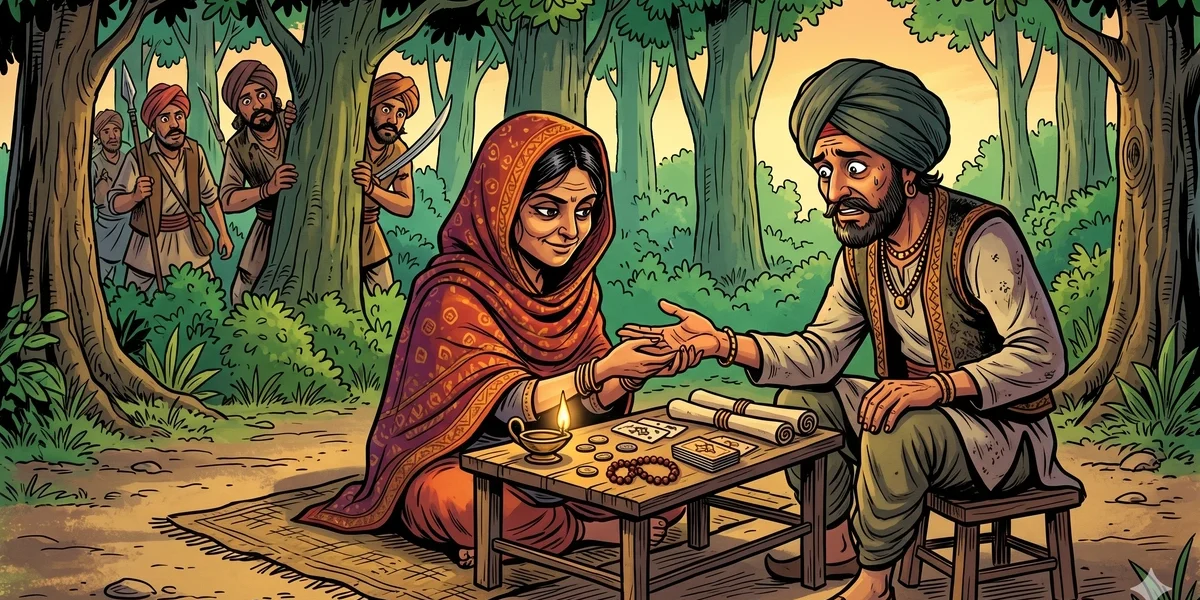
Sitting close to the well was a pedlar who went about selling perfumes and face powders to village women. He overheard Bopoluchi, and he decided to deceive her and force her into marriage. He was not truly a pedlar at all, but a wicked robber with a great deal of money. The very next day he arrived at Bopoluchi’s door dressed as a prosperous farmer, carrying tray after tray of fine dresses, fine food and fine jewels.
Bopoluchi could hardly believe it. Everything had happened exactly as she had boasted. The robber told her he was her father’s brother, back after many years away, and that he had come to marry her to his son, her cousin. She believed every word and was delighted. She tied her few belongings in a bundle and set off with him, full of happiness.
As they walked along the road, a crow on a branch called out:
“Bopoluchi, what a pity!
You’ve lost your wits, my pretty!
That is no uncle by your side,
But a robber, who has lied!”
“Uncle,” said Bopoluchi, “that crow has a strange croak. What is it saying?”
“Nonsense,” said the robber. “Every crow in these parts croaks like that.”
Farther on, a peacock saw the pretty girl and screamed the very same words. “Uncle,” said Bopoluchi, “what is the peacock saying?”
“Nonsense,” said the robber. “Peacocks round here always scream like that.”
Then a jackal slipped across the road and howled the warning too. “Uncle,” said Bopoluchi, “why does that jackal howl so oddly?”
“Nonsense,” said the robber. “All the jackals in this country howl that way.”
So Bopoluchi walked on until they reached the robber’s house. There he told her the truth: he was no uncle, and he meant to marry her himself. She wept bitterly, but he had no pity. He left her with his mother, a very, very old woman, and went off to arrange the wedding feast.
Now, Bopoluchi’s hair was so long and lovely that it fell all the way to her ankles, while the old mother had not one hair left on her head.
“Daughter,” said the old woman as she dressed Bopoluchi in the scarlet wedding clothes, “how did you get such wonderful hair?”
“Oh,” said Bopoluchi, “my mother grew it by putting my head in the big rice mortar and pounding it with the pestle. With every blow my hair grew a little longer. It works every time.”
“Perhaps it would make my hair grow!” cried the old woman.
“Perhaps it would,” said clever Bopoluchi.
So the old woman put her head in the mortar, and Bopoluchi pounded so hard that the old woman did not get up again. Then Bopoluchi dressed her in the scarlet wedding clothes, sat her on the low bridal stool, pulled the veil down over her face and set the spinning wheel in front of her, so the robber would take her for the bride. Bopoluchi put on the old woman’s clothes, picked up her bundle and hurried away.
On the road home she saw the robber coming towards her, carrying a stolen millstone on his head to grind flour for the feast. Terrified, she slipped behind a hedge. The robber did not know her in his mother’s clothes; he took her for a stranger from another village and ducked behind the hedge on the other side so as not to be seen himself. And so Bopoluchi got home safely.
When the robber reached his house, he saw a figure in scarlet on the bridal stool, sitting at the spinning wheel, and thought it was Bopoluchi. He called to her to help him lift down the millstone, but she did not answer. He called a second time, and still there was no reply. In a fury he hurled the millstone at her, and the figure toppled over. It was not Bopoluchi at all, but his own ancient mother! The robber wept and beat his chest. But when he understood that Bopoluchi had escaped, he flew into a rage and swore he would carry her off somehow.
Bopoluchi was sure he would come for her. So every night she asked to sleep at a different friend’s house, and left her own little bed empty. After a month or so she had stayed with all her friends and felt unable to ask any of them twice. She returned home despite the danger, taking a sharp bill-hook to bed with her.
Sure enough, in the middle of the night four men crept in. Each of them took hold of one leg of the bed, and they lifted it and carried it off, with the robber holding the leg just behind her head. Bopoluchi was wide awake, but she pretended to be sound asleep. When they reached a lonely, empty place and the men were off their guard, she whipped out the bill-hook and swiftly struck down the three helpers. The robber ran off in terror and scrambled up a nearby tree like a wild cat before she could reach him.
“Come down,” shouted Bopoluchi, waving the bill-hook, “and fight me!”
He would not come down. So she gathered every stick she could find, piled them around the trunk and set them alight. The tree caught fire, and the robber, choking on the smoke, tried to jump and was killed by the fall.
Then Bopoluchi went to the robber’s house and took away all the gold, silver, jewels and clothes hidden there. She came home to her village so rich that she could marry anyone she liked, and so her adventures came to an end.
Where this tale comes from
Flora Annie Steel wrote down this story in Tales of the Punjab, a book of tales she gathered from village story-tellers on her winter tours; the notes were added by R. C. Temple. Temple explains that the name Bopoluchi means “Trickster,” and that the word used for the robber was thag, literally “a deceiver.”
Temple also records the animals’ warning in the original Punjabi, three short lines saying that Bopoluchi has lost her wits and been fooled by a thag. The rhyme above is a new English version. Steel describes the old mother’s death, the robber’s helpers and his own end more bluntly; they are told briefly here.
Read the original: Flora Annie Steel, Tales of the Punjab (Project Gutenberg #6145, Bopolûchî)
Reading guidance: For mature readers. The story includes forced-marriage deception, killing with a pestle and bill-hook, a body disguised as a bride, attempted recapture and a fatal fire-and-fall escape.
A closer reading
The robber overhears what Bopoluchi lacks and supplies a convincing imitation of it: a relative, gifts and a promised wedding. Her wish to belong makes his deception persuasive, but responsibility for the capture lies with him. Each animal warning is immediately reinterpreted by the very person it identifies as dangerous.
Bopoluchi’s disguises reverse the robber’s method. He impersonates kin to control her; she changes clothes and stages a bride to escape him. The later episode also shows the limits of her support: friends shelter her, but she fears asking again and becomes vulnerable at home. Needing further help is not a failure of courage.
The escape is fiercely violent, including the killing of the robber’s mother and his helpers. Calling Bopoluchi clever does not require treating each death as a model solution. The ending gives her wealth and choice of a husband, but says nothing about restoring stolen goods to their earlier owners.
Try this with the story
Compare the two false identities—uncle and disguised older woman—by recording who creates each, what the other person believes and whether its purpose is control or escape. Then identify the point where continued help from the village could change the later attack.
Questions to ask
- Why did Bopoluchi say her uncle was coming, even though she had no uncle?
- Which warnings did Bopoluchi hear on the road, and why didn’t she listen?
- How did Bopoluchi use the old woman’s clothes and the bridal stool to escape?
- Was Bopoluchi brave, clever, or both? Give an example.
You may also like
- The Robber Bridegroom — another tale of a young woman who escapes a robber who wants to marry her
- The Barbers Clever Wife — another Punjab tale of a quick-witted woman who outsmarts thieves
- The Clever Wife — another story about a woman whose wits get her out of trouble
Also known as: Bopoluchi
Frequently Asked Questions
Why does Bopoluchi believe the supposed uncle?
How does she first escape?
Why is she endangered again?
Does the ending restore her choices?
You May Also Like
 Indian Folk Tales
Ages 9-12
Indian Folk Tales
Ages 9-12
The Jackal and the Partridge
A fussy jackal says a true friend must make him laugh, make him cry, feed him and save his life, so his friend the partridge sets out to do all four.
 Indian Folk Tales
Ages 9-12
Indian Folk Tales
Ages 9-12
Savitri and the Lord of Death
When a wise man warns that her chosen husband will die within a year, Princess Savitri marries him anyway, and when Death comes for him, she follows.
 Indian Folk Tales
Ages 9-12
Indian Folk Tales
Ages 9-12
Mr. Mighty-of-His-Mouth
Mr. Mighty-of-his-Mouth uses nothing but quick words to scare off a whole tribe of goblins, proving to his strong friend that wit beats muscle.