The Story of the Crane and the Crab
The Story of the Crane and the Crab: Source: Hitopadesha | Type: Hitopadesha | Country: India | Language: English In a certain pond there lived many fishes and
Origin and Attribution
This story is preserved in the Hitopadesha (Hitopadeśa), compiled by the Sanskrit scholar Narayana Pandita in approximately the twelfth century CE. It falls within Book I: Mitralabha (“The Gaining of Friends”), which examines — among other themes — the specific danger of the trusted advisor who systematically exploits that trust. The tale of the Crane and the Crab is one of the most structurally compelling stories in the Indian didactic tradition: it is a story about a deception that is discovered not through the deceiver’s mistake but through the investigative intelligence of a victim who refuses to accept the established narrative. Related versions appear in the Panchatantra of Vishnu Sharma (c. 3rd century BCE) and in Buddhist Jātaka tales, where the Crab — or a functionally equivalent character — serves as the figure of practical intelligence that breaks the Crane’s long-running predatory scheme. The story is one of the few in the Hitopadesha tradition where the protagonist of the resolution is not the most powerful creature but the most methodical one.
“Pratārako dīrgha-kālaṃ — dhūrtaḥ sarvān pratārayet, ekena yukti-matā buddhyā — naśyati baka-yathā krame.”
“A skilled deceiver may fool all for a long time — but is destroyed, as the crane was, by a single intelligence that investigates methodically.” — Hitopadesha I
Beat I — The Crane’s Scheme
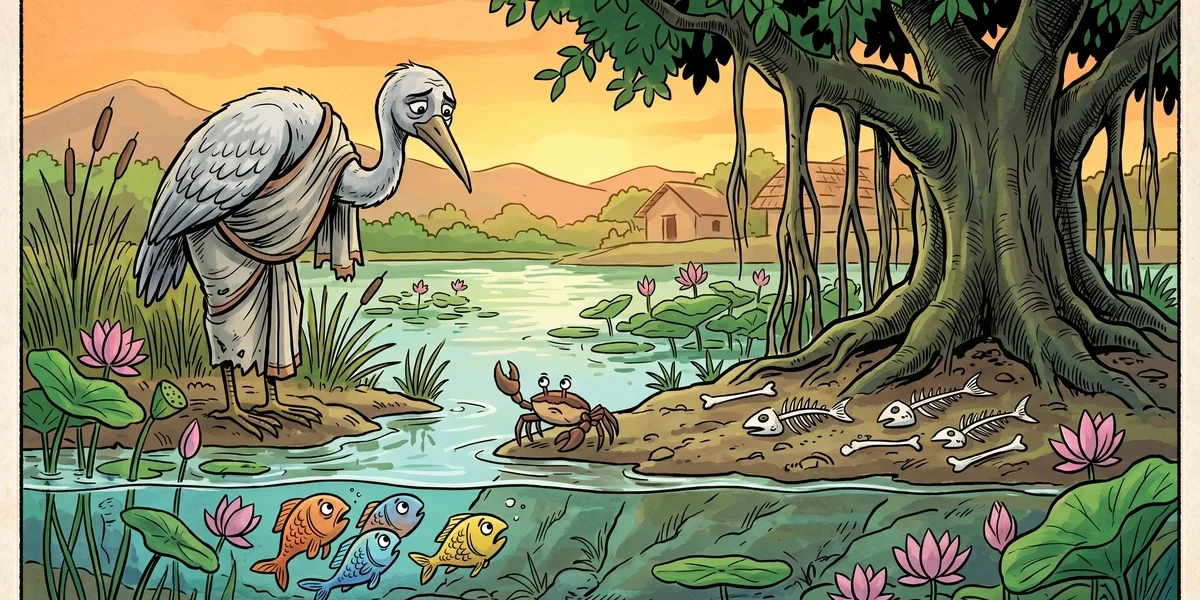
An old Crane lived beside a lake full of fish. In its youth the Crane had hunted directly — but age had reduced its speed, and direct hunting was no longer reliable. It devised instead a scheme of elegant predatory intelligence. It sat at the water’s edge wearing an expression of deep sorrow, conspicuously refusing to eat. The fish of the lake, curious, gathered near it. What was wrong? Why was it not eating?
The Crane told them a sorrowful story: it had overheard fishermen planning to drain the lake and take all its fish. The Crane, which had lived beside this lake for decades and had always respected the fish community, could not bear to watch this happen. If only there were a deeper, safer lake nearby — which there was, the Crane said — where the fish could be relocated before the fishermen came. The Crane offered to carry the fish there, one by one, in its beak.
The fish, alarmed by the prospect of the drought and grateful for the Crane’s apparent selflessness, agreed. One by one they allowed themselves to be carried off — and one by one the Crane carried them to a convenient rock some distance from the lake, ate them, and returned with a story of the new lake’s excellent qualities. The scheme ran for a considerable time. The lake’s population steadily declined.
Beat II — The Crab That Investigated
Among the lake’s inhabitants was a Crab. When its turn came, it too asked to be carried to the new lake. The Crab held on to the Crane’s neck with its claws as the Crane flew — and as they approached the vicinity of the rock, the Crab looked down. It saw bones. Many bones. The bones of fish. The Crab did not panic and did not release its grip. It tightened its claws around the Crane’s neck and asked, very quietly, where exactly this new lake was — because what it could see below did not resemble a lake at all.
The Crane, feeling the Crab’s grip tighten and reading the situation with the clear-eyed intelligence of a predator who recognises it has been caught, apparently decided honesty was now the only available option. The conversation was brief. The Crab’s claws tightened further. The Crane died. The Crab returned to the lake and reported what had happened — including the bone-strewn rock that was the destination the Crane had been describing, for seasons, as paradise.
Beat III — Analysis Through the Lens of Nītiśāstra
The Hitopadesha‘s analysis of this story focuses on the specific quality that distinguished the Crab from the fish that preceded it: not courage, not strength, not superior knowledge, but the habit of parīkṣā — investigation, the direct examination of what is actually present rather than acceptance of what has been narrated. The fish had each accepted the Crane’s account of the situation: the drought threat, the better lake, the Crane’s concerned benevolence. The Crab accepted none of these. It held on, looked down, and asked questions when what it saw contradicted what it had been told.
Kautilya’s Arthaśāstra treats parīkṣā as one of the primary duties of the intelligent minister: before acting on any report, examine the evidence directly if it is available. The chain of fish who trusted the Crane’s narrative without independent verification represents what Kautilya calls śruta-mātra-viśvāsa — trust based on hearing alone — which he classifies as a reliable path to exploitation. The Crab’s method — physical proximity to the evidence, direct observation, and real-time questioning when the observation contradicts the narrative — is the Arthashastra’s recommended counter to this vulnerability.
The story also illustrates the dynamics of cumulative deception. The Crane’s scheme worked for so long because each individual transaction was plausible, the Crane’s apparent sorrow and benevolence established trust, and the disappearance of each fish could be explained by the story of successful relocation. The scheme’s vulnerability was not in any single transaction but in the accumulation of missing fish — evidence that was available for anyone who looked at the whole pattern rather than each individual story. The Crab was the first creature to do this, and the doing of it was sufficient.
Beat IV — The Moral and Its Living Relevance
The story’s moral addresses an extremely common dynamic: the trusted figure — whether a financial advisor, a community leader, a colleague, or an institution — who has established sufficient trust to operate a deception across many transactions over an extended period. Each individual transaction is plausible; the pattern, examined as a whole, is not. The protection against this is not the suspicion of every individual claim but the habit of pattern-examination — the Crab’s approach of looking at the whole trajectory, not just the most recent story.
The Crab’s specific technique — holding on while looking at the evidence — is also worth noting. It did not release the Crane when the situation became ambiguous; it used the moment of ambiguity to gather more information. This is the opposite of the paralysis that ambiguity often produces, and it is the Hitopadesha‘s image of active intelligence under pressure: the mind that observes, questions, and tightens its grip at precisely the moment when most minds would either panic or accept the reassurance being offered.
Moral: The deceiver who operates within a community of the trusting will eventually deceive beyond the limits of plausibility; the one who investigates the pattern rather than accepting each story will stop the destruction.
Why This Story Has Lasted
The Crane and the Crab has endured because the Crab is one of the most satisfying protagonists in the Indian didactic tradition: small, methodical, physically tenacious, and entirely unimpressed by the Crane’s established reputation for benevolence. The story does not require a hero of great strength or obvious virtue — it requires a creature with the habit of looking at what is actually there when the narrative offered does not match the evidence available. This combination — modest protagonist, devastating investigative clarity, elegant physical resolution — makes the story as compelling in performance as it is in reading, and it has been adapted across Sanskrit, Hindi, Bengali, Kannada, Tamil, and numerous other South Asian literary traditions without losing any of its force. The bones on the rock are one of the most visually arresting images in classical Indian narrative, and they have given the story a life in visual art, folk theatre, and modern children’s literature that parallels its life in the scholarly and ethical traditions where it originated.
About the Hitopadesha
The Hitopadesha (“Beneficial Instruction”) was compiled by Narayana Pandita in Sanskrit, approximately the twelfth century CE, at the court of King Dhavalachandra of Bengal. Its four books draw on the Panchatantra of Vishnu Sharma and the Nītiśāstra tradition, addressing the practical wisdom of friendship, conflict, and governance through animal fables in a frame narrative addressed to a king’s sons. The text was among the earliest Sanskrit works translated into English (1787) and has exercised lasting influence on South Asian and global didactic literature.
You May Also Like
 Hitopadesha
Ages 6-8
Hitopadesha
Ages 6-8
The Story of the Prince and the Procuress
The Story of the Prince and the Procuress: Source: Hitopadesha | Type: Hitopadesha | Country: India | Language: English In a certain city there lived a young
 Hitopadesha
Ages 6-8
Hitopadesha
Ages 6-8
The Story of the Jackal, Deer, and Crow
The Story of the Jackal, Deer, and Crow: Source: Hitopadesha | Type: Hitopadesha | Country: India | Language: English In a certain forest there once lived a
 Hitopadesha
All Ages
Hitopadesha
All Ages
Bopoluchi the Clever Girl
Bopoluchi the Clever Girl: Once upon a time, in a village in Punjab, there lived a girl named Bopoluchi who was known throughout the land for her quick wit and