The Story of the Lion, the Camel, the Jackal and the Crow
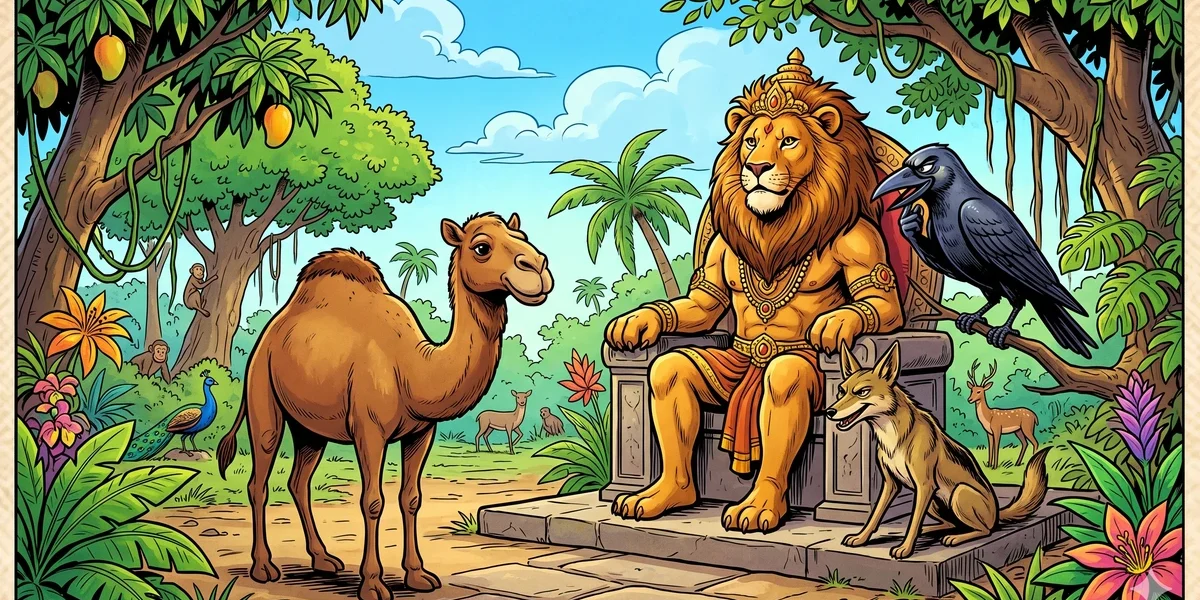
The Story of the Lion, the Camel, the Jackal and the Crow: In a ertain part of the jungle, there lived a lionking, by the name of Madotkata. His retinue
The Story of the Lion, the Camel, the Jackal and the Crow
Origin and Manuscript Tradition
This tale of treacherous fellowship appears in Panchatantra Book III, Kakolukiyam (On Crows and Owls), and is one of the collection’s most sophisticated explorations of false friendship. It survives in all major Sanskrit recensions and was transmitted through the Persian and Arabic Kalila wa Dimna tradition, where it became a standard reference in discussions of political betrayal. The story is structurally elegant: the crow and jackal devise a scheme in which every element of the trap is made to look like voluntary generosity. The camel Kradanaka is not forced; he is manoeuvred into making the offer that kills him, so that the lion’s honour is technically preserved and the camel’s own words become the instrument of his destruction. Vishnu Sharma presents this as the most insidious form of treachery: one in which the victim cannot even protest, because the act was formally his own choice.
The Company of Four
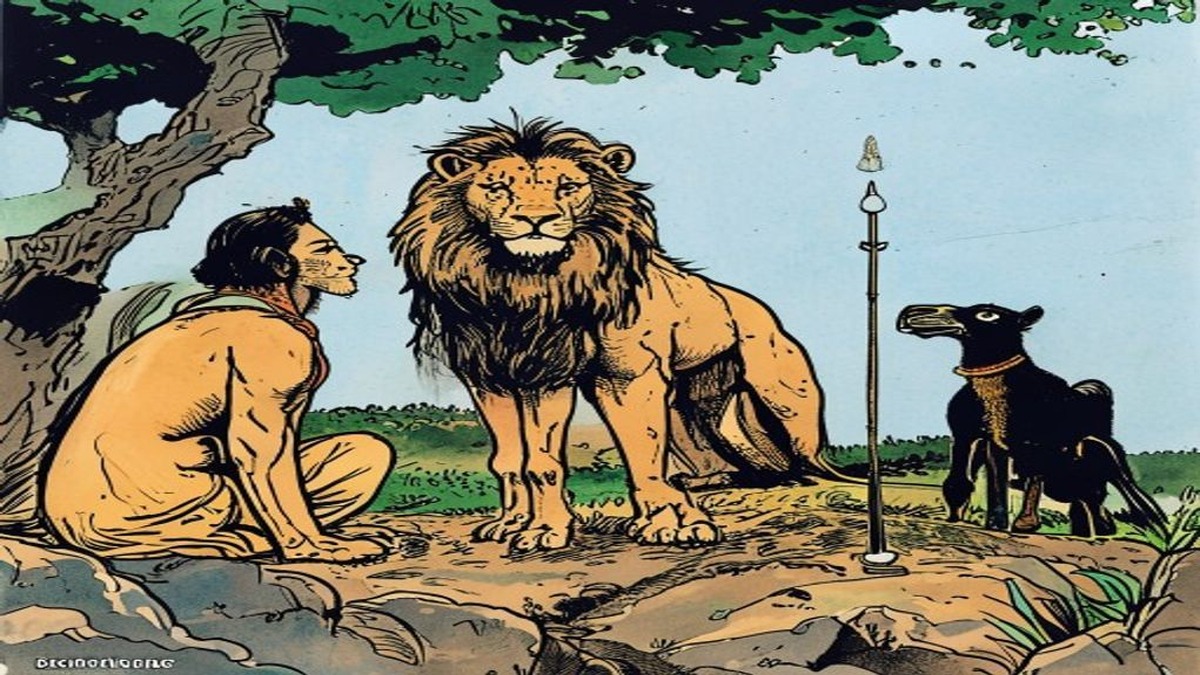
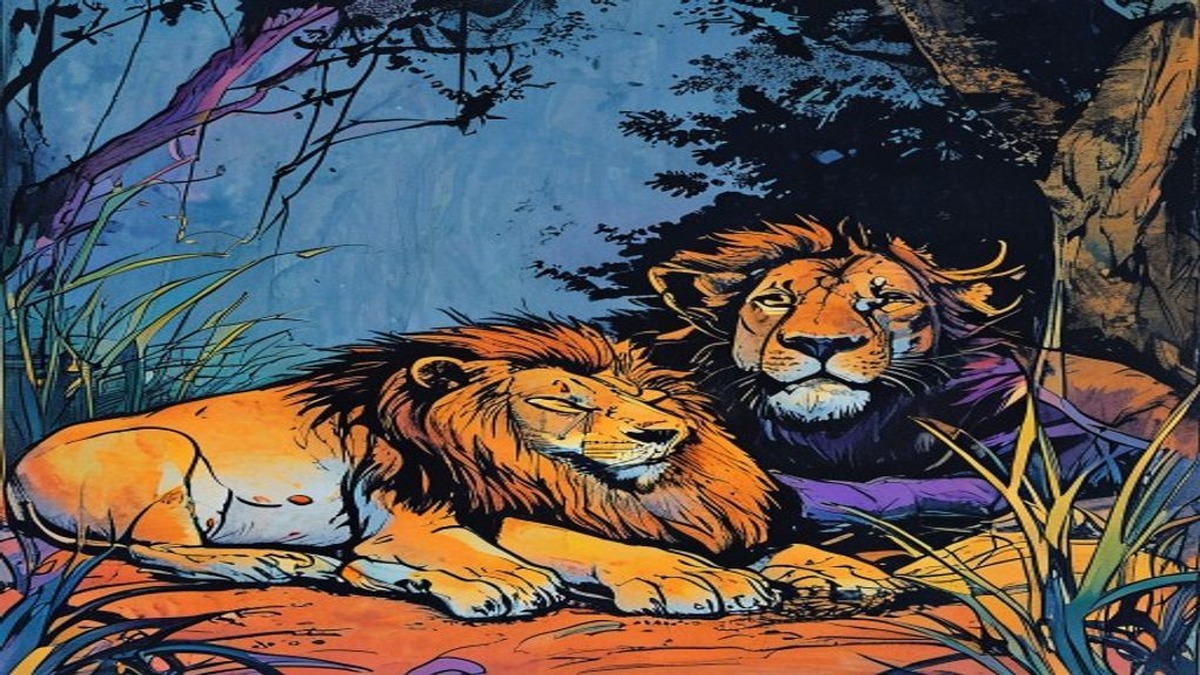
A lion named Madotkata had gathered around him an unusual court: a crow named Dhabolika who served as his scout and intelligence-gatherer, and a jackal named Gomaya who served as his advisor. The three had lived together comfortably for some time when they encountered a camel named Kradanaka who had become separated from his caravan in the forest and was wandering, frightened and lost. The lion took pity on him and offered him protection. Kradanaka, enormously relieved, accepted gratefully and joined the group.
The arrangement was agreeable while the lion was healthy. He hunted and the four companions shared the meat, the camel eating his portion of grain and greens nearby. The camel was gentle, trusting, and somewhat simple; he understood the hierarchy of the group clearly (lion, then crow, then jackal, then himself) and found this acceptable because the lion’s protection was genuine and the company was pleasant. He did not think deeply about what the jackal and crow were when the lion was not present. He should have.
A bull elephant charged Madotkata from the edge of the forest one day and the lion, though he drove the elephant off, was badly wounded in the fight. He lay under a spreading tree, unable to move without pain, unable to hunt. The crow and jackal, accustomed to eating the lion’s kills, began to feel hunger within days. They looked at the camel and then at each other, and began to talk quietly when Kradanaka was grazing at a distance.
The Protocol of False Sacrifice
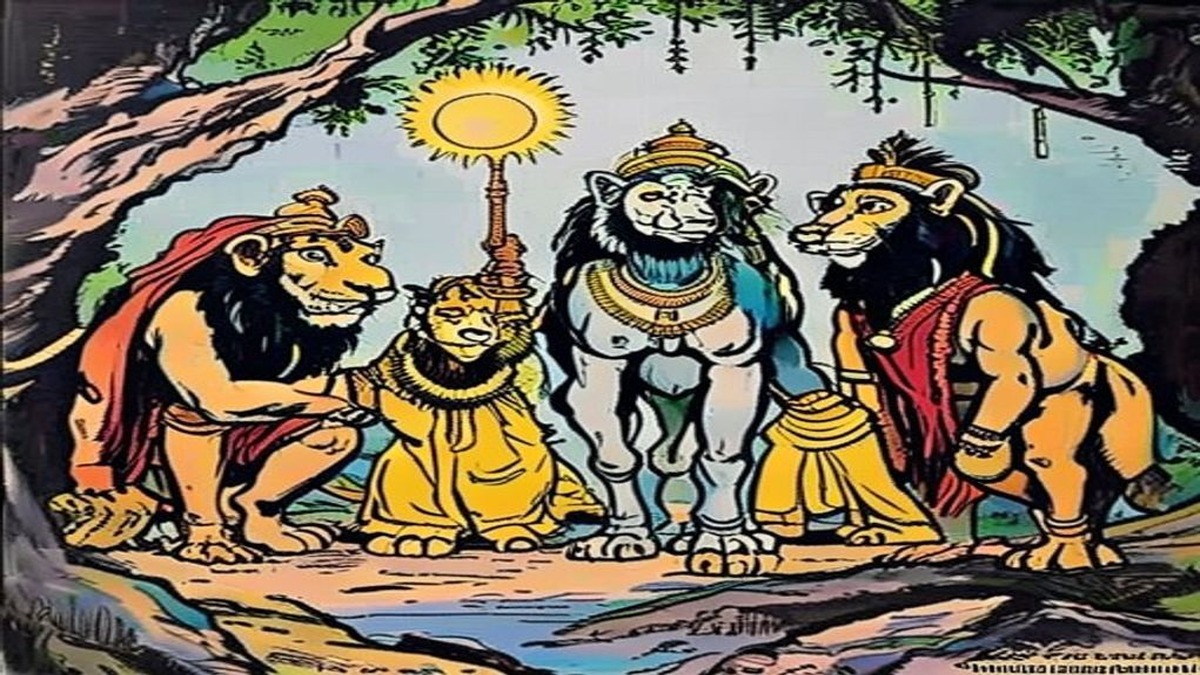
The jackal outlined the scheme to the crow. They would go before the lion together, with the camel present, and each would offer itself to be eaten, so that the lion’s hunger might be relieved. The lion, who had a sense of honour, would refuse. Then the camel — moved by the example, and by a simple-hearted wish to demonstrate his loyalty — would make the same offer. At that point, neither the crow nor the jackal would refuse on the lion’s behalf. They would accept instead. The camel’s words would have sealed his fate.
The crucial detail was that the lion’s honour must remain intact. He could not kill a guest who had come to him for protection; that would violate the fundamental law of hospitality that even predators in the Panchatantra observe. But if the camel offered himself — freely, in front of witnesses — then the technical structure of the act was sacrifice, not murder, and the lion’s hands were clean. The crow and jackal did not tell the lion this plan. They simply arranged the setting.
The crow went first before the assembled group, bowing deeply. “Your Majesty is hungry and suffering. Please eat me; I am small, but I am your servant and my life is yours.” The lion declined with genuine feeling. The jackal went next: “No, eat me instead — the crow is too small and I am larger. My life is worth more as your food than as your follower.” The lion refused again, moved by the loyalty of both. Then Kradanaka, watching this exchange, felt the pull of the social logic that had been constructed for him. He could not be less loyal than the others. He stepped forward.
The Words That Could Not Be Taken Back
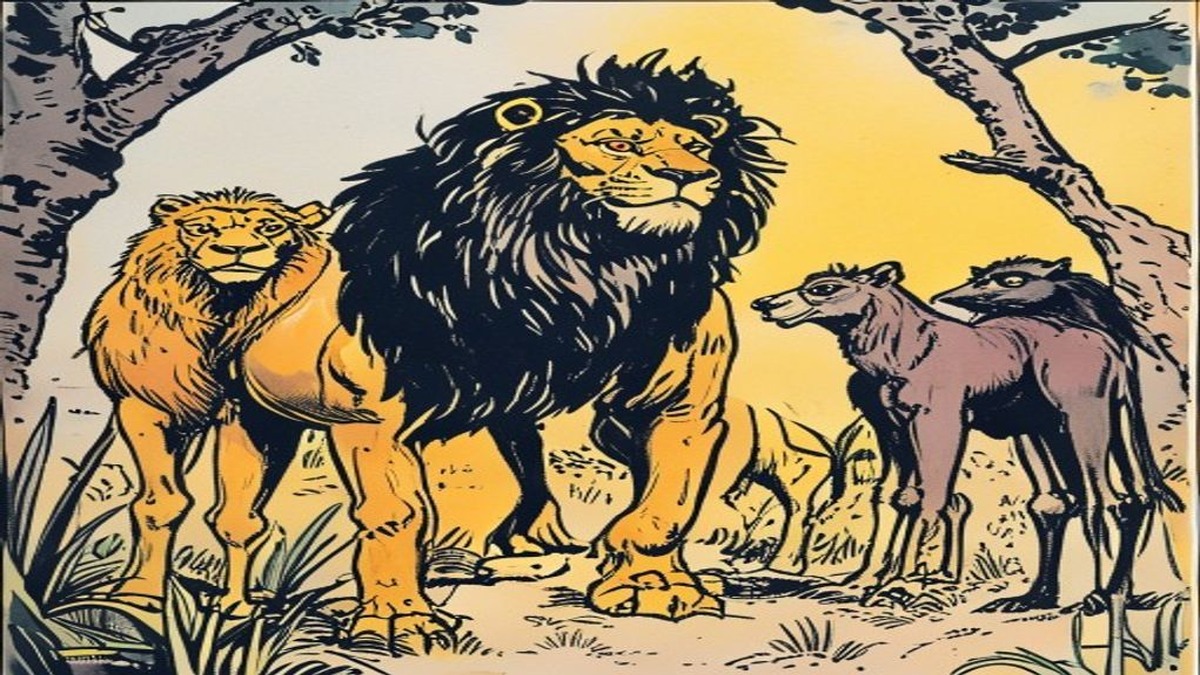
“Your Majesty,” said Kradanaka, “the crow and jackal are too small to satisfy your hunger. Please eat me. I am large, I am strong, and if my life can restore your strength so that you can hunt again and protect this forest, then it is well spent.”
The crow and jackal exchanged a glance. Before the lion could decline, the jackal spoke quickly: “The camel has offered freely and in front of witnesses. To refuse would dishonour his gift and his loyalty. Your Majesty must accept, or the camel’s generosity becomes meaningless.” The crow added: “This is what Kradanaka wants. It is his choice. We cannot take that from him.”
The camel looked at the crow and then at the jackal, and in that moment understood what had been done. The crow and jackal had refused when offered themselves, knowing they would be refused. They had calculated that the camel would make the same offer, not calculating that the calculation would stop there. There was nothing to be done. He had spoken the words in front of witnesses. The lion, exhausted by hunger and moved by what appeared to be his guest’s genuine sacrifice, accepted. The camel was killed. The crow and jackal ate well that evening, and thought themselves clever.
Moral and Sanskrit Wisdom
मित्रं न नेयं यस्य विश्वासं न भवेत्
Mitram na neyam yasya vishvasam na bhavet — “One should not lead as a friend one in whom trust cannot exist.”
— Panchatantra III, Sanskrit proverbial tradition
Vishnu Sharma does not label the crow and jackal as villains in the simple sense; he labels them as creatures whose interests did not align with the camel’s, who were in the position of appearing to be his companions, and who used that position to manoeuvre him into a fatal decision. The lesson is not “do not trust anyone” but rather: examine the interests of those who appear to be your friends in any situation where those interests might diverge sharply from yours. The camel’s error was not trusting the lion, whose protection was genuine; it was failing to examine the crow and jackal separately, whose interests were entirely different from the lion’s.
Why This Story Has Lasted 2,300 Years
This tale endures because it describes a form of manipulation that operates entirely within the logic of the victim’s own values. Kradanaka was not deceived about a fact; he was manoeuvred into a social situation in which his own loyalty, his own desire to match the generosity of his companions, produced the outcome his companions desired. The crow and jackal did not lie to the camel; they created a context in which the camel’s honest character generated the result they needed. This is manipulative at a level more sophisticated than deception: it requires accurate modelling of the victim’s psychology and the construction of a situation in which that psychology becomes self-destructive.
Political philosophers and military strategists across the centuries have recognised this tale as a description of what they call entrapment through social norms: using the target’s commitment to reciprocity, loyalty, or honour to produce an action that serves the manipulator rather than the target. The camel stepped forward because he could not bear to appear less loyal than the crow and jackal. He had no reason to suppose the offer would not be declined as theirs had been, because he did not know that the protocol had been designed specifically so that his offer would not be declined.
The story’s most uncomfortable element is the lion’s role: he accepts without full understanding, technically innocent because the camel offered voluntarily. Vishnu Sharma does not exonerate him — a wiser lion would have recognised the choreography — but the moral weight falls most heavily on the crow and jackal. They understood what they were doing and did it anyway. The camel understood nothing until the moment it was too late. This asymmetry of understanding within an apparently equal social exchange is the mechanism Vishnu Sharma most wants his students of statecraft to recognise and guard against.
Frequently Asked Questions
What is the moral of the Lion, Camel, Jackal and Crow story?
Examine the separate interests of those who appear to be your companions, especially in situations where those interests might sharply diverge from yours. The camel trusted the group without distinguishing between the lion's genuine protection and the crow and jackal's concealed self-interest.
How is this form of manipulation different from ordinary deception?
The crow and jackal never lied to the camel. They constructed a social situation in which the camel's own loyalty and desire to reciprocate generated the outcome they needed. Manipulating someone through their honest values is more sophisticated than deceiving them through false facts.
Why could the lion accept the camel's offer without dishonour?
The offer was made voluntarily, in front of witnesses, in the form of explicit sacrifice. The lion's honour required him to refuse an attack on a guest; it did not require him to refuse a guest's freely spoken offer. The crow and jackal designed the protocol specifically to navigate this distinction.
Which Panchatantra book contains this story?
The tale is in Panchatantra Book III (Kakolukiyam, On Crows and Owls), compiled by Vishnu Sharma around the 3rd century BCE as part of a curriculum in statecraft, alliance management, and the recognition of false friendship.
What does this story teach about evaluating companions?
In any group, examine each member's interests separately rather than treating the group as a unit with shared loyalty. The camel correctly identified the lion as a genuine protector but failed to apply the same scrutiny to the crow and jackal, whose interests were entirely different from the lion's.
You May Also Like
 Panchatantra Stories
Ages 9-12
Panchatantra Stories
Ages 9-12
The Story of the Jackal, the Lion, the Leopard and the Tiger
The Story of the Jackal, the Lion, the Leopard and the Tiger: In a certain part of the 9jungle, there lived a jackal, by the name of Mahachaturaka. One day, he
 Panchatantra Stories
Ages 9-12
Panchatantra Stories
Ages 9-12
The Four Learned Fools
The Four Learned Fools: Four learned men resurrect a dead lion, forgetting the danger they've unleashed A classic Indian folk tale retold for young readers.
 Panchatantra Stories
Ages 3-5
Panchatantra Stories
Ages 3-5
Suchimukha and The Monkey
A Panchatantra fable about a well-meaning bird named Suchimukha, a troop of cold monkeys, and the danger of giving advice where none is wanted.