The Story Of Prince Yamato Take
The Story Of Prince Yamato Take: The insignia of the great Japanese Empire is composed of three treasures which have been considered sacred, and guarded with
Origin & Tradition
Yamato Takeru (ヤマトタケル, “He Who Strikes Yamato” or “Brave One of Yamato”) is Japan’s greatest legendary hero — a figure documented in both the Kojiki (古事記, 712 CE) and the Nihon Shoki (日本書紀, 720 CE) as a prince of the Yamato court whose extraordinary martial ability was deployed, campaign after campaign, against the enemies of the imperial realm. He is the Japanese cultural archetype of the warrior hero — ferocious, brilliant, capable of defeating enemies through both direct combat and brilliant disguise — and simultaneously one of the tradition’s most melancholy figures: a man of superhuman capacity who was never given a place in the world his victories created, and who died alone on a mountain far from home, transformed into a white bird by the grief of his own unsatisfied longing for an ordinary life.
Beat I — The Prince His Father Feared
Yamato Takeru is not the eldest son of the Emperor Keikō — he is one of many princes — but his elder brother discovers very early what his father will eventually understand: that this prince is dangerous in a way that has nothing to do with rebellion. His brother humiliates him, and Yamato Takeru responds with a violence so extreme and so methodical that the Emperor sends him away — to the western provinces, to subdue the Kumaso chieftains who have refused imperial authority, hoping that the task will either kill him or keep him usefully occupied far from the court.
Yamato Takeru defeats the Kumaso — not by direct combat but by disguising himself as a young woman at their feast, concealing his sword under his robes, and killing both chieftains before they understand what is happening. The dying chieftain names him Yamato Takeru — the bravest in Yamato — as his last act. The prince returns to court, having done what armies could not, and his father sends him east immediately, against the Emishi of the eastern provinces, without allowing him to rest.
Beat II — The Campaigns and the Gifts
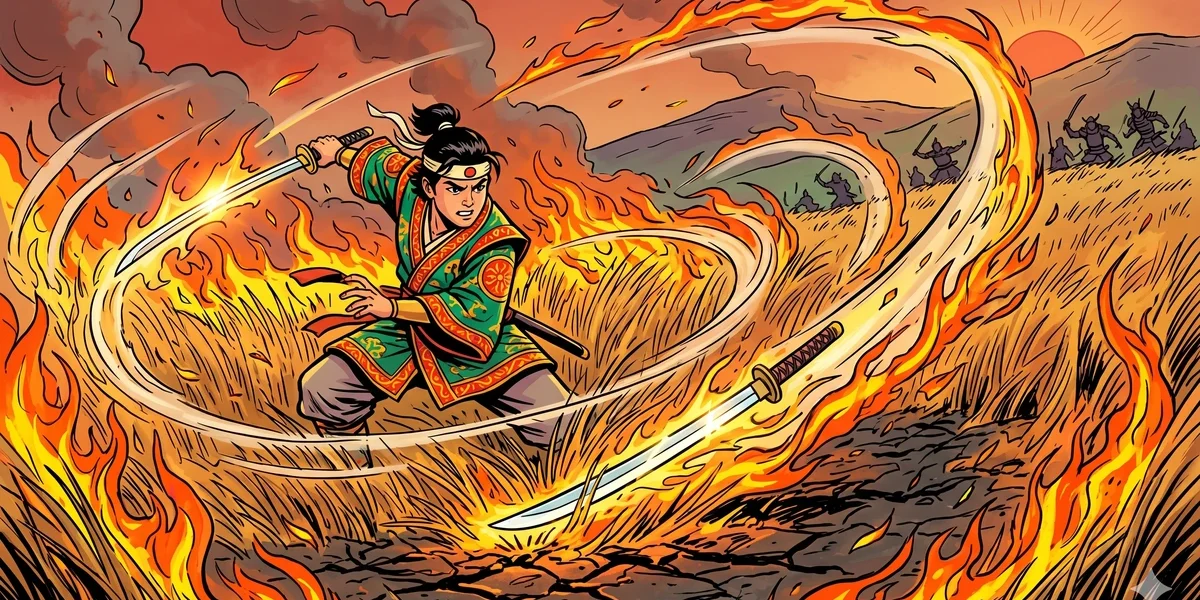
Yamato Takeru travels east, collecting allies and sacred objects along the way. His aunt, the great shrine-mistress at Ise, gives him the sword Kusanagi no Tsurugi (草薙の剣, “Grass-Cutting Sword”) — one of the three imperial regalia of Japan — and a fire-starting kit in a bag. He defeats the eastern enemies through a combination of military genius and the use of these gifts: when an enemy lord tricks him into a field and sets fire to the grass around him, Yamato Takeru uses Kusanagi to cut the grass and the fire-starter to set a counter-fire, turning the trap against its setter.
He marries twice, loses the wife he loves — Ototachibana-hime, who throws herself into the sea to calm a storm that threatened their crossing — and arrives at the eastern shore with the campaign completed, weeping for her as he passes the mountain where she is no longer with him. He returns westward. His final campaign is against the god of Mount Ibuki, whom he goes to fight without taking Kusanagi. He defeats the god but is cursed by the encounter. He falls ill on the road home, cannot complete the journey, and dies on the plain of Nobo, composing poems for his homeland that are among the most celebrated in the Man’yōshū.
Beat III — Eiyū no Kodoku: The Hero’s Structural Loneliness
Japanese literary tradition has always read the Yamato Takeru narrative as a tragedy of a specific structural type: the hero who is too useful to be allowed to live normally and too dangerous to be allowed to live near power. His father does not send him away because he is a bad son — he sends him away because keeping him at court creates a problem that no political arrangement can solve. Yamato Takeru is the solution to every external problem the empire faces and the source of the internal problem that his presence creates.
This structural position — deployed as a tool by the state, never integrated into the ordinary life his victories make possible for others — is what Japanese scholars identify as eiyū no kodoku (英雄の孤独, the hero’s loneliness). The hero’s extraordinary capacity is the reason for his deployment; it is also the reason he cannot rest. The campaigns never end because there is always another enemy, always another region that requires pacification, always one more task that only he can accomplish. He is the bow that is never unstrung.
His death — alone on a mountain road, far from his father’s court, far from the people he loves, in pain from a divine curse he incurred in one campaign too many — is the folk tradition’s honest account of what happens to weapons that are never allowed to become tools of peace. The sword that pacifies the world cannot make a home in it.
Beat IV — The White Bird
After Yamato Takeru dies, his soul transforms into a white bird — a plover or swan, depending on the version — and flies south toward his home. Those who loved him try to follow the bird; it leads them through mountains, across plains, across the sea, always just ahead, until it settles at the place associated with his divine form. The white-bird ending is not consolation in any ordinary sense; it does not restore what was lost. It is the tradition’s way of saying that a life of this magnitude cannot simply end — it must transform into something that continues moving, that cannot be held, that is visible from a distance but never close enough to touch.
The poems Yamato Takeru composed on his deathbed — for the Yamato mountains he could see from Nobo plain, for the homeland he could not reach — are the human record at the center of the transformation. The warrior who could defeat any enemy died longing for a hill he had seen from childhood. The sword and the poem: the tradition holds both, because the hero was both, and neither alone is enough to say what he was.
“The hero who is feared by his own father and used against enemies that even armies cannot subdue pays a cost that no conquest can repay — and the greatest warrior in the land may be the most alone, because the sword that pacifies the world cannot make a home in it.”
Why This Story Lasted
Yamato Takeru has lasted for thirteen centuries because he encodes the deepest ambivalence about heroism that the Japanese tradition contains: the recognition that the qualities that make a person most useful to the state are often the qualities that make it impossible for the state to give that person what they need. His victories are real; his loneliness is equally real; neither cancels the other. The white bird flying south is the tradition’s image of what becomes of extraordinary capacity that was never given a home.
Yamato Takeru in the Kojiki and Japanese Culture
Yamato Takeru’s narrative occupies a central position in the Kojiki’s account of the early imperial period. His sword, Kusanagi no Tsurugi, is one of the three sacred imperial regalia of Japan — along with the mirror Yata no Kagami and the jewel Yasakani no Magatama — and is enshrined at Atsuta Shrine in Nagoya. The deathbed poems attributed to him are among the earliest examples of waka poetry and are studied as the origin point of the classical Japanese lyric tradition. Yamato Takeru has been dramatised in kabuki, Noh, manga, and anime, and his figure — the sword, the disguise, the longing deathbed poem — remains one of the most recognisable icons in Japanese traditional culture.
Frequently Asked Questions
What is the moral of The Story of Prince Yamato Take?
The greatest warrior’s capacity is also the source of his greatest suffering: he is too useful to be allowed to rest, too dangerous to be kept near power, and too extraordinary to be given the ordinary life his victories secure for others. The story argues that heroism of this magnitude carries a structural cost that no amount of victory can repay, and that the tradition’s honest response to this recognition is elegy rather than triumph.
Why does Yamato Takeru’s father keep sending him on campaigns?
Because Yamato Takeru’s presence at court creates a problem — his father fears him, or at minimum cannot comfortably contain him — and each campaign offers a solution to that problem while also genuinely needing someone of his capability. The Emperor’s motives are not purely malicious; the campaigns are real threats that require real resolution. But the campaigns are also convenient, and the Kojiki does not conceal this convenience.
What is Kusanagi no Tsurugi and why is it significant?
Kusanagi no Tsurugi (草薙の剣, “Grass-Cutting Sword”) is one of the three sacred imperial regalia of Japan, given to Yamato Takeru by his aunt at Ise Shrine before his eastern campaign. It is the sword that saves his life in the burning-grass trap. Its significance is both practical (it can cut grass and create fire-breaks) and cosmological (it is a divine weapon passed from heavenly god to shrine-mistress to warrior). It is enshrined at Atsuta Shrine in Nagoya and has not been publicly displayed in recorded history.
Who is Ototachibana-hime and what does her sacrifice mean?
Ototachibana-hime is the wife Yamato Takeru loves most deeply, who throws herself into the stormy sea to calm it and allow his ships to cross during the eastern campaign. Her sacrifice saves the campaign; it also leaves Yamato Takeru with a grief he carries for the rest of his life. Her death is the moment the story begins to turn toward its tragic ending: the warrior who could defeat any human enemy cannot protect the person he loves from the sea’s claim. Her name lingers in his lament poems, and the straits where she died carry her name in the Kojiki’s account.
What does the white-bird transformation at the end symbolise?
The transformation of Yamato Takeru’s soul into a white bird — flying south toward the homeland he could not reach alive — is the tradition’s acknowledgement that a life of this magnitude cannot simply cease. The bird is perpetually in motion, perpetually south-bound, perpetually just beyond reach: the image of longing that cannot be completed, made visible in the form of something that can keep moving after the body has stopped. It is elegy given wings.
You May Also Like
 Japanese Folk Tales
All Ages
Japanese Folk Tales
All Ages
My Lord Bag Of Rice
My Lord Bag Of Rice: Long, long ago there lived, in Japan a brave warrior known to all as Tawara Toda, or “My Lord Bag of Rice.” His true name was Fujiwara
 Japanese Folk Tales
All Ages
Japanese Folk Tales
All Ages
The Story Of The Man Who Did Not Wish To Die
The Story Of The Man Who Did Not Wish To Die: Long, long ago there lived a man called Sentaro. His surname meant “Millionaire,” but although he was not so rich
 Japanese Folk Tales
Ages 9-12
Japanese Folk Tales
Ages 9-12
The Snow Woman (Yuki-Onna)
The Snow Woman (Yuki-Onna): In the mountains of Japan, where winter descended with the weight of ancient spirits and snow fell so thickly that the world became