The Sparrow And The Crow
A delightful Indian folk tale about a tidy sparrow, a dirty crow, and a meal of khichri. Learn why small habits and truthful friendship matter.
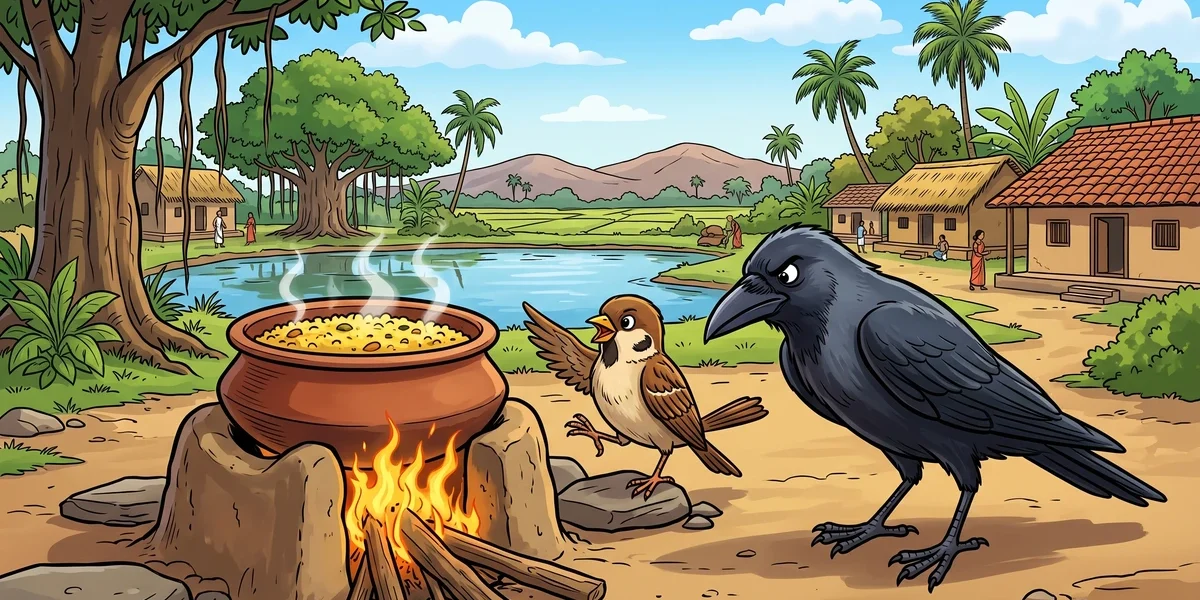
The Sparrow and the Crow: Two Birds, Two Philosophies
No pair of birds in Indian folk narrative carries more contrasting symbolic freight than the sparrow and the crow. The sparrow — small, brown, grain-fed, nest-building — represents the domestic, the modest, the quietly industrious life of the village household. The crow — black, loud, omnivorous, opportunistic — represents the cunning scavenger, clever enough to survive anywhere yet unable to resist the temptation of other birds’ gains. When these two birds face each other in a folk tale, the contest is not merely one of size or cleverness but of dharma: which mode of life — patient industry or opportunistic cunning — ultimately prevails?
In Sanskrit literary tradition, the crow (kaka) is one of the most morally complex birds. Crows appear in the Panchatantra as both clever schemers and loyal friends. In the Ramayana, a crow (Jayanta) attacks Sita and suffers Rama’s punishment — representing the danger of exceeding one’s station. In folk ritual, crows serve as vehicles of ancestors (pitru-paksha offerings are fed to crows), giving them a sacred intermediary role. The sparrow (chidiya), by contrast, appears in folk idiom as the emblem of modest happiness: “a sparrow’s contentment” is proverbial across multiple Indian languages for sufficiency without excess. The tale’s confrontation between them is therefore a confrontation between two fully developed symbolic universes.
The Nest and the Street: Domestic Space vs. Scavenger Territory
One of the tale’s recurrent structural contrasts is spatial: the sparrow builds and defends a nest — a domestic interior, a bounded sacred space — while the crow operates in the open, unenclosed, adaptable to any context. In Indian folk architecture and ritual, the interior of the home is associated with grihya (household) dharma: the sacred fire, the threshold deity, the protective rituals that maintain the family’s spiritual integrity. The nest is the bird equivalent of the grihya — a consecrated space the sparrow has made through labor and maintained through vigilance.
The crow’s attempted intrusion into this space (in many variants, the crow covets the sparrow’s food, nest, or chick) constitutes a violation of atithi-dharma — guest ethics — or outright theft. Indian narrative consistently punishes such violations, because the household’s sanctity is not merely social but cosmic: the home maintains the boundary between controlled and uncontrolled reality. When the crow overreaches into the sparrow’s domestic sphere, the tale’s resolution demonstrates that this transgression has a cost that no amount of cunning can avoid paying.
Chidiya’s Wisdom: Small Size, Proportionate Strategy
What enables the sparrow to prevail despite obvious physical disadvantage? In most Indian folk variants, it is not strength but strategic intelligence — what Sanskrit political theory calls upaya (expedient means) or shakti deployed proportionately. The sparrow does not try to match the crow in a contest of raw ability; instead, she (often figured as female in Indian variants) recruits allies, exploits the crow’s overconfidence, or uses the crow’s own momentum against it. This is the narrative embodiment of nitishastra (political science) at village scale: the weaker party that thinks clearly and acts proportionately can prevail against a stronger opponent who relies on bulk advantage.
The Panchatantra’s crow-stories frequently demonstrate this principle from the crow’s own perspective — the crow uses cunning to survive against eagles and humans. When the sparrow tale inverts this, placing the crow in the role of bully rather than strategist, it reveals the limits of cunning: intelligence without ethical grounding eventually collides with a community whose collective interest enforces limits on individual exploitation. The sparrow’s victory is not merely personal; it is the victory of the household ecosystem over the opportunist who consumes without contributing.
The Crow’s Overreach and the Moral Economy of the Village
Indian village moral economy — the implicit rules governing who is owed what, and what happens to those who take more than their share — is deeply embedded in folk narrative. The crow who steals the sparrow’s grain or invades her nest is not merely a personal villain but a figure who violates the redistributive ethics of the village commons. In traditional Indian agriculture, even birds have their customary shares: gleaning rights (sikkha-dharma) allow birds to take fallen grain, but taking from the active harvest or from another creature’s stored provisions crosses into transgression.
The tale’s resolution — typically the crow’s humiliation, expulsion, or loss — performs a community function: it reaffirms these boundaries through narrative. Every village child who heard it absorbed the lesson that cleverness deployed against the household’s domestic rights will eventually find itself outmaneuvered by the combined force of righteous indignation, community solidarity, and the sparrow’s own unexpectedly formidable resolve. The laugh at the crow’s expense is the village’s collective enforcement of its moral economy.
“The crow thought itself clever — and it was. But the sparrow was just, and in the end, justice outweighs cleverness by the exact weight of community.”
Why This Story Lasted
The Sparrow and the Crow has lasted because every community contains its sparrows and its crows — its modest, industrious households and its opportunistic exploiters — and every community needs to periodically remind itself what happens when the latter overreaches. The tale’s comedy (the crow’s defeat is almost always comic) releases tension without requiring real-world confrontation; its moral clarity provides a shared ethical reference point that transcends caste and region. And the sparrow’s triumph gives the small and the modest a narrative victory that the world’s actual power structures rarely provide — which is perhaps why it is always the sparrow audiences cheer for, and the crow they laugh at, no matter how many times the story is told.
Frequently Asked Questions
What do the sparrow and crow symbolize in Indian folk tradition?
The sparrow (chidiya) symbolizes modest contentment, domestic industry, and household dharma — proverbially associated with sufficiency without excess across Indian languages. The crow (kaka) symbolizes opportunistic cunning and scavenging intelligence, and also serves as a sacred intermediary for ancestors in pitru-paksha rituals. Their confrontation embodies two contrasting philosophies of life.
Why is the sparrow’s nest significant in the story?
The nest represents the grihya (household) dharma — a consecrated domestic space equivalent to the sacred hearth of Indian ritual life. The crow’s attempt to invade or exploit this space constitutes a violation of household sanctity, which Indian narrative consistently frames as a transgression with unavoidable consequences.
How does the sparrow overcome its size disadvantage?
Through upaya (expedient means) — strategic intelligence deployed proportionately. The sparrow typically exploits the crow’s overconfidence, recruits community allies, or uses the crow’s own momentum against it. This embodies nitishastra (political science) at village scale: the weaker party that thinks clearly can prevail against a stronger but ethically ungrounded opponent.
What is the “moral economy of the village” that this tale enforces?
Indian village moral economy includes customary redistribution rules — gleaning rights (sikkha-dharma) allow birds to take fallen grain, but taking from active harvests or stored provisions crosses into transgression. The tale reaffirms these boundaries: cleverness deployed against domestic rights will be outmaneuvered by righteous indignation and community solidarity.
How does the crow appear in the Panchatantra and Ramayana?
In the Panchatantra, crows appear as both clever schemers and loyal friends, frequently using intelligence to survive against much larger threats. In the Ramayana, the crow Jayanta attacks Sita and is punished by Rama — illustrating the danger of exceeding one’s station. The Sparrow and the Crow borrows the crow’s Panchatantra intelligence but inverts its role, making the crow a bully whose cunning lacks ethical grounding.
Frequently Asked Questions
**Q: Why is this story important?**
You May Also Like
 Aesop's Fables
Ages 9-12
Aesop's Fables
Ages 9-12
The North Wind and the Sun
The North Wind and the Sun: In the time when the gods still walked among mortals and the forces of nature were personified as powerful beings with their own
 Aesop's Fables
Ages 3-5
Aesop's Fables
Ages 3-5
Bholu’s Freedom | What Does Freedom Mean?
Bholu’s Freedom | What Does Freedom Mean?: The construction site looked like a huge maze, filled with the various sounds emanating from men and machinery. True
 Aesop's Fables
Ages 3-5
Aesop's Fables
Ages 3-5
The Monkey and the Crocodile: A Panchatantra Fable
A clever monkey and a crocodile become friends, but greed and betrayal test their bond in this Panchatantra tale.