The Selkie Wife: A Scottish Tale of Love and the Sea
The Selkie Wife: A Scottish Tale of Love and the Sea: On the rocky shores of Scotland, where the North Sea crashes against ancient cliffs, there lived a
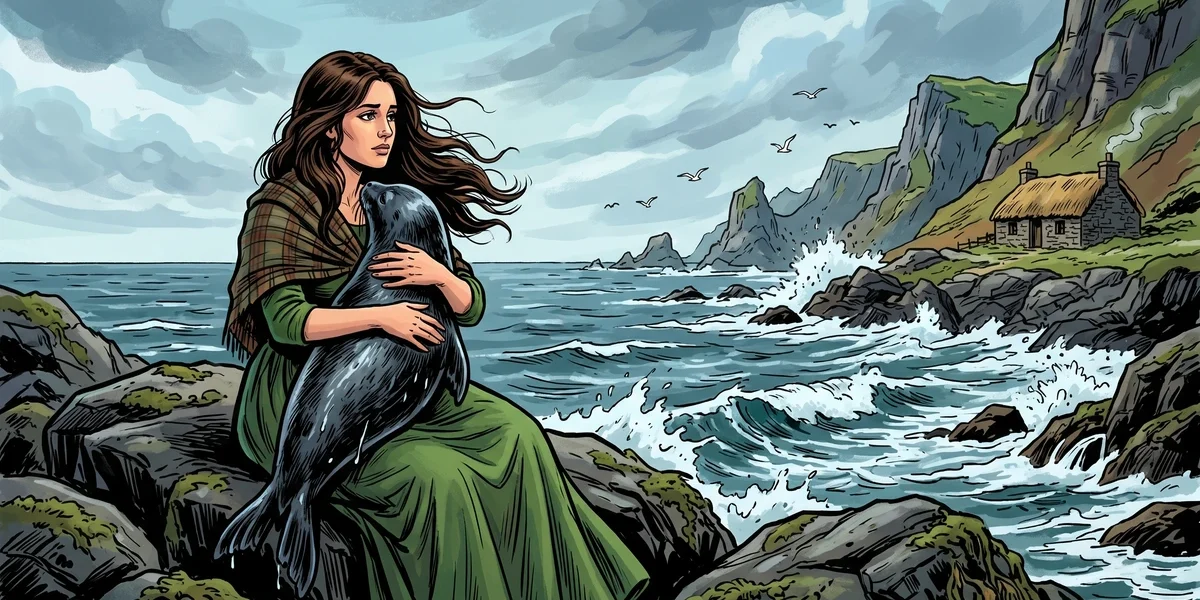
Along the wind-scoured coasts of Scotland — and most insistently in the Northern Isles of Orkney and Shetland — the people have always told of the selkie folk: seal-beings who slip free of their sleek skins to walk the shore in human shape. The Selkie Wife belongs to one of the most widely recorded supernatural legends of the North Atlantic world. Folklorists classify it as migratory legend ML 4080, “The Seal Woman,” in Reidar Th. Christiansen’s The Migratory Legends (1958), and it stands as the maritime cousin of the great Eurasian swan-maiden tale type, ATU 400 (“The Man on a Quest for His Lost Wife”). Wherever the swan-maiden flies, the seal-bride swims: a man steals the magical garment of an otherworldly woman, compels her into marriage, and is undone when the garment is at last found again.
The word selkie itself descends from the Scots selch and the Old Norse selr, “seal” — a linguistic fossil of the Norse settlement that shaped Orkney and Shetland for six centuries and left behind the now-extinct Norn tongue. The seal-bride legend was gathered from living storytellers across the Hebrides, Orkney, and Shetland by nineteenth-century collectors such as Walter Traill Dennison, whose Orkney Folklore and Sea Legends preserved the islanders’ “selkie folk” beliefs, and it echoes the Shetland material recorded by Samuel Hibbert in his Description of the Shetland Islands (1822). The fullest modern gathering is David Thomson’s lyrical The People of the Sea (1954), assembled from oral tradition in Scotland and Ireland. A close Icelandic analogue, Selshamurinn (“The Seal-Skin”), tells of a man of Mýrdalur who hides a seal-woman’s skin and forces her to wed him — proof of how far this single story travelled across the cold northern water.
The Skin Beneath the Stone
On the rocky shores of Scotland, where the North Sea breaks white against ancient cliffs, there lived a fisherman named Duncan MacLeod. Every dawn he cast his nets into the silver water, and though he was honest and hardworking, he was lonely. At night he sat by his cottage fire, listening to the wind cry across the moor, and wished for a companion to share his small and salt-stained life.
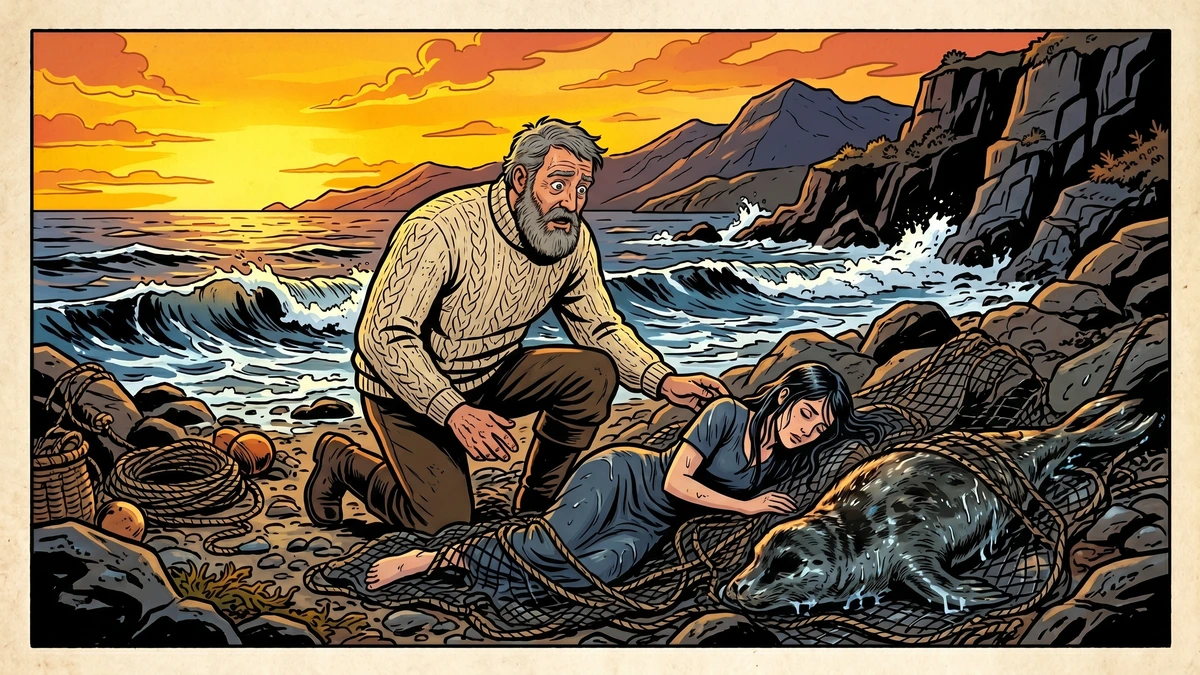
One cold autumn evening, as the sun sank like a blood-orange into the sea, Duncan found something extraordinary tangled in his nets. A woman with long dark hair lay gasping on the shingle, her skin still bright with the wet of the deep. Beside her lay a seal’s skin — black, flawless, shimmering with an otherworldly light. Duncan knew the old tales. The village elders spoke in low voices of the selkie folk, who could shed their skins and walk as mortals, yet who could never return to the sea without them.
His heart raced. Here, he thought, was his one chance never to be alone again. Without weighing the rightness of it, he seized the seal’s skin and hid it beneath a loose hearthstone. When the woman opened her eyes — eyes as dark and deep as the midnight ocean — she looked at him in confusion, then understanding, then despair. “Where is my skin?” she cried, her voice like a wave drawn back across sand. “Please. I must return to the sea. My family waits for me.” But Duncan only extended his hand and asked her, instead, to marry him.
Seventeen Years by the Window Facing the Sea
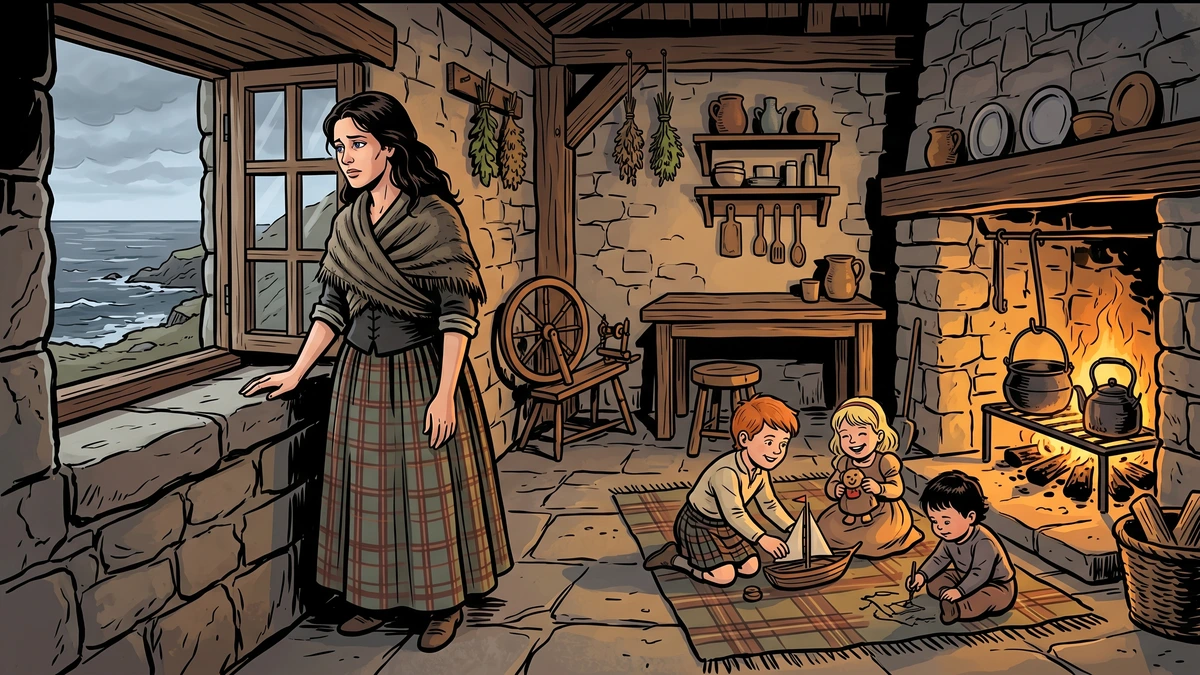
The selkie woman, whose name was Morveren, could not refuse. Without her skin she was bound to human form, and so — slowly, painfully — she agreed. She came to Duncan’s cottage as his wife, and in the years that followed she bore him three children: a daughter, Catriona, and two sons, Malcolm and Iain. She learned to bake and to spin, to laugh at the hearth and to dance at the harvest. Duncan loved her with his whole heart, and in his own clumsy way she came to hold a tenderness for him.
Yet always her gaze drifted to the window that faced the water. Always, when the wind dropped at night, she listened for the barking song of the seals upon the skerries. Duncan saw it, and feared it. He moved the seal’s skin from beneath the hearthstone into an iron-bound chest, and hid the chest below the floorboards, weighted with stones and curtained behind old fishing nets. For seventeen years he kept his secret, and for seventeen years Morveren carried, unspoken, the salt-ache of a sea she could not reach.
This is the deep cruelty at the centre of the selkie legend, and the islanders who told it understood it well. The selkie wife is never an unwilling worker or a poor companion. She is, in every recorded version, a good and loving wife — and that is precisely what makes the theft unbearable. Her husband has not won her; he has caged her. The marriage is real, the children are real, the affection is real, and none of it cancels the fact that she was never free to choose it.
The Loose Floorboard
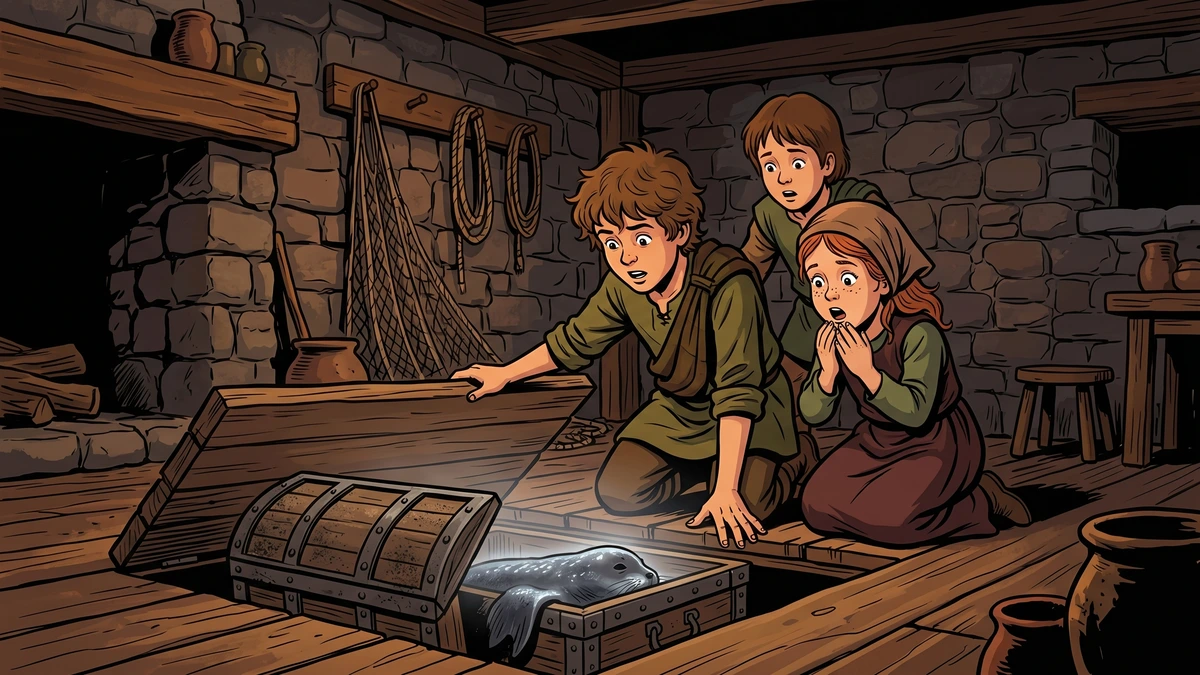
One summer afternoon, while Duncan was out upon the water and Morveren was gathering heather on the high moor, the children set themselves to explore the cottage. They turned over a brass candlestick and a hand-carved box and bundles of tarred net — and then Malcolm prised up a loose floorboard and called out to the others. Below lay the iron-bound chest. Inside it they found the seal’s skin, perfectly preserved, breathing a faint and silvery shimmer into the dim room.
“This is our mother’s,” whispered Catriona, the eldest, as understanding flooded through her. “I have seen something like it in my dreams. I remember the sea.” When Morveren came home that evening and found the skin laid out upon her bed, she stopped on the threshold, trembling. For seventeen years she had pressed down the longing for the blue depths and the song of her own people. The sight of the skin woke all of it at once.
Her children gathered close around her, and their father was not there to stop them. “Mother,” said Iain, the youngest, with tears upon his face, “we did not know. Father told us you chose to stay — that you loved him, and us. But now we see what you gave up.” Morveren knelt and gathered them in. “I do love you,” she said. “Every hour I spent teaching you, holding you, laughing with you — that was true love, and nothing can unmake it. But I am also a daughter of the deep. I have carried two hearts inside me, and both of them have been breaking.”
Leaving with the Tide
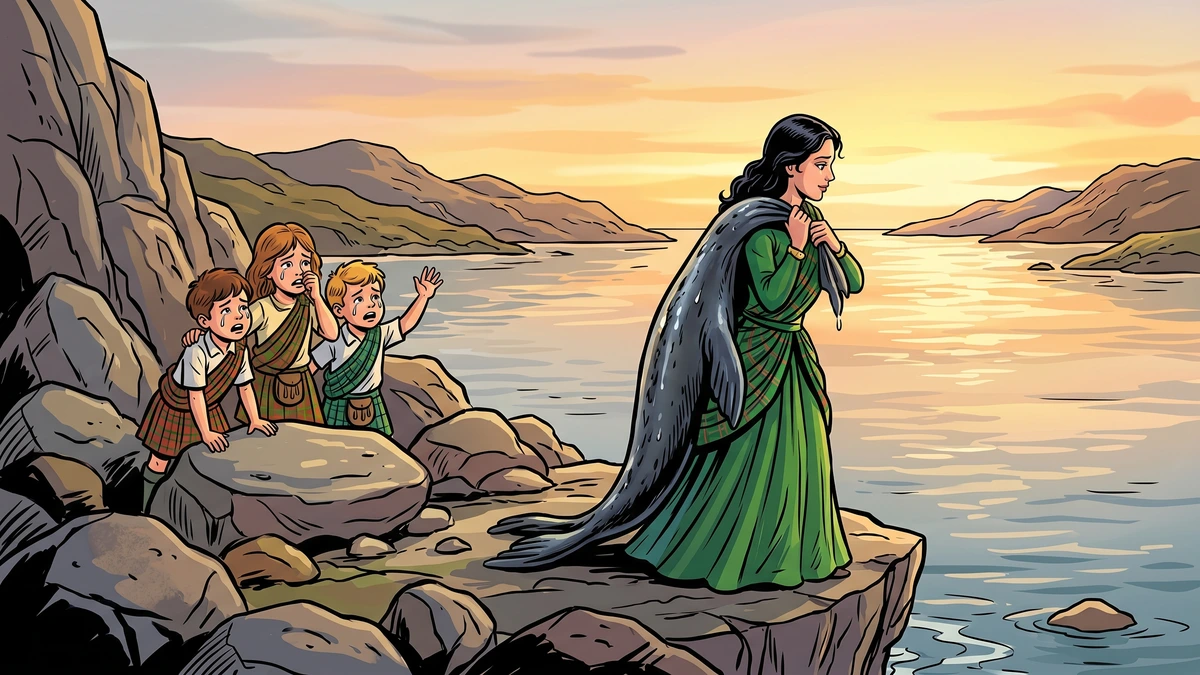
That night Duncan returned to find his wife quietly making ready. When he saw the seal’s skin he fell to his knees. “I stole your freedom,” he said, and his voice broke. “I thought love meant holding fast. I was wrong.” Morveren touched his face with great gentleness. “You gave me seventeen years of a different love, Duncan. You taught me human tenderness. But you also taught me, by keeping me, that love which cages is not love at all.”
She would not vanish without a promise. “Every seventh year,” she told her children, “I will come to this shore and call for you. In my heart I will always be your mother. The sea cannot undo what we have made together.” At dawn, as the light came grey and gold over the headland, Morveren drew the seal’s skin about her. Her human shape melted away, and in its place stood a great seal with knowing eyes that still held something of the woman her family had loved. The children watched from the rocks as she slipped beneath the foam.
Duncan never married again. He lived out his days having learned the hardest lesson the sea could teach him — that to love is, in the end, to let go. And every seventh summer, true to her word, a seal with strange pale markings hauled out upon the skerry below the cottage and sang a long, low song that made the grown children weep with a joy and a grief that could not be told apart. They became storytellers themselves, and carried the tale of the Selkie Wife down to every generation that followed.
Variants Across the Northern Seas
No two tellings of the seal-bride legend are exactly alike, and the differences are themselves a kind of folklore map. In many Orkney and Shetland versions the husband is not a fisherman but a crofter or a “merman-catcher,” and the skin is hidden not under a floor but in a thatched roof, a haystack, or a locked kist. The number of children varies — most often three, sometimes seven — and so does the manner of discovery: a child innocently mentions the “bonny skin” Father keeps in the rafters, or the wife herself stumbles upon it while the man is at the kirk. What never varies is the structure folklorists recognise as the heart of ML 4080: capture by theft of the skin, a marriage of constraint, accidental rediscovery, and irreversible departure to the sea.
The legend’s kinship with the swan-maiden type (ATU 400) places it within one of the most ancient and far-flung story families known to scholarship. Swan-maidens shed feather-cloaks in the lake-lands of Scandinavia, Siberia, and Central Asia; the Japanese hagoromo tells of a celestial maiden whose feather-robe is hidden by a fisherman; and along the Atlantic edge of Europe the same compulsion and the same loss are told of the seal. The selkie is simply what the swan-maiden becomes when the imagination that shapes her lives by a grey northern sea rather than an inland marsh. Coastal Ireland tells the tale too — of the roan, the seal-people of Donegal and the western isles — and David Thomson’s The People of the Sea moves seamlessly between Scottish and Irish tellings precisely because the storytellers themselves did.
Scholars of the Northern Isles, writing in journals such as Scottish Studies, have long noted that the selkie legend also carried a sober social function. In communities where drowning was common and seal-hunting both necessary and uneasy, the story half-explained the seal’s human eyes and mournful cry, and it offered a tender, face-saving account of marriages that were unhappy, of wives who left, and of children born of unions the community quietly understood to have been unequal. The supernatural frame let hard human truths be spoken aloud.
The Moral of the Tale
The selkie legend was never a simple story of magic. The islanders who told it across the Northern Isles understood it as a hard meditation on possession and freedom — on the truth that a beloved compelled is a beloved lost. Duncan’s grief is not punishment for cruelty so much as the natural harvest of a love that began as theft. The story insists that the things we cling to most tightly are exactly the things we cannot truly hold: a wild creature, a free will, a heart that belongs first to itself.
The old fisher-folk of the Scottish coast had a saying for it, weathered smooth by long use along those shores:
“The sea will hae its ain.”
— Scots: “The sea will have its own.” A traditional coastal proverb of the Northern Isles, spoken of all things that, sooner or later, must return to where they belong.
What cannot be kept by force can sometimes still be kept by love freely given. Morveren’s promise to return every seventh year is the story’s quiet mercy: the bond between mother and child is not broken by her leaving, only by her caging. Love that opens its hand does not lose the beloved. Love that closes its fist loses everything but the empty fist.
Why This Story Has Lasted
For more than two centuries — and surely far longer in unwritten telling — the seal-bride legend has held the imagination of everyone who has heard the surf on a northern shore. It lasted, first, because it was true to the lives of the people who told it. Coastal communities in Orkney, Shetland, and the Hebrides lived intimately with the seal: a creature with strikingly human eyes, a mournful voice, and the unsettling habit of watching fishermen from the water. The legend gave shape to that uncanniness, and to the real griefs of island life — the wife who pined for a home she had left, the spouse lost to the sea, the marriage made more from circumstance than from choice.
It lasted, too, because its moral never expires. The selkie wife is among the most humane figures in all of European folklore precisely because the tale refuses to make her husband a villain or a monster. He is only an ordinary, lonely man who confused longing with love and possession with belonging — a mistake as available to us today as it was to him. The story endures because it tells every listener, gently and without scolding, the same difficult thing: that the people we love are not ours, that freedom is the price and proof of real devotion, and that the sea, in the end, will have its own.
The Selkie in Modern Memory
Few figures of British and Irish folklore have travelled so far beyond their home shores. The selkie has become a recurring presence in modern storytelling: in the poems and stories of the Orcadian writer George Mackay Brown, in Scottish and Irish song, in literary novels of the islands, and in animated films that have carried the seal-folk to audiences who have never stood on a northern beach. Each retelling reaches for the same emotional core — the ache of a divided belonging, the impossibility of keeping what is wild, the strange gentleness of a parting that is not a betrayal. The persistence of the selkie in contemporary culture is itself evidence of the legend’s depth: a story does not survive two hundred years of retelling, and then leap into new media, unless it is answering a question its listeners still feel.
That question is not really about seals at all. It is about every love that asks one person to give up a part of themselves for another — the home left behind for a marriage, the calling set aside for a family, the self quietly folded away to keep a household whole. The selkie wife makes that hidden cost visible by turning it into a sealskin under a stone. And in doing so the tale offers, across the centuries, the same steady counsel: that the truest love does not hide the skin. It hands it back, and trusts what returns of its own free will. Modern readers meet the selkie again and again because that counsel has never stopped being hard, and never stopped being needed.
You May Also Like
 Celtic Folk Tales
Ages 9-12
Celtic Folk Tales
Ages 9-12
Brewery Of Eggshells
The classic Welsh changeling tale from Joseph Jacobs' Celtic Fairy Tales (1892), in which a young mother of Treneglwys uses the ancient eggshell-brew ruse, prescribed by the Wise Man of Llanidloes, to expose two fairy changelings and recover her stolen twins.
 Celtic Folk Tales
Ages 9-12
Celtic Folk Tales
Ages 9-12
Powel, Prince of Dyfed
Powel, Prince of Dyfed: owel, Prince of Dyfed, was lord of the seven Cantrevs of Dyfed; and once upon a time Powel was at Narberth, his chief palace, where a
 Celtic Folk Tales
Ages 9-12
Celtic Folk Tales
Ages 9-12
Morraha
Morraha: orraha rose in the morning and washed his hands and face, and said his prayers, and ate his food; and he asked God to prosper the day for him. ’s