The Salad
The Salad: As a merry young huntsman was once going briskly along through a wood, there came up a little old woman, and said to him, ‘Good day, good day; you
The Salad (German: Der Krautesel, literally “The Cabbage-Donkey”; KHM 122 in the Brothers Grimm’s Kinder- und Hausmärchen; ATU 567A “The Magic Bird-Heart” combined with ATU 566 “The Three Magic Objects and the Wonderful Fruits”) is one of the most ingeniously constructed magical-revenge tales in the entire Grimm corpus — a story in which a generous young huntsman who shares his last crust with a poor old woman is rewarded with a wishing-cloak, a gold-laying bird’s heart and, at the end, with two heads of magical salad that turn the wicked into asses and back again. The tale was first added to the Grimm collection in the second edition of the Kinder- und Hausmärchen, published by the Realschulbuchhandlung in Berlin in 1819, where it took its now-canonical place at number 122 in volume two. It was first translated into English by Edgar Taylor in his 1826 Grimm’s Goblins / German Popular Stories — the very translation in which it acquired its still-current English title “The Salad” — and was retranslated more faithfully and at full length by Margaret Hunt in her two-volume Grimm’s Household Tales (London: George Bell, 1884) under the heading “Donkey Cabbages.”
Origins and Canonical Attribution
“Der Krautesel” did not appear in the foundational 1812 first edition of the Kinder- und Hausmärchen; it was one of the new tales the Grimms added in 1819 from material they had been gathering throughout the intervening decade. Heinz Rölleke’s standard scholarly edition (Kinder- und Hausmärchen, Vollständige Ausgabe, Reclam 1980, with critical apparatus) and Hans-Jörg Uther’s authoritative Handbuch zu den Kinder- und Hausmärchen der Brüder Grimm (de Gruyter, Berlin 2008, pp. 264–266) trace the principal manuscript source of the story to Henriette Dorothea (“Dortchen”) Wild of Cassel, the apothecary’s daughter who would in 1825 become Wilhelm Grimm’s wife and who supplied many of the warmest and most domestic Hessian narratives in the second-edition manuscripts. The Grimms’ own Anmerkungen (the third volume of “notes,” 1822 and again 1856) link “Der Krautesel” to the older central-European tradition of the wishing-cloak and the gold-laying creature, citing parallels in Der Pfaffe Amis (the thirteenth-century Middle High German jest-book of Der Stricker), in the seventeenth-century Italian collection of Giambattista Basile (Lo cunto de li cunti IV, 1, “La Pietra del Gallo“), and in the international Fortunatus-cycle of magical-purse narratives that had circulated in printed German chapbooks since the 1509 Augsburg Fortunatus. The 1819 first printing carried the title-page Kinder- und Hausmärchen, gesammelt durch die Brüder Grimm. Zweite vermehrte und verbesserte Auflage, in two octavo volumes with the green-and-cream paper wrappers characteristic of the Berlin edition.
The Tale

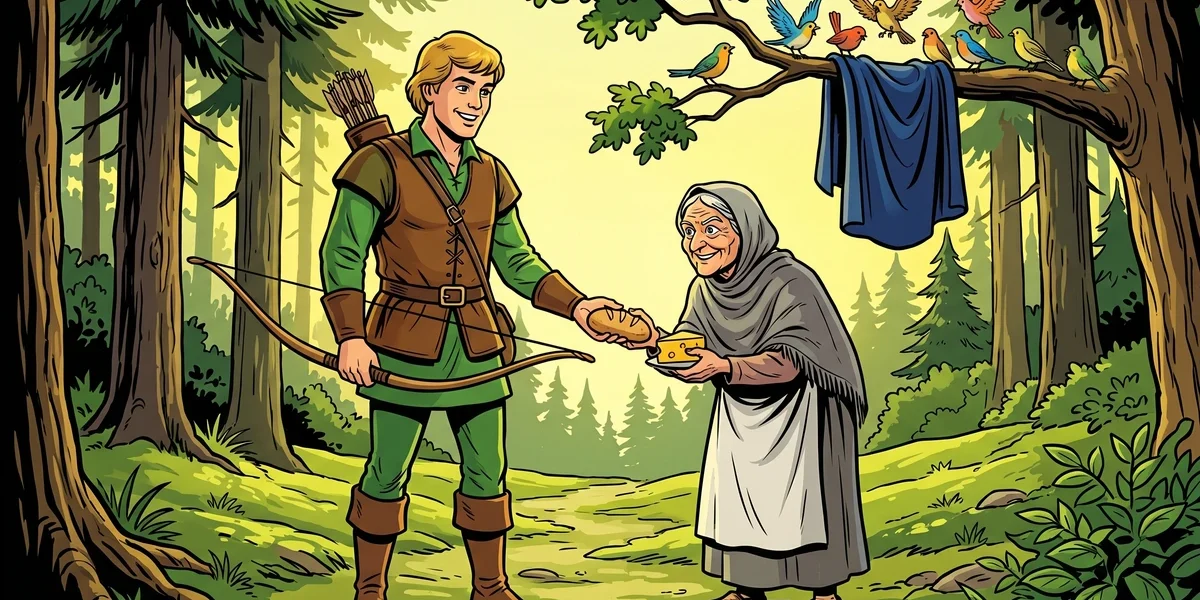
There was once a young huntsman, merry-hearted and honest of step, who was making his way briskly through a great German forest one summer afternoon when there came up the path a little old woman, bent and dusty and worn. “Good day, young master,” she said. “You step lightly, but I am hungry and I am thirsty — will you give a poor old woman something to eat?” The huntsman, who had no great hoard but who could not refuse the old, took out the bread and cheese he was carrying for his own supper and put them into her hand. The old woman ate, and as she ate she watched him with bright sharp eyes. “I will reward you,” she said, “for I am not what I seem. Walk on a hundred paces under these tall pines, and you will come to a great oak. In the branches you will see nine birds quarrelling over a cloak. Shoot once into the middle of them: one will fall dead, and the cloak will fall with it. The cloak is a Wünschmantel — a wishing-cloak. Whoever wears it shall stand at once in any place where he wishes himself. Cut open the dead bird, take out its heart, and keep it; for whoever sleeps with that heart beneath his pillow shall find a piece of red gold there every morning when he wakes.”
The Wishing-Cloak and the Gold-Laying Heart
The huntsman thanked the strange old woman and walked on. A hundred paces under the pines he heard the chatter and squabble of birds, just as she had foretold; he looked up, saw the nine of them tugging and pulling at a soft dark cloak, raised his bow, and shot into their midst. One bird tumbled dead at his feet; the cloak fell after it, and the rest of the flock screamed away into the trees. The huntsman cut open the bird, took out its small warm heart, wrapped it in a clean leaf and placed it in his pouch, and folded the cloak over his arm. That night he laid the heart beneath his pillow, and in the morning, when he reached his hand under the bolster, he found a single round piece of red gold lying there as bright as the rising sun. Every morning thereafter the same gold piece appeared, and within a year he had heaped up so great a fortune that the cloak hung in the corner of his room and the chest at the foot of his bed could no longer hold the coin. “Of what use is gold,” he said to himself one evening, “if I never go out and look at the world?” So he hung the cloak about his shoulders, slipped the bird’s heart into his pocket, and set out to see what kind of place the wide world was.

His wandering brought him at last to a great gloomy castle in the middle of a green meadow at the edge of a dark wood, and at the highest window of the castle stood an old woman with a young and beautiful girl beside her. “Look there,” whispered the old woman to the girl, “there comes a young man through the wood who carries a heart in his pocket that lays gold every morning — and a cloak about his shoulders that will carry him at a wish. We must have them, my child. He has more than is fitting for any honest man, and we have a use for them ourselves.” The huntsman, weary from his road, asked at the gate for a night’s lodging; he was made very welcome, and very soon was so deeply in love with the bright-eyed daughter of the house that he could think of nothing but her. The old woman gave the girl a cup brewed from herbs that loosen all hold on what one carries; that night, while the huntsman slept, the girl reached softly into his pocket, drew out the bird’s heart, and laid it under her own pillow — and from that morning onward the gold piece appeared not under his head, but under hers, where the old witch took it away each dawn. The huntsman, lost in the love of her face, never noticed that he had been robbed.
The Diamond Mountain and the Cloud
“We have the heart,” said the old witch in private, “but the cloak is still on his shoulders. That, too, we must have.” So the daughter sat at the window for several days with a sigh on her lips and a great sadness in her eyes, until the huntsman could bear it no longer. “What grieves you, dearest?” he asked. “Yonder,” she said, pointing to a far blue ridge, “stands the granite mountain on which the diamonds grow brighter than dewdrops, and it is so beautiful that I cannot stop thinking of it; and yet only the wind and the hawks may go there, for it is too sheer for human feet.” “Is that all that troubles you?” he cried. “Come under my cloak and we shall both be there in a heartbeat.” So he drew her under the wishing-cloak, wished them both upon the granite mountain, and there in an instant they stood — with the diamonds glittering at their feet like a thousand cold-burning stars. They picked the brightest, and as they bent down the witch’s old herbs began to do their work; a heavy sleep stole over the huntsman, and he laid his head in the girl’s lap and was lost. While he slept she took the cloak gently from his shoulders, hung it about her own, gathered up the diamonds in her apron, and wished herself home again to the castle — and left him sleeping on the bare granite peak.

When the huntsman awoke and saw what had been done to him he sat down upon a stone and wept. “Alas,” he said, “what wickedness there is in the world!” The granite mountain belonged to a tribe of fierce mountain-giants, and presently three of them came striding by in their seven-league boots. The first nudged the huntsman with the toe of his boot. “What worm is this,” he growled, “that lies here on our rock?” “Tread on him,” said the second, “and have done.” But the third laughed and said, “It is not worth the trouble. He’ll wander higher up, and a cloud will come down and bear him away — let the wind do our work.” And they passed on. The huntsman, who had heard everything from beneath his feigned sleep, climbed quickly to the highest peak; and there he had not long to wait, for a great pale cloud came drifting along the ridge, caught him gently in its skirts, and carried him for a long, long time away over the forests, away over the rivers, away over the cities and farms of the world — until at last it set him down with a soft bump in the middle of a vegetable garden, between green rows of cabbages and red rows of beets.
The Two Salads
“Well,” said the huntsman, picking himself up, “I am hungry enough to eat anything that grows. Salad will at least keep me on my feet.” He pulled up the nearest head of green leaf-cabbage and bit into it — and at the second bite a strange feeling ran through him, his ears stretched up, his face stretched out, his hands turned to hooves, and he found himself standing on four legs in the garden, an ass with long brown ears, twitching its tail in dismay. But hunger is hunger; he wandered on, found another bed of salad of a paler colour, and bit into one of those heads — and at once his ears shrank back to a man’s ears, his hooves became hands again, his tail vanished, and he stood once more in his own shape on his own two feet. “Now I have it,” he said. “Two heads of one salad and two heads of the other — one to undo what the other has done. With these in my pouch I shall pay my debts at the witch’s castle.” He cut off two heads of the bad cabbage and two of the good, hid them in his bag, browned his face with walnut juice so that not even his own mother would know him, and set off back across the world to the witch’s castle.

The witch did not recognise him; she opened to a sun-burnt traveller who called himself a courier of the king. “I have ridden a thousand miles,” he said, “to bring His Majesty the rarest salad that grows under heaven. But the sun has scorched the leaves on the road, and I do not know if it will keep until I reach the palace.” The witch’s eyes brightened at once, and the daughter’s too. “Such a salad we must taste,” they said. “Just one leaf, just one little leaf.” He gave them two whole heads of the bad salad with a courteous bow, and the old witch herself carried them down to the kitchen to dress. She could not wait until the bowl was on the table; she put a leaf into her mouth at the chopping-board, and the kitchen-maid coming in did the same, and they had not even finished chewing when their ears stretched, their faces lengthened, and the two of them went braying down the steps of the cellar with their hooves clattering on the flagstones. The daughter, alone above and impatient, called for the dish to be brought up; the huntsman carried it himself, set it before her, and watched her bite the green leaf with her own white teeth — and within a moment she too was an ass, with the gold-laying bird’s heart in a little leather bag still hanging from her neck and the wishing-cloak still folded in her closet upstairs.
The huntsman tied all three of the asses on a rope and led them down the road to a mill, where he gave them into the miller’s keeping. “Treat the old grey one harshly,” he said, “stripes three times a day and one bundle of hay; the kitchen-maid stripes once a day and three bundles of hay; the youngest, who is a beautiful young she-ass, no stripes at all, but three bundles of hay.” Some weeks later the miller sent word that the old grey ass had died of hard usage and a hard heart, but that the two younger ones lived. Then the huntsman pitied them, fetched them home from the mill, and gave them each a leaf of the second salad. The kitchen-maid stood up a kitchen-maid again, and ran out into the world with her right ear still a little long; but the daughter knelt at the huntsman’s feet with her old bright human eyes, and wept. “Forgive me,” she said, “my mother forced me to it; I never wanted to harm you. The cloak is hanging in the closet, and the bird’s heart is here on a string about my neck. Take them, and let me go.” But the huntsman lifted her up, and said, “Keep them; I had rather have you than the gold and the cloak together.” So they were married, and lived happily till the end of their days.
Moral
Was du säst, das wirst du ernten — und wer Gutes giebt, dem wird zwiefach Gutes gegeben. (“What you sow, that shall you reap — and whoever gives good shall be given good twofold.”) The Grimms gloss the moral of Der Krautesel as: kindness freely given to a stranger by the roadside is the seed of one’s own future fortune; and the proud who turn that gift to their own greedy use will, in the end, eat the very salad that turns them into the beasts they have always been within. The huntsman’s first generosity to the old woman is the deed that earns him the cloak, the heart, the salad, and at last the bride. The witch’s greed is what carries her down to the mill in the form of an ass.
Why It Has Lasted
“The Salad” survives so vividly into our own century because the Grimms folded into a single short narrative four of the most beloved motifs of European magical-tale literature: the wishing-cloak (Wünschmantel) which appears already in the medieval German Wunschmantel of Heinrich von dem Türlin’s Diu Crone (c. 1230); the gold-laying bird’s heart, which Hans-Jörg Uther catalogues as a hallmark of ATU 567 in The Types of International Folktales (FF Communications no. 284, Helsinki 2004) with parallels recorded in 211 oral versions across thirty-one national archives; the diamond mountain, a stock element of central Asian shahr-e-elmas tradition that reached Germany through the Arabian-Nights borrowings of the seventeenth-century chapbook tradition; and the transformation-salad, a peculiarly central European motif whose nearest cousins are the Italian cipolla of Basile and the Russian jabloko of Afanas’ev. Joseph Jacobs in his 1894 More English Fairy Tales, Andrew Lang in The Yellow Fairy Book (1894, where the tale appeared under the title “The Donkey-Cabbage”), and Wanda Gaág in her hand-lettered Tales from Grimm (Coward-McCann 1936) all chose to retell “Der Krautesel” precisely because of this density of magical machinery. It is the rare Grimm tale in which the trickster’s victory comes not through royal favour, mighty deeds or supernatural intervention, but through something as humble as a vegetable plot — and that homely, almost comic mechanism is one of the secrets of its long survival.
The Manuscript Tradition and the 1819 Recension
“Der Krautesel” entered the canon at one of the most active periods in the Grimms’ career as collectors. The 1810 manuscript known as the Ölenberg Manuscript — the so-called Brentano-manuscript that Wilhelm sent to Clemens Brentano and which is now preserved at the abbey of Notre-Dame d’Ölenberg in Alsace — does not contain “Der Krautesel”; the tale was added to the canon during the eight-year window between the 1812 first edition and the 1819 second edition, a period in which the Grimms supplemented their original Hessian core with a wider net of Westphalian, Lower Saxon and Hessian-Wild material. Heinz Rölleke’s Die älteste Märchensammlung der Brüder Grimm (Cologny-Geneva 1975) and his later Brüder Grimm: Kinder- und Hausmärchen, Ausgabe letzter Hand (Reclam 1980) trace the textual changes between the 1819 first printing of “Der Krautesel” and the seventh and final edition of 1857 (the Ausgabe letzter Hand revised by Wilhelm in his last decade); the differences are small, but the 1857 text smooths the dialect of the witch’s speech, sharpens the geometric repetition of “stripes three times a day, hay once” / “stripes once, hay three times” / “hay three times, no stripes,” and lengthens slightly the closing clause of the marriage. The text most readers know in English is Margaret Hunt’s 1884 close translation of the 1857 edition.
Translations and English Reception
Edgar Taylor’s German Popular Stories (London: C. Baldwyn, 1823 and 1826, two volumes, illustrated with George Cruikshank’s tiny etched plates) was the first translation of the Grimms into English, and the second volume of 1826 included “Der Krautesel” under the new English title “The Salad” — a striking simplification of the more literal “Donkey-Cabbages” but a title that immediately fixed itself in the Anglophone tradition. Taylor’s text follows the 1819 German closely but tones down the harsher punishments: the old witch in his version dies of “ill-temper” rather than of the miller’s stripes. Margaret Hunt’s two-volume Grimm’s Household Tales (London: George Bell, 1884, with John Ruskin’s introduction) restored the precise distribution of stripes and hay among the three asses and gave the tale its scholarly English text under the more accurate title “Donkey Cabbages.” Lucy Crane’s 1882 Household Stories from the Collection of the Brothers Grimm, illustrated by her brother Walter Crane, did not include the tale — perhaps because of its unusually direct treatment of revenge — but Andrew Lang did, in his Yellow Fairy Book of 1894, and from there the story passed into a long line of Edwardian and Victorian children’s collections. Wanda Gaág’s beautifully hand-lettered 1936 retelling for Coward-McCann, Ralph Manheim’s authoritative 1977 Pantheon translation, and David Luke’s 1982 Penguin Classics edition each gave the tale a fresh and faithful voice; Maria Tatar’s 2002 Annotated Brothers Grimm reprints Margaret Hunt’s English text and provides the most useful set of side-notes for a modern reader.
Tale-Type and Comparative Folklore
The Aarne-Thompson-Uther catalogue classifies “Der Krautesel” as ATU 567A “The Magic Bird-Heart” combined with ATU 566 “The Three Magic Objects and the Wonderful Fruits” — a “compound type” in which two well-known European tale-types have fused into a single longer narrative. Hans-Jörg Uther (The Types of International Folktales, FF Communications no. 284, 2004) records around two hundred and twenty oral versions of this combined type, with the densest clusters in northern Germany, Switzerland, Bohemia, the upper Volga and the Caucasus; isolated Italian, Romanian and Catalan versions exist in the published archives of Giuseppe Pitrè, Petre Ispirescu and Francisco Maspons y Labrós. The principal motif-numbers from Stith Thompson’s Motif-Index of Folk-Literature (Indiana University Press 1955–1958) for the present tale are: D1469.7 (Bird-heart that gives gold), D1520.10 (Magic transportation by cloak), D562.1 (Transformation by eating fruit or vegetable), K2213.3.1 (False bride betrays hero for her mother), Q286 (Uncharitableness punished — greedy witch turned to ass), and Q42 (Generosity to old woman rewarded). The Wünschmantel and the gold-laying creature together form a set of “wonderful objects” that runs from the Sigmund-saga of Old Norse (the cloak tarnkappe on King Gunther’s shoulders in the Nibelungenlied str. 442) through the medieval German Fortunatus printed in Augsburg in 1509 and on into the Hessian peasant tradition the Grimms collected in the second decade of the nineteenth century.
Symbolism and Reading
Folklorists from Bruno Bettelheim (The Uses of Enchantment, Knopf 1976) to Maria Tatar (The Hard Facts of the Grimms’ Fairy Tales, Princeton 1987) and Jack Zipes (The Brothers Grimm: From Enchanted Forests to the Modern World, Routledge 1988, second ed. 2002) have read “Der Krautesel” as one of the Grimms’ clearest moral fables of active kindness rewarded. The hunter’s first deed — sharing his cheese with a poor old woman — is the small generosity that summons the entire magical machinery of the rest of the tale; everything that follows is, in a sense, the working-out of that first hospitality. Marie-Louise von Franz, in her 1972 Interpretation of Fairy Tales, argues that the bad and good salad together form a classical pair of animus-tests: the bad salad reveals the hidden beast in the human heart, and the good salad permits the redemption of the contrite soul. Marina Warner (From the Beast to the Blonde, Chatto & Windus 1994) reads the witch’s death by stripes and the daughter’s restoration to humanity as a careful Grimm-period weighing of culpability: the witch is the architect of greed and is destroyed; the daughter is the reluctant instrument and is restored. The transformation-into-ass motif (Eselsverwandlung) reaches back to Apuleius’s second-century Metamorphoses (“The Golden Ass”) and through the Latin medieval exempla of Caesarius of Heisterbach (Dialogus Miraculorum, c. 1220) into the German peasant imagination — a long pedigree for a vegetable that, in this small Grimm tale, becomes the perfectly humble instrument of a perfectly proportioned justice. It is no accident that Karl-Heinz Mallet, in Untertan Kind: Behauptungen und Beobachtungen (Beltz 1985), called “Der Krautesel” “a sermon about reciprocity preached in vegetables.”
Frequently Asked Questions
What is the original German title of “The Salad” and what does it mean?
The original German title is “Der Krautesel,” which translates literally as “The Cabbage-Donkey” or “The Cabbage-Ass.” The English title “The Salad” was coined by Edgar Taylor in his 1826 translation Grimm’s Goblins / German Popular Stories. Margaret Hunt later restored the more accurate “Donkey Cabbages” in her 1884 edition. The German compound word emphasises the central magical mechanism of the tale: a head of cabbage-salad that turns whoever eats it into a donkey, and a second salad that restores them to human form.
Is “The Salad” classified as ATU 566 or ATU 567?
Both. “Der Krautesel” is what folklorists call a “compound type”: it combines ATU 567A “The Magic Bird-Heart” (the gold-laying bird’s heart and the wishing-cloak) with ATU 566 “The Three Magic Objects and the Wonderful Fruits” (the transformation-salad). Hans-Joerg Uther’s 2004 Types of International Folktales (FF Communications no. 284) catalogues around 220 oral versions of this combined type across northern Germany, Switzerland, Bohemia, the upper Volga and the Caucasus. The fusion of the two tale-types into a single Grimm narrative is one of the reasons the story feels so densely magical.
Who told the Grimms “Der Krautesel” and when did it first appear in print?
Heinz Roelleke and Hans-Joerg Uther identify Henriette Dorothea (“Dortchen”) Wild of Cassel as the principal informant. Dortchen, who would become Wilhelm Grimm’s wife in 1825, was the apothecary’s daughter and supplied many of the warmest and most domestic Hessian narratives in the second-edition manuscripts. The tale did not appear in the foundational 1812 first edition of Kinder- und Hausmaerchen; it was added in the 1819 second edition published in Berlin by the Realschulbuchhandlung, where it took its now-canonical place at number 122 in volume two.
What is the moral of “The Salad”?
The Grimms gloss the moral of Der Krautesel as: kindness freely given to a stranger by the roadside is the seed of one’s own future fortune, and the proud who turn that gift to their own greedy use will, in the end, eat the very salad that turns them into the beasts they have always been within. The huntsman’s first generosity to the old woman is the deed that earns him the cloak, the heart, the salad, and at last the bride. The witch’s greed is what carries her down to the mill in the form of an ass. The original German blockquote moral is: “Was du saest, das wirst du ernten” (What you sow, that shall you reap).
Where does the wishing-cloak motif come from?
The Wuenschmantel of “Der Krautesel” belongs to a long pedigree of magical garments in Germanic literature. The earliest literary witness is the Tarnkappe of King Gunther in the Middle High German Nibelungenlied (str. 442, c. 1200). It reappears in Heinrich von dem Tuerlin’s romance Diu Crone (c. 1230), in the Wuenschdinge of the medieval Spielmannsdichtung, and in the printed Augsburg Fortunatus chapbook of 1509, in which the hero owns both a wishing-cap and a magic purse. Stith Thompson’s Motif-Index of Folk-Literature catalogues the wishing-cloak motif as D1520.10 (Magic transportation by cloak).
You May Also Like
 Grimm's Fairy Tales
Ages 9-12
Grimm's Fairy Tales
Ages 9-12
Snow White and the Seven Dwarfs
Snow White and the Seven Dwarfs: In a kingdom where mountains touched the clouds and forests stretched endlessly, there lived a king and queen who ruled with
 Grimm's Fairy Tales
Ages 9-12
Grimm's Fairy Tales
Ages 9-12
The Frog-Prince
The Frog-Prince: One fine evening a young princess put on her bonnet and clogs, and went out to take a walk by herself in a wood; and when she came to a cool
 Grimm's Fairy Tales
Ages 9-12
Grimm's Fairy Tales
Ages 9-12
Rapunzel
Rapunzel: There were once a man and a woman who had long in vain wished for a child. At length the woman hoped that God was about to grant her desire.