The Old Man, his Young Wife, and the Thief
The Old Man, his Young Wife, and the Thief: In India, long ago, there lived a wealthy merchant in a small village near the banks of a sacred river. The houses

The Old Man, his Young Wife, and the Thief
Source: Panchatantra, Book V — Apariksitakarakam (Ill-considered Action), attributed to the sage Vishnu Sharma, composed c. 300 BCE–300 CE; this redaction follows the Sanskrit Tantrakhyayika and Patrick Olivelle’s critical translation (Oxford University Press, 2006).
वीरं विनाशयति सर्पं मॉरःः
A wealthy old merchant marries a young wife and, fearing her youth and his age, devises elaborate precautions to keep other men at a distance. One night a thief enters the household and hides in the rafters. In the darkness, the old man and his wife begin an argument about the precautions — and the young wife, with the particular logic of the mishandled, turns the situation entirely to her advantage. The thief, caught between two people too absorbed in their domestic contest to notice him, becomes the most unexpected element in a triangle that was always about power, not affection.
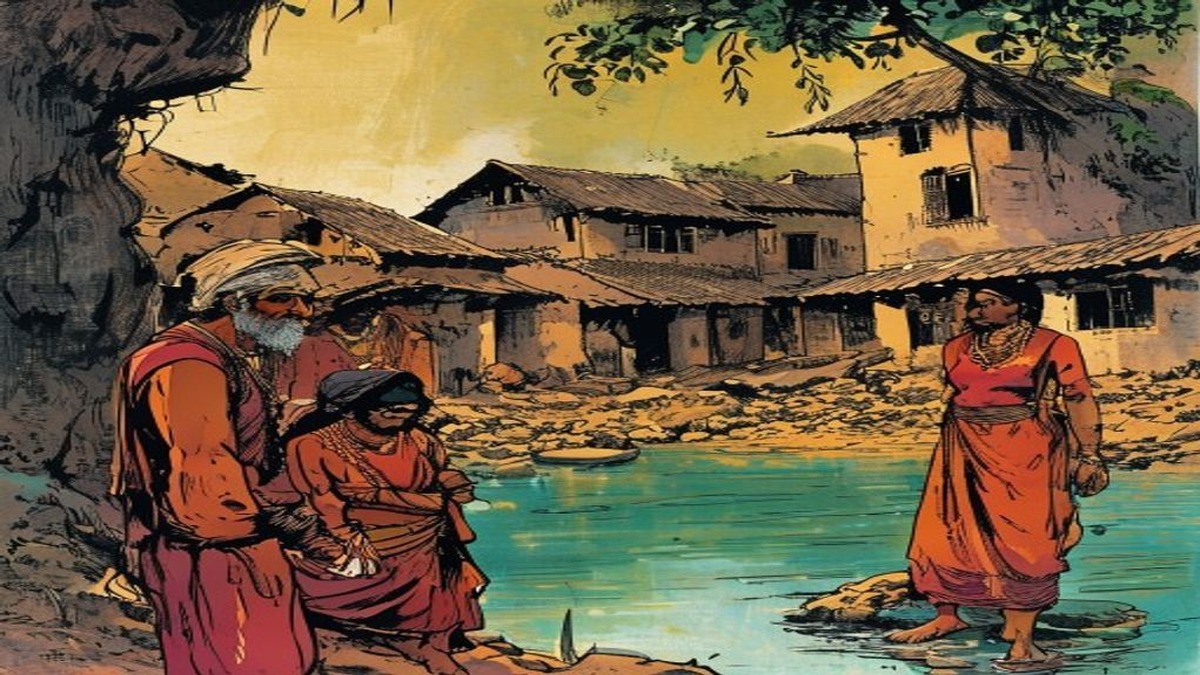
Part I: The Household of Precautions
In the trading city of Ujjain there lived a merchant named Dhanadatta who had accumulated considerable wealth and, in his sixtieth year, a considerably younger wife. Chandramati was twenty-two, clever, and not unaware of what she had married — comfort, security, and a husband whose primary emotion toward her was anxiety. He was afraid of what her youth meant in proximity to his age. He spent much of his considerable intelligence designing systems to address this fear.
The systems were elaborate. Dhanadatta had installed locks of a particular design on every exterior door. He had dismissed all the male servants and replaced them with women, excepting only the ancient porter Gopala, who was eighty and moved no faster than the gate he guarded. He conducted a nightly inspection of the house before retiring. He had arranged the sleeping chamber so that he occupied the side closest to the door, with Chandramati against the wall.
Chandramati observed all of this with the patience of a woman who understood that the precautions were not about her behaviour but about his fear, which was in some sense a tribute to her and in another sense profoundly insulting. She had not been given an opportunity to demonstrate that the precautions were unnecessary. The precautions had simply arrived as the terms of the marriage, alongside the comfortable house and the excellent food.
This was the situation on the night a thief named Shatrughna climbed through the kitchen window, the one window Dhanadatta had never quite gotten around to fitting with a proper lock.
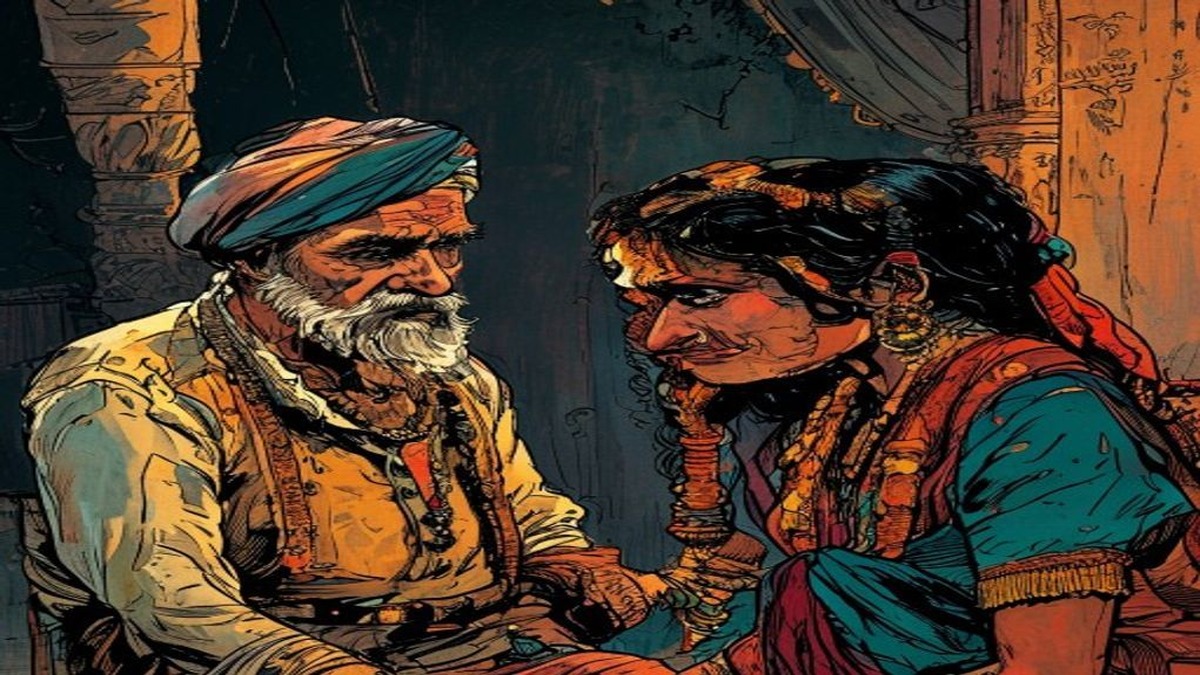
Part II: The Thief in the Rafters
Shatrughna was a careful thief. He had cased the merchant’s house for three nights and knew which rooms contained the strongboxes. He also knew about the kitchen window. He had climbed in, navigated the dark ground floor, and reached the main hall when he heard voices from the sleeping chamber above — louder than he had expected at this hour. The couple was arguing.
Rather than retreat and return on a quieter night, Shatrughna made the professional error of curiosity: he climbed to the ceiling beams of the hall, from which he could observe the chamber through the carved lattice above the door, and waited for the argument to conclude. He would wait, he thought, for quiet, then proceed to the strongboxes.
The argument did not conclude. It was the particular kind of argument that married couples have when the real subject cannot be spoken directly: ostensibly about the kitchen window lock, actually about everything else. Dhanadatta had discovered the unlocked window during his nightly inspection and was delivering a lecture on security. Chandramati was listening with a quality of attention that was very close to its opposite.
Then she said something that made Shatrughna grip his beam with both hands.
“If you are so concerned about intruders,” she said pleasantly, “you might want to know that there is already one in the rafters. I saw him come in through the kitchen window half an hour ago. I was curious to see what you would do.”
Dhanadatta made a sound. Shatrughna, in the rafters, had exactly enough time to consider a number of things simultaneously: that he had been seen, that the woman had sat on this information for half an hour, and that he was now in a situation far more complicated than a burglary.
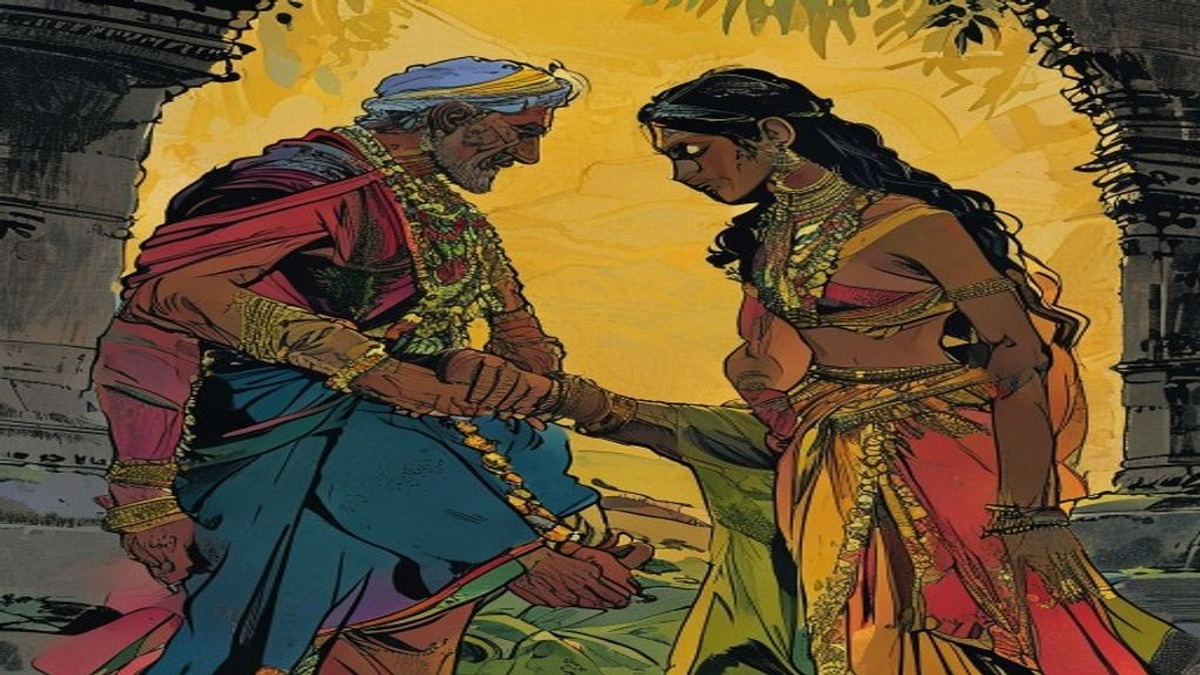
Part III: The Negotiation
What followed was less a confrontation than a renegotiation. Chandramati had not told her husband about the thief in order to produce his arrest; she had told him in order to produce a conversation she had been waiting to have for some time. She addressed Shatrughna directly, through the lattice.
“You,” she said, “come down. My husband will not call the authorities because the authorities finding a thief in his house would raise questions he cannot answer about his security arrangements, and his pride cannot bear those questions. Is that correct, husband?”
Dhanadatta, who was experiencing several emotions simultaneously, found this analysis accurate but objectionable. He said something that was halfway between agreement and protest. Chandramati treated it as agreement.
Shatrughna came down from the rafters, because a thief who has been caught by a woman who seems to know what she is doing is in a better position listening to her than running for the kitchen window. He was, at close range, younger than expected and not unintelligent looking. He stood in the hall holding his bag of tools and waited.
“Here is what will happen,” Chandramati said. “You will take nothing from this house tonight. You will, however, spend an hour in this hall hearing me describe every security weakness in this house that my husband has failed to address in two years of marriage. You will then go home and not return. In exchange, I will not call for the neighbours.” She looked at her husband. “And my husband will, by next week, address every weakness I describe, because now they are documented and he cannot pretend he did not know about them.”
The Panchatantra notes, with the dry satisfaction of a narrator who has made his point, that Shatrughna found this a better outcome than he had any right to expect, and that Dhanadatta found it, on reflection, a more efficient security audit than his own methods had produced. The kitchen window was fitted with a lock of the correct type the following morning.
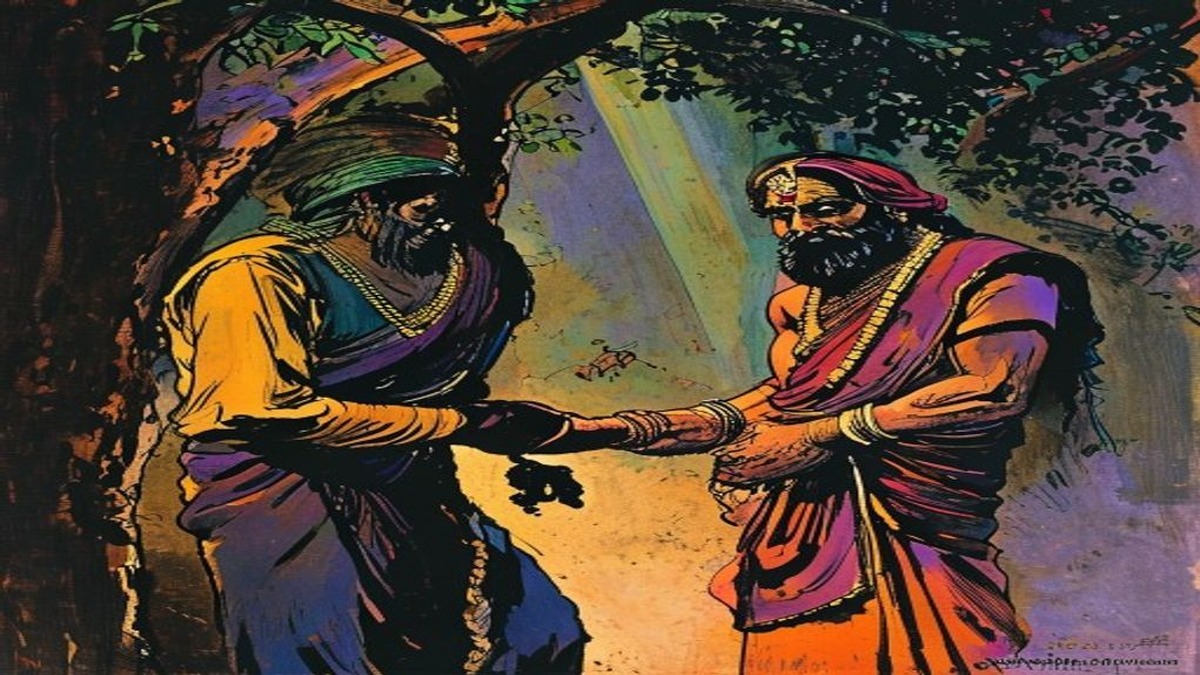
Part IV: What the Story Teaches
Vishnu Sharma’s closing observation is typically compressed: “The man who fears what his precautions are designed to prevent has already surrendered the thing he is trying to protect. The woman who understood this had no need of precautions.”
The tale is unusual in the Panchatantra for the degree to which the female character drives the plot through intelligence rather than being driven by it. Chandramati is not a villain; the text does not frame her awareness of the thief as a betrayal of her husband. She is instead the story’s most competent actor, the one who identifies the real problem — not the thief, but the insecurity that the thief’s existence has exposed — and uses the situation to address it.
Dhanadatta’s error, the text implies, was not in marrying a younger woman but in treating his fear as an architectural problem to be solved with locks and guards. Security built on anxiety rather than trust is security with the kitchen window always open. It is, the story gently suggests, a category error to confuse the management of fear with the building of trust — and a household run on the first will always have unlocked windows that the second would not.
Why This Story Has Lasted Three Thousand Years
“The Old Man, his Young Wife, and the Thief” endures because it is simultaneously a comedy of domestic anxieties and a remarkably clear-eyed analysis of what happens when systems designed to manage fear substitute for the harder work of building trust. The three characters — the fearful old man, the intelligently patient young wife, and the thief who stumbles into a domestic situation far more complex than his original intentions — form a triangle whose tensions every culture recognises immediately.
The story entered Arabic Kalila wa Dimna and was widely retold in medieval Persian and Turkish literature, where the wife’s role was sometimes diminished but the thief’s discovery of the couple’s domestic economy was preserved. In European fabliaux tradition it became one of the key exemplars of the fabliau form — a domestic comedy in which the clever wife outwits both husband and intruder — and influenced Boccaccio’s treatment of similar material in the Decameron.
For modern readers, the story’s central observation retains its edge: that systems of control imposed by anxiety rather than grounded in genuine relationship are always incomplete, always have an unlocked window, and will eventually provide an education to someone, though not always the one who built them. Chandramati’s calm is the calm of a person who understood from the beginning what her husband’s precautions could not account for: herself.
Frequently Asked Questions
What is the moral of The Old Man, his Young Wife, and the Thief?
The story teaches that security built on anxiety rather than trust is always incomplete. The old merchant's elaborate precautions all have gaps because they are designed to manage his fear rather than build genuine relationship. His wife's intelligence, which he failed to engage as a partner, turns out to be the most significant factor in the household's actual security — used not against him, but to produce a better outcome than his own systems would have managed.
Which book of the Panchatantra does this story come from?
The story comes from Book V, Apariksitakarakam (Ill-considered Action). The ill-considered action here is the merchant's approach to his marriage: his elaborate system of locks and guards addresses the symptom (his fear) rather than the cause, and leaves the fundamental vulnerability — the unlocked kitchen window, and the wife's unused intelligence — unaddressed.
What does Chandramati do when she sees the thief enter?
Chandramati watches the thief enter through the kitchen window and says nothing for half an hour — deliberately waiting. When her husband begins lecturing her about security, she uses the information about the thief as leverage: she reveals his presence as evidence of the household's actual security failures, then engineers a resolution that forces her husband to address those failures rather than simply punishing the thief.
How is the female character in this story different from other Panchatantra tales?
Chandramati is unusually active as an agent in the Panchatantra's narrative tradition. Rather than being the object of the plot — the young wife over whom the old man worries — she is the story's most competent actor. She identifies the real problem, holds information strategically, and produces a resolution that serves her own interests while being technically fair to all parties. The text does not frame her cleverness as a moral failing.
How did this story influence later literature?
The story entered Arabic Kalila wa Dimna and spread through Persian and Turkish retellings. In European fabliaux tradition it became a key example of the clever-wife comedy genre, in which a wife outwits both husband and intruder. Scholars have traced structural similarities to several tales in Boccaccio's Decameron, suggesting that the story's travel through Arabic and Latin intermediaries brought it into the mainstream of Italian Renaissance narrative.
You May Also Like
 Panchatantra Stories
Ages 3-5
Panchatantra Stories
Ages 3-5
The Lion Makers
The Lion Makers: Once upon a time, long ago, there were four friends who lived in a small village. All of them lived nearby and knew each other since the time
 Panchatantra Stories
Ages 3-5
Panchatantra Stories
Ages 3-5
The Donkey in the Tiger’s Skin
The Donkey in the Tiger's Skin: The Donkey in the Tiger’s Skin: A Panchatantra Tale of Deception Undone In the heart of a bustling kingdom, where cotton fields
 Panchatantra Stories
Ages 3-5
Panchatantra Stories
Ages 3-5
The Story of Mantharaka, the Weaver
The Story of Mantharaka, the Weaver: In a certain town, there lived a weaver, by the name of Mantharaka. One day, while he was weaving, the wooden supports of