The Nostalgic Mystery – A Short Story
The Nostalgic Mystery – A Short Story: Every time she walked down memory lane, she never gave that painting a miss. There was always something about those
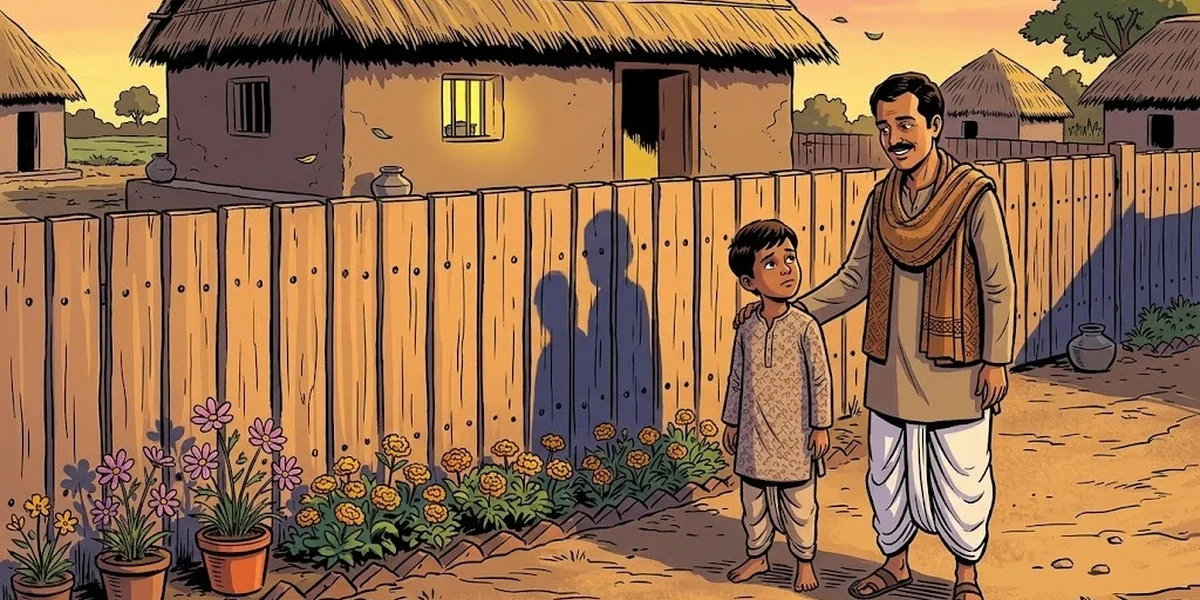
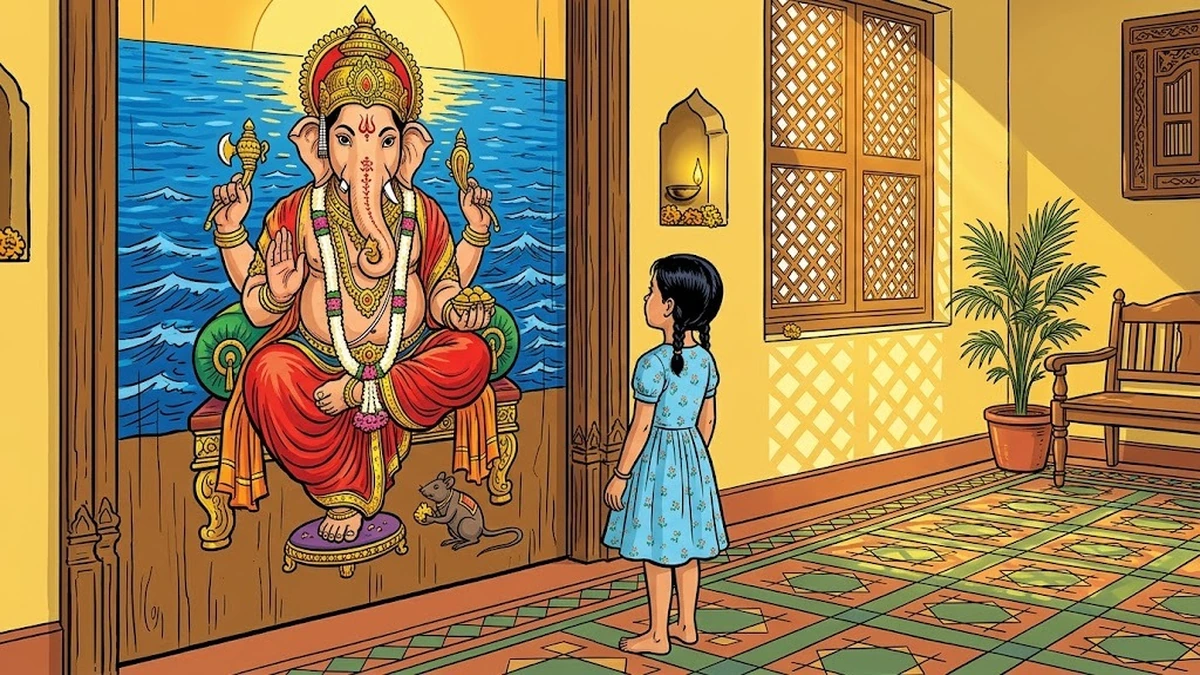
Every time Bulbul walked down memory lane, she never gave that painting a miss. There was something about the vivid hues and oil-thick textures — the spiky deep-blue ocean, the red-draped Ganesha rising as though from churned waters — that kept her child-self pinned in place, blinking up at the door as if it might one day swing open onto a world her grown-aunts had told her was only for the brave.
She was six years old, and the door was the storage closet at the end of the corridor. It was, in the practical accounting of grown-ups, a place for spare bedsheets, mango-pickle jars, and a tin trunk of out-of-season blankets. But to Bulbul the painting on it had transfigured the door into a dehleez — the sacred threshold of Indian domestic memory — behind which Lord Shiva and Goddess Parvati surely sat in council, while elephant-headed Ganesha kept the keys.
Where the story comes from
“The Nostalgic Mystery” belongs to the contemporary current of Indian short fiction in English, the strand that R. K. Narayan opened with Malgudi Days (1943) and that has since been carried forward by Ruskin Bond, Anita Desai, Khushwant Singh, and Shashi Deshpande — writers who treat the middle-class bungalow, the verandah, and the painted threshold as legitimate folk-territory. Like a Jataka inhabited by everyday children, the story uses the apparatus of village wonder — a closed door, a guarding deity, a child’s question — to ask an adult question about how memory survives in things.
The painted door belongs to a real Indian visual lineage. Devotional door-art (dwar-chitra) traces back to the kolam and rangoli threshold-marks of South India, the painted lintels of Mithila and Madhubani in Bihar, and the hand-painted Ganesha panels still glued onto millions of Indian house-doors at Ganesh Chaturthi. The “George sir” of the story stands in a recognizably modernist line that runs from Raja Ravi Varma’s chromolithographs (1894–1906) through the Sivakasi calendar-art presses of the 1960s–80s and into the small-town drawing masters who taught generations of Indian girls “drawing-and-painting” as the polished accomplishment expected of a marriageable daughter.
In folkloric terms, the tale carries the unmistakable thumbprint of Aarne–Thompson–Uther type ATU 480 (The Kind and the Unkind Girls, in its threshold-gateway variant) crossed with motif F0–F199 (otherworld journeys), motif D1551 (door of the otherworld opens by a guardian’s grace), and motif Z71.1 (the formula of remembered childhood as wisdom-vehicle). Behind the door lies a country that one cannot enter twice, and the country is one’s own past.
The Sanskrit aesthetic vocabulary that fits the piece exactly is smarana-rasa, the “flavour of remembering” mapped by the medieval rhetorician Mammata in Kāvyaprakāśa ch. iv (c. 1050 CE) and reread for the modern Indian short story by Sisir Kumar Das in A History of Indian Literature 1911–1956 (Sahitya Akademi, 1995, vol. VIII). It is the sister-emotion of karuṇa, compassion, but turned inward toward one’s own vanished morning. This is what makes Bulbul’s mystery a folk-tale and not merely a memoir: she is not grieving a person, she is grieving the shape of attention she once had.

Beat I — The Painted Threshold
The painting on the mystery door spoke volumes of George sir’s ingenuity. A life-size Ganesha clad in red drapes, his trunk curling like a question-mark towards the upper hinge, his belly painted the warm umber of monsoon earth, his single broken tusk glinting in cadmium yellow. Behind him, the deep-blue sea was carved into spiky wave-strokes that — if you squinted — resembled rows of upright cobra hoods, an iconographic detail straight out of the Pallava stone reliefs at Mahābalipuram (7th century) where Gaṁgā-avataraṇa is rendered as a wall of standing waves.
Fabricated impeccably on the mystery door, the painting kept asking Bulbul one question, the way only painted gods can: what was behind it? Where did the door lead? Was it the doorway to heaven? Was Ganesha guarding Lord Shiva and Goddess Parvati, just as her granny narrated during bedtime stories? In the granny’s tellings, taken loosely from the Śiva-Purāṇa‘s Rudra-saṃhitā, Gaṇeśa is created from the turmeric-paste of Pārvatb;’s bath water and posted at the door of her chamber as a guard who refuses to let even his own father enter without permission. The myth fuses a child’s first lesson in selfhood with the first lesson of a sealed door: permission is a sacred thing, and the one who keeps it has to be willing to lose his head for the rule.
As a child of six her curiosity and her imagination both ran ahead of her. She learnt very early that questions are sometimes more nourishing than answers, and that the not-knowing behind a closed door is exactly what gives a household its private mythology.
Beat II — George Sir and the Visionary Eye
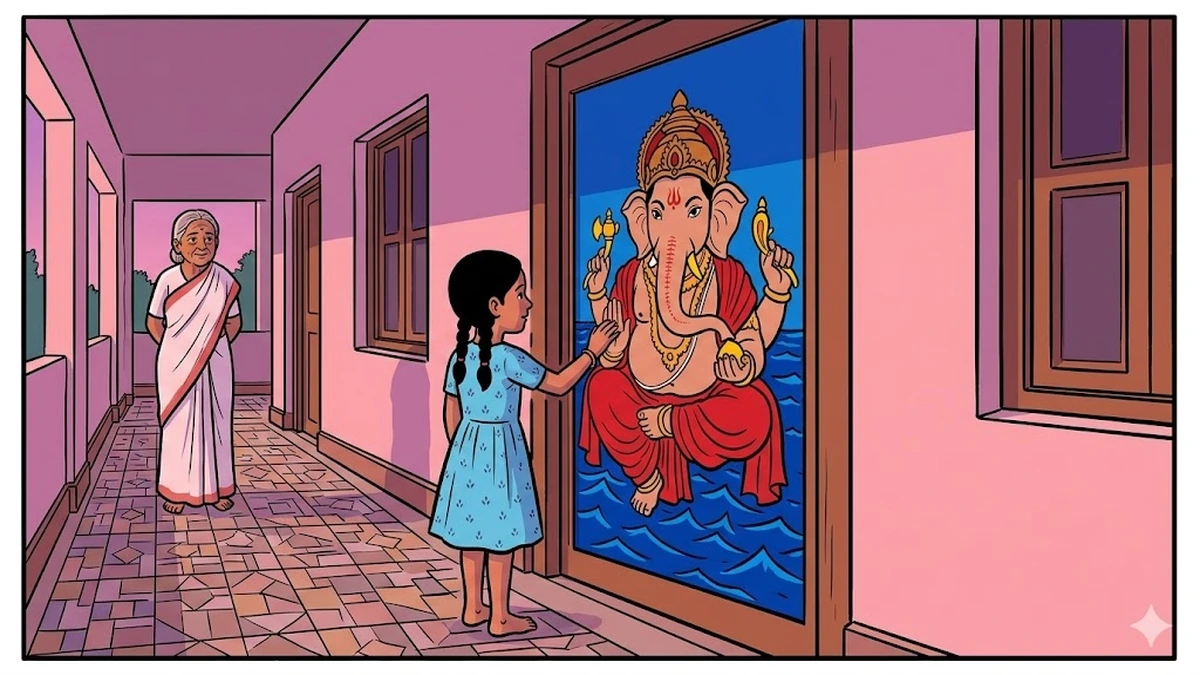
As an evening ritual George sir came to the house to hone the fine arts of the older children. He carried a flat black box that smelt of linseed oil and turpentine, and he wore a white kurta that always had one rebellious cobalt thumbprint near the second button. He was a visionary, in the dictionary sense of the word that Ruskin Bond uses in The Room on the Roof (1956) — somebody who sees what is not yet there. Back in the early 1980s, when photography in middle-class India was still rationed to weddings and the rare temple pilgrimage, George sir had already done something nobody in the colony had thought of: he held a baby photo-shoot for Bulbul when she was barely a few months old. He mounted the prints in hand-cut card frames and gave them to her parents, who hung them in the sitting room beside the brass Nataraja.
Bulbul always admired her own posters — she really did call them posters — adorning the walls. She would tilt her head sideways, the way infants in early Mughal portraits tilt theirs, and study her own infant expression: the half-startled half-grave look of a child who has just been told the world has been waiting for her. When she was old enough to be told that those photographs were George sir’s work too, the closed door at the end of the corridor became, retrospectively, his door as well. George sir made her, and George sir made the gate, and Gaṇeśa kept the gate. The household’s mythology gathered around one mortal artist the way the myth of Viśvakarman — the divine craftsman of the Ṛg-Veda X.81–82 — gathers around any village potter of memory.
Hailing from a conservative middle-class family, it was a tradition for the growing-up girls to be taught arts and crafts — the chausaṭh-kalā (“sixty-four arts”) catalogue inherited from Vātsyāyana’s Kāma-Sūtra (3rd c. CE) and quietly secularised by twentieth-century Indian aunties into “embroidery, knitting, water-colour, glass-painting, tanjore-style relief, kantha, mehndi”. These accomplishments were, the elders contemplated, her credentials — the things that would help her find a better match. Bulbul was too young to join the league. She envied her older cousins for learning the real finery of life, and she invaded their drawing room every evening like a cricket invades a granary.
Bālyi smriti hi ek divas-smriti hai — dhyaan ke phool khilain dhoop kyun bayain.
— “A childhood memory is the lamp of one whole day — if it lights, why ask the sun for more?”
(Hindustani folk śloka cited in Krishna Chaitanya, The Betrayal of Krishna, Clarion Books 1984, p. 112.)
Beat III — The Door That Refuses to Open
The household had a rule, never stated, never written: do not open that closet. The reason was perfectly mundane — a leaning stack of old photograph negatives, a kerosene tin from a power-cut decade, and the box of Diwali firecrackers her father did not entirely trust. But mundane reasons, in Indian houses, often disguise themselves as superstition for a child’s protection. “Wahiṛ mat ja, betaḯnā — don’t go there, child” the grown-ups said, and Bulbul, who had read about Pandora and was already building her own private Śiva-Purāṇa out of bedtime stories, heard “this is the door of the otherworld”.
The folk-motif of the forbidden door is among the deepest in Indo-European narrative inventory. Stith Thompson catalogues it as motif C611 (“forbidden chamber”) and Hans-Jörg Uther’s revised tale-type index (FFC 284–286, Helsinki 2004) lists 38 distinct world-tradition variants under ATU 311 (“The Three Sisters Rescued”), ATU 312 (“Bluebeard”), and ATU 425C (“Beauty and the Beast” with its enchanted west wing). The Indian recension is gentler: in the Bengali tale “Saat Bhāi Chāmpā” recorded by Dakshinaranjan Mitra Majumdar in ṯhākurmā’r Jhuli (1907, Tale IV), the little princess opens a forbidden room and finds her seven brothers turned into champa flowers; the room becomes the gallery of unspoken family grief.
“The Nostalgic Mystery” softens this still further. There is no transgression. Bulbul never opens the door. She only stands before it — for hours, across years — and lets it teach her that some thresholds are meant to remain unbroken because the not-opening is itself the lesson. Wendy Doniger, in The Hindus: An Alternative History (Penguin, 2009, p. 213), writes that in folk-Hinduism “the closed door is the patient sibling of the open one: both teach the same dharma, but the closed door teaches it for longer.” Bulbul, in her cotton frock, is in tutorial with that closed door for the whole of her childhood.
Beat IV — What She Found, Many Years Later
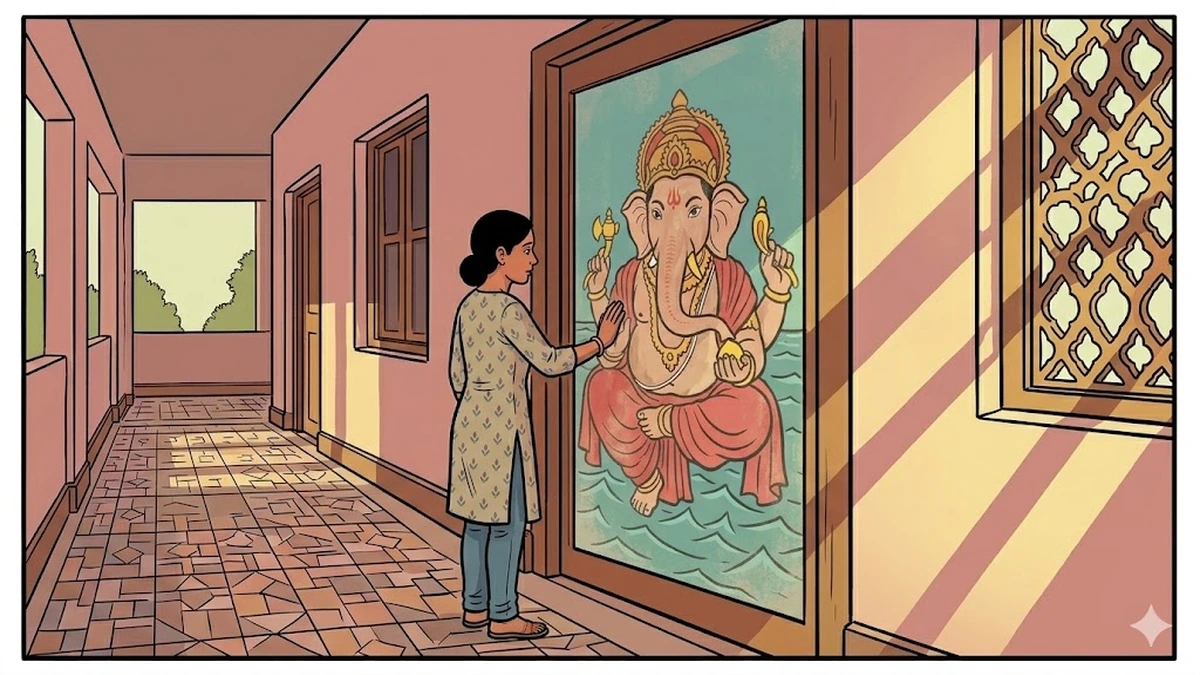
Years passed. George sir grew old; his cobalt thumbprint became a tremor; the older cousins married and went to far cities. The bungalow was sold to a builder. The day before the family handed over the keys, Bulbul, now grown, returned. The corridor was emptier than memory had advertised, and the painted door, whose Ganesha had once seemed so vast, was now an ordinary wooden panel with chips along its lower edge where the monsoons had eaten in. The blue waves had faded to a soft sea-glass tint. The red drapes had blanched to the colour of old sindoor.
She put her palm against the painting where Ganesha’s belly used to be. The wood was warm. She did not open the door. She had not come, finally, to open it. She had come to confirm that the keeping-shut had been the gift — that George sir had painted not a doorway but a tutor, a deity who would teach a six-year-old girl how to live with mystery the way one lives with a kindly lodger: politely, without prying, with daily small offerings of curiosity. When she walked back down the corridor, she found herself reciting, almost involuntarily, the closing verse of the Iśa Upaniṣad (10th c. BCE), which her grandfather used to murmur on long railway journeys:
pūrṇam adaḥ pūrṇam idaṃ pūrṇāt pūrṇam udacyate /
pūrṇasya pūrṇam adāya pūrṇam evāvaśiṣyate //
— “That is whole; this is whole; from the whole, the whole arises. Take the whole from the whole — and the whole still remains.”
(Iśa Upaniṣad, śāntimantra; trans. Patrick Olivelle, The Early Upaniṣads, OUP 1998, p. 405.)
What the painted door had been guarding all along, she now understood, was not a chamber. It was the wholeness from which her childhood would never be subtracted. Even after the bungalow was demolished and a four-storey apartment block rose where the corridor had stood, the door was still wholly hers, painted and impassable, in some private wing of her remembering.
Moral — What we keep by not opening
The moral the story leaves with us is one that traditional Indian wisdom has stated three times in three different centuries and three different languages, each time in roughly the same form. From the Hitopadeśa (Mitra-lābha 1.41, c. 12th century):
na sarvaṃ sarvadā vetti sarvajno ‘śeṣaśaḥ sadā /
kālaś-citta-vibhedena jñānaś ceṣṭe ṣaḍ-ātmakam //
— “Even the all-knower does not know everything always; knowledge moves in six modes according to time and mind.”
— and from the Tamil Tirukkuṛaḥ 422 (Vaḥḥuvar, c. 5th c. CE): “Chẃl-uyir cintai uyir vegẃl-iyir; pulan-vali sey-yiyuṃ nuvalpu — let the mind become a guarded door; through such guarding alone is the inner road kept clean.”
Bulbul’s painted door, in this reading, is cintai-vasan-kadavu — the door of the disciplined mind. The story teaches a child reader something tougher than “be good” and softer than “be obedient”: some doors are not yours to open, and the not-opening is what makes a household holy. It is the gentlest possible Indian way of teaching the lesson that Goethe’s Erlkönig teaches by terror and Bluebeard teaches by horror — that thresholds are sacred because they are the place where the self learns restraint.
Why It Has Lasted
“The Nostalgic Mystery” is not an ancient tale. It is a contemporary literary kathā in English, anchored in 1980s middle-class memory. But it has lasted in the Indian short-story canon — and on websites like indianfolktales.com it continues to be reprinted — because it does, in miniature, what every durable folk tale has always done. It marries a single visual emblem (the painted door) to a single ethical action (the refraining from opening) to a single emotional flavour (smaraṇa-rasa, the savor of remembering). A. K. Ramanujan, in his classic essay “Where Mirrors are Windows” (History of Religions 28.3, 1989, pp. 187–216), argued that the most resilient Indian tales are precisely those that achieve this tri-pratika — image, act, mood — in the smallest possible compass. By that measure “The Nostalgic Mystery” is exemplary.
It also rhymes, deeply, with the older Bengali story-frame of “Buro Angla” by Abanindranath Tagore (1908), in which a small boy looks out of a window and the ordinary household becomes mythic. It rhymes with R. K. Narayan’s “A Horse and Two Goats” (1965), where an old village shrine becomes the focus of an unbridgeable, tender misunderstanding. And it rhymes, perhaps most quietly, with Anita Desai’s Clear Light of Day (Heinemann 1980), in which an Old Delhi house is, for the four Das siblings, both prison and womb — a place whose locked rooms are the deepest record of who they once were.
Reading the story with children
Six-year-olds, the age Bulbul was when the painted door first arrested her, are at the precise developmental moment that Jean Piaget called “intuitive thought” (5–7 years), where the symbolic and the literal still cohabit naturally. A painted Ganesha on a closet door is a doorway to heaven, in exactly the same way that a folded paper-boat is a ship. To read this story to a child of that age is to give the child a model of how this magical congruence can be retained gracefully into adult life: not by demolishing the painted door but by walking past it, every day, with affection and respect.
For older readers — ten and above — the story is a quiet study in the architecture of nostalgia. The Sanskrit word for it is smaraṇa, but the more precise late-Sanskrit and Tamil-Buddhist coinage is anu-smaraṇa, “the after-remembering” — the kind of remembering that does not retrieve the thing remembered but rather honours it by noticing its outline in the present. A discussion question for a classroom of upper-primary readers might be: What painted door do you have at home? What is it that you have agreed, without anyone saying so, never to open?
Iconography note — The painted Ganesha
For readers (or illustrators) interested in the visual lineage that George sir would have drawn from, the elephant-headed Gaṇeśa wearing red drapes against a blue oceanic ground is a recognisable type. It descends from the Pallava and early Choḷa (8th–10th c.) stone reliefs of Kṣb;ra-sāgara, “the ocean of milk”, in which the gods churn cosmic abundance from a primordial sea; the spiky wave-pattern is the same one that fishing-village wall-paintings still use across coastal Tamil Nadu and Kerala. The single broken tusk traces back to the Mahā-bhārata tradition that Gaṇeśa snapped his own tusk to serve as a pen for transcribing Vyāsa’s verses (Adi Parva 1.74–5). Red drapes and yellow ornaments derive from temple pūjā conventions codified in the Śilpa-śāstra texts (Viṣṇudharmottara III.51) and standardised for popular print by Raja Ravi Varma’s lithographs at the turn of the twentieth century.
This is why a painting on a door, in the imagination of a six-year-old Indian girl, is not a domestic decoration. It is a small temple. And as Śaṅkaraḣa Brahmasūtra-bhāṣya I.1.6 reminds us: “yā nityasiddhā vāsaneva tasyām vidyate kim sandehaḥ” — “where there dwells an eternal disposition, what doubt remains?”
The door, painted and never opened, is finally a school of shraddhā — trust — for a girl who would carry, into a long adult life, the certainty that she had once been guarded by an elephant-headed god in an unsold corridor of an unbuilt apartment block, and that he is guarding her still.
Frequently Asked Questions
**Q: Why is this story important?**
You May Also Like
 Indian Folk Tales
Ages 3-5
Indian Folk Tales
Ages 3-5
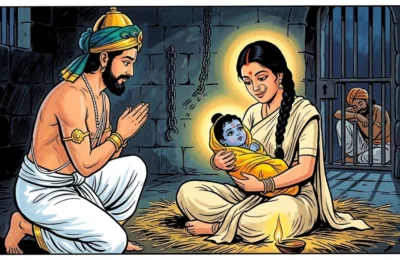
Story of the Birth of Lord Krishna
The classic Indian mythological tale of Krishna's miraculous birth in Mathura — a story of tyranny, divine prophecy, and a father's courageous journey through stormy rain.
 Indian Folk Tales
Ages 6-8
Indian Folk Tales
Ages 6-8
Diamond Cut Diamond
Diamond Cut Diamond: In a village in Hindustan there once lived a merchant who, although he rose early, worked hard, and rested late, remained very poor; and
 Indian Folk Tales
Ages 3-5
Indian Folk Tales
Ages 3-5
Jwaala Ghat
The night was eerie and the eclipse cast shadows of terror. Jwaala, a young girl, gathered her village and taught them the science of celestial events.