The Lion And The Crane
The Lion And The Crane: The Bodhisatta was at one time born in the region of Himavanta as a white crane; now Brahmadatta was at that time reigning in Benares.
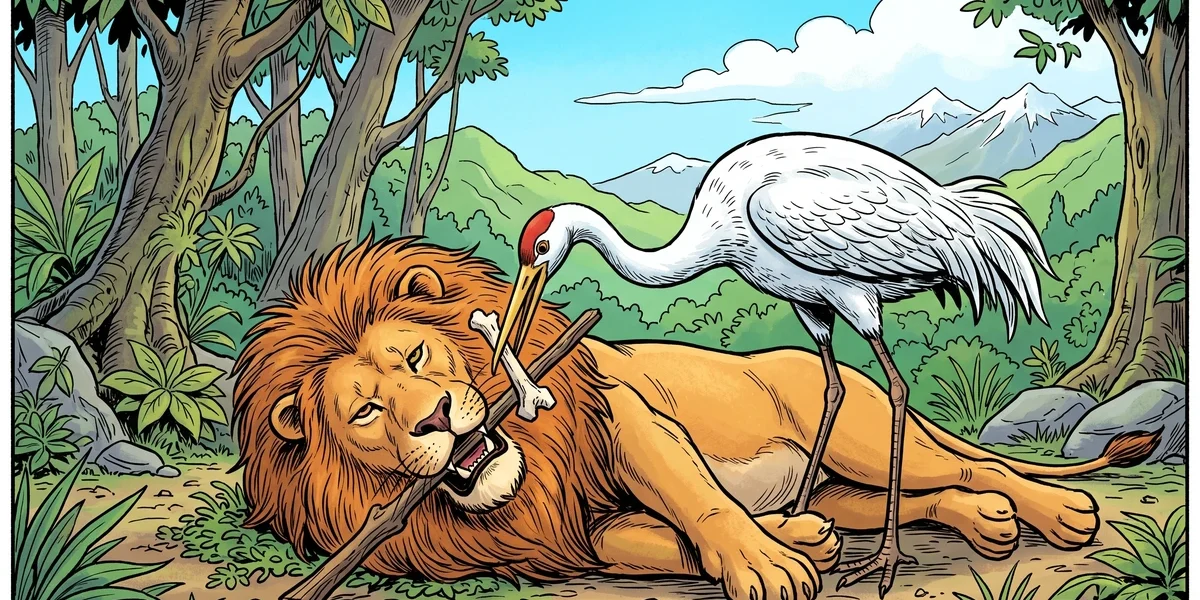
The Lion and the Crane — Panchatantra, Book III: Kākolūkīyam (Of Crows and Owls); also in the Buddhist Jātaka canon
This tale appears in both the Panchatantra tradition, compiled by Vishnu Sharma around 300 BCE, and in the Buddhist Jātaka canon — one of the few fables shared between the two great Indian pedagogical traditions. It concerns the ingratitude of the powerful toward those who help them, and the wisdom of recognising in advance that certain beneficiaries will not honour the debts of aid. The crane who removes a bone lodged in a lion’s throat saves the lion’s life and then discovers that the lion considers the fact of surviving the procedure to be sufficient reward. The Panchatantra uses this exchange to instruct on the specific dangers of expecting gratitude from those for whom gratitude is structurally inconvenient.
Beat I — The Lion’s Distress and the Crane’s Offer
A powerful lion, hunting in a forest, swallowed a bone that lodged itself in his throat. He could neither swallow it further nor cough it up. The pain was acute and the danger was real — a lion unable to eat dies, and the progression from bone-in-throat to starvation was not a long one. He padded through the forest making a sound that the other animals found deeply satisfying: the king of beasts, diminished, suffering, unable to roar properly.
A crane, long-necked and observant, assessed the situation with the practical eye of a creature who spends its days reaching into difficult spaces after elusive targets. The bone was visible when the lion opened his mouth in distress. The crane’s beak was precisely the right length and shape to reach it. The operation was technically straightforward — the challenge was entirely the matter of putting one’s head inside a lion’s mouth and trusting that the lion would not close it.
The crane raised this point directly with the lion: what guarantee of safety could the lion provide? The lion, in pain and desperate, offered everything that a desperate lion can offer — his word, his promise, his gratitude, his future protection. He was the king of the forest; a crane who helped him would have the lion’s permanent favour and the security that implied. The crane assessed this offer, assessed the lion’s desperation, assessed the technical simplicity of the procedure, and decided the risk was manageable. She reached into the lion’s mouth with her long beak and extracted the bone cleanly.
Beat II — The Request for Reward and Its Reception
The lion’s relief was immediate and complete. He shook his mane, stretched his great neck, and breathed without obstruction for the first time in what had been a very unpleasant interval. He was himself again — which is to say, he was a lion in full possession of his capacities and his dignity, rather than a lion in distress making promises to birds.
The crane waited for the acknowledgement of debt and the beginning of its discharge. The lion looked at her for a moment with the particular expression of a powerful creature reassessing a situation from a position of strength rather than weakness. Then he spoke: had the crane not already received a sufficient reward? She had placed her head inside a lion’s mouth and withdrawn it intact. Most creatures who put their heads inside a lion’s mouth did not have this experience. The fact that she had emerged unbitten was itself a gift of considerable magnitude — a gift that only a lion could give, through the deliberate restraint of not closing his jaws.
The crane understood immediately that no further reward was coming. The lion’s argument was not made in good faith; it was made to close the ledger on a debt he found inconvenient to carry. She withdrew without pressing the point further.
Beat III — On Gratitude, Power, and Structural Inconvenience
The Panchatantra does not present the lion as unusually villainous. He is, in the context of the tradition, a recognisably common type: the powerful actor who, when helped from a position of weakness, revises his assessment of the debt once strength is restored. This is not rare behaviour. It is so common that the Panchatantra and the Buddhist Jātaka tradition both felt it needed specific illustration and analysis.
The analysis the Panchatantra offers is structural rather than moral: gratitude is easiest to feel and hardest to express when it is owed to someone less powerful than the debtor. The lion owed the crane something that, if acknowledged and paid, would have established a visible precedent — that a lion can be indebted to a bird, that the king of the forest had needed help from a creature he could swallow. This precedent was structurally inconvenient for a lion whose authority rested partly on the impression of invulnerability. The debt was real; its public acknowledgement was a cost the lion was not willing to pay.
The Arthashastra of Kautilya addresses this dynamic in the context of diplomatic obligation: a ruler who accepts help from a weaker ally must decide whether to honour the resulting debt or to revise the terms of the relationship once the crisis has passed. Kautilya recommends honouring the debt — not from sentiment but from calculation: the ruler who establishes a reputation for reliable gratitude will find help more readily available in future crises. The lion’s calculation was different and shorter-term, and the Panchatantra’s readers understood where that calculation led.
Beat IV — What the Crane Should Have Known
The Panchatantra draws a second lesson alongside the condemnation of the lion’s ingratitude: the crane had access to all the information needed to predict this outcome before agreeing to help. She knew she was dealing with a lion — a creature whose entire social identity depended on projecting strength and owing nothing. She knew the help she was providing was the kind that, once delivered, gave the recipient immediate restoration of the very power that made acknowledgement of debt structurally problematic. She knew the lion’s promise was made from a position of desperation that would not outlast the extraction of the bone.
The Panchatantra does not say the crane was wrong to help — acts of help have their own value independent of the ingratitude they receive. But it does say the crane was wrong to expect payment: she helped a lion and then expected a lion to behave in a way that lions, when restored to strength, do not reliably behave. The wisdom the tradition extracts from this story is not “do not help the powerful” but rather “do not help the powerful while expecting gratitude, unless you have assessed the specific powerful actor in question and found evidence that gratitude is part of their character.”
“He who expects gratitude from the powerful in proportion to the service rendered has not yet studied the powerful carefully enough.”
Why This Story Has Lasted 2,300 Years
The Lion and the Crane endures because the lion’s response — reframing his restraint as the gift rather than acknowledging the crane’s service as the gift — is so recognisable as a pattern of powerful behaviour that it requires no translation across cultures or centuries. Every tradition that has told this story has done so because every tradition has produced lions who, once restored to strength, find reasons why the debt of their weakness need not be acknowledged. The crane is not a fool — she is a competent actor who misjudged the specific lion. The Panchatantra’s lesson is to judge the specific lion before placing your head in his mouth.
About the Panchatantra
The Panchatantra (“Five Treatises”) was composed by Vishnu Sharma circa 300 BCE as a compendium of nītiśāstra — statecraft, ethics, and worldly wisdom — expressed through interlocking animal fables. The Lion and the Crane also appears in the Buddhist Jātaka canon, one of the few tales shared between the Brahminic and Buddhist narrative traditions. It has been translated into Pahlavi, Arabic (Kalīla wa-Dimna), Hebrew, Latin, and all major European vernacular languages, and remains one of the most widely recognised fables in world literature.
Frequently Asked Questions
**Q: Why is this story important?**
You May Also Like
 Panchatantra Stories
Ages 9-12
Panchatantra Stories
Ages 9-12
The Story of the Farmer’s Wife
The Story of the Farmer’s Wife: In a certain town, there lived a farmer and his wife. As her husband was old, the woman was always thinkingof other men and
 Panchatantra Stories
Ages 6-8
Panchatantra Stories
Ages 6-8
The Tale of Golden Droppings
The Tale of Golden Droppings: Check thoroughly even what seems to be impossible.” There was a special bird named Sindhuka, who lived in a huge tree on the top
 Panchatantra Stories
Ages 6-8
Panchatantra Stories
Ages 6-8
The Story of the Enmity Between Crows and Owls
The Story of the Enmity Between Crows and Owls: Once upon a time, all the birds, the swans, the parrots, cranes, cuckoos, nightingales, owls, peacocks, doves