The King Of The Ants
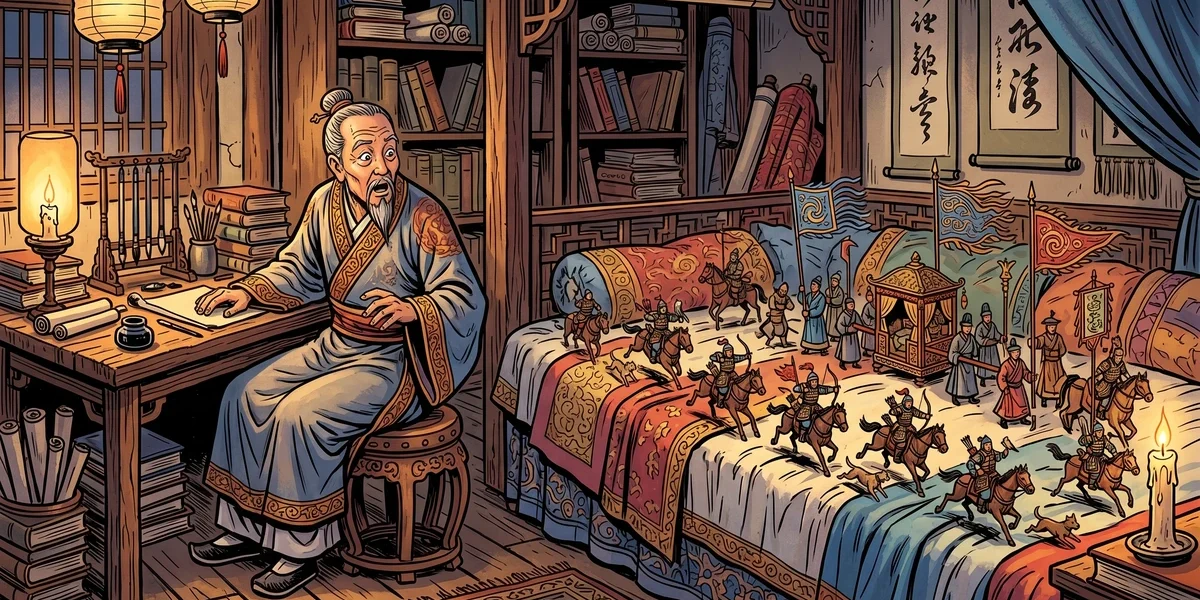
The King Of The Ants: Once upon a time there was a scholar, who wandered away from his home and went to Emmet village. There stood a house which was said to be
Origin & Tradition
“The King of the Ants” belongs to a family of Chinese folk narratives in which human kindness shown to small or apparently insignificant creatures generates cosmically disproportionate returns — typically because the creature turns out to be a supernatural being in ordinary form, whose capacity for bao en (報恩, reciprocal repayment of kindness) is as extraordinary as their true nature. The story appears in Richard Wilhelm’s Chinesische Volksmärchen (1914) and reflects the convergence of two distinct but reinforcing traditions in Chinese popular ethics. The first is the Chinese animist-Daoist conviction that consciousness and moral agency are not limited to human beings but distributed throughout the natural world, so that the ant, the fish, the bird, and the serpent are not merely creatures but potential persons — beings with inner lives, memories, and the capacity for the full range of moral responses including gratitude. The second is the Chinese Buddhist tradition of fang sheng (放生, “life release”) — the practice of purchasing captive animals and releasing them as a merit-generating act, grounded in the Buddhist teaching that all sentient beings possess the same fundamental Buddha-nature and therefore deserve the same fundamental compassion.
Part I — The Rescue and the Promise
The story’s protagonist — typically a gentle, unpretentious young man, the kind of person who notices things that others walk past — encounters an ant colony in distress. The specific nature of the crisis varies across versions: the ants may be struggling to cross a flooded stream, threatened by an animal attack, caught in a fire, or simply imperilled in some way that their own scale makes overwhelming and that a moment of human intervention could easily address. The hero stops. He does not stop because he calculates that helping will bring reward; he stops because the creatures are in trouble and he has the means to help them. This uncalculating kindness is the story’s moral foundation: the act of helping must precede any awareness of what is being helped, otherwise it is not kindness but investment.
The rescue is accomplished with appropriate simplicity — a branch laid across the water for the ants to cross, a boot placed to redirect the fire, a handful of crumbs left to sustain a colony in winter. From the human perspective, the gesture is trivial: a moment’s attention, a small expenditure of effort, the kind of casual benevolence that leaves no memory. But from within the ant colony, the intervention was everything — as large in its effect on their world as the intervention of a god.
The Ant King — who in Chinese folk taxonomy is understood as the ant colony’s divine ruler, a supernatural being of considerable power who maintains his position at the colony’s centre as the dragon maintains the undersea palace or the mountain spirit maintains the peak — observes everything. He notes who performed the rescue, what it cost them, and the quality of their motivation. The promise of bao en is implicit in Chinese folk ethics: kindness received creates an obligation to repay. The Ant King, whatever his form and whatever the scale of his kingdom, is subject to this obligation as much as any human.
Part II — The Crisis and the Unexpected Ally
Time passes, and the hero finds himself facing a challenge that exceeds his unaided capacity — typically a task set by a powerful authority whose completion is required before the hero can obtain something he desires, often a marriage or an inheritance. The tasks are of the kind that make individual human effort inadequate: separate a mountainful of mixed grain by variety overnight, find a needle dropped in an ocean, count the sands of a particular riverbed. These are tasks designed to be impossible, tests whose function is to demonstrate either extraordinary capacity or the possession of extraordinary allies.
At the moment of apparent impossibility — typically late at night, the deadline approaching, the hero sitting in despair beside the impossible task — the Ant King arrives. His appearance is, again, at first unremarkable: a small voice in the dark, an unusual concentration of movement at the floor’s edge. But the Ant King knows the hero, knows why he has been sent, and mobilises the full resources of the ant kingdom in his service. By morning, the grain has been sorted perfectly, every seed in its correct category, every impossible requirement met — accomplished not through magic in the dramatic sense but through the extraordinary collective intelligence and physical capacity of a million workers, each doing a tiny portion of a task that only their aggregate makes possible.
This resolution is one of the story’s most satisfying structural features: the ants’ help is not miraculous in the sense of violating natural law; it is a demonstration of what natural capacity, properly organised and motivated, can achieve at scale. The individual ant can sort one grain; a million ants, working through the night with the coordination that their social structure provides, can sort a mountainful. The human hero’s problem — which seemed to require supernatural intervention — turns out to require only the mobilisation of a natural capacity that he had inadvertently secured through the simple act of helping creatures in distress.
Part III — Fang Sheng and the Buddhist Ethics of Life Release
The hero’s rescue of the ant colony — whether or not the story explicitly frames it in Buddhist terms — participates in the Chinese Buddhist tradition of fang sheng (放生, “life release” or “freeing life”). Fang sheng is the practice of purchasing animals destined for slaughter — fish from markets, birds from cages, insects from destruction — and releasing them into environments where they can live freely. The practice is grounded in the Buddhist teaching that all sentient beings experience suffering, all possess Buddha-nature, and all are therefore deserving of the same compassion one would extend to a suffering human being.
The fang sheng tradition in China dates at least to the Sui dynasty (581–618 CE), when Emperor Yang established “life release ponds” (fang sheng chi, 放生池) throughout the empire. By the Tang dynasty, fang sheng had become one of the most widely practiced Buddhist merit-generating activities among both clergy and laypeople — a practice that generated gong de (功德, merit) precisely because it enacted the bodhisattva’s commitment to the liberation of all sentient beings from suffering. The folk narrative tradition reinforced this practice by providing stories — like “The King of the Ants” — in which fang sheng’s merit was demonstrated not abstractly but through specific, gratifying, plot-level consequences: the creature released returns to save its rescuer.
The tradition also interacted with the Chinese animist conviction that extraordinary creatures — those who have accumulated sufficient jing (精, vital essence) through age or unusual circumstance — can assume human form, hold divine offices in the supernatural hierarchy, and exercise powers far beyond those suggested by their ordinary appearance. The ant colony’s Ant King is a supernatural officer in the cosmological administration, whose authority over his domain is as real as the Dragon King’s authority over the sea — and whose capacity for grateful reciprocation is correspondingly formidable. To help an ant colony is, potentially, to help a god in disguise; and the person who helps without calculating whether the recipient is a god demonstrates a quality of compassion that the gods consistently choose to reward.
Part IV — Scale, Consciousness, and the Ethics of Small Things
“The King of the Ants” makes a philosophical claim that is more radical than it might initially appear: that the ethical obligations we have toward other beings do not diminish as the beings get smaller. This is not a claim unique to Chinese folk narrative — it is implicit in Buddhist ahimsa, in Jain teachings about the moral status of microscopic organisms, and in contemporary animal ethics — but it is stated with particular elegance through the story’s plot structure. The hero’s act of kindness toward the ants is not presented as an act of unusual virtue; it is presented as the obvious response of a decent person to creatures in distress. The radical claim is in what the act generates — the return that the Ant King provides — which demonstrates that small creatures can exercise great power and that the ethical texture of one’s relationship to all beings, at all scales, determines what powers become available in moments of need.
This claim connects to a broader Chinese folk cosmology in which the world is understood as a dense network of moral reciprocities operating at every scale simultaneously. The person who maintains good relationships — with parents, with neighbours, with strangers, with the spirits of the land, and with the smallest creatures of the field — is embedded in a web of potential allies whose aggregate power is incalculable. The person who maintains good relationships only at the scale of obvious importance — only with powerful people, only when the return is visible and calculable — has sealed off most of this network and left themselves isolated in precisely the moments when the network’s full breadth is most needed.
“He saved them because they were drowning, not because he expected them to save him. But when he was drowning in his own impossible task, a million small helpers appeared — and the mountain of grain was sorted by morning, because he had once laid a branch across a stream for creatures he never expected to remember it.”
Why This Story Lasted
“The King of the Ants” lasted because ants are perfect vehicles for its lesson. Everyone has seen ants. Everyone knows, at least abstractly, what an ant colony can accomplish collectively. And everyone has, at some point, either stepped around an ant trail or stepped through it, either moved a drowning ant from a puddle or ignored it, either experienced the small claim of a small creature on their attention or dismissed that claim entirely. The story takes this ordinary micro-decision — the moment when a small creature’s trouble does or does not engage our attention — and reveals it as a moral crossroads with potentially large consequences. It does not make this claim with theological elaboration; it demonstrates it through plot, which is the most convincing kind of demonstration.
The story also lasted because the ant kingdom’s response to the hero’s crisis is genuinely satisfying — not because it involves magic but because it involves the correct application of real capacities. The ants work all night sorting grain; this is what ants actually do, at a scale that human beings cannot organise. The story’s resolution is not a wish granted but a debt repaid by the only means available to an ant colony, which turns out to be exactly adequate. This elegance — the problem solved by the means that the solution itself generated — is what makes the story feel not merely pleasant but right.
You May Also Like
 Chinese Folk Tales
Ages 9-12
Chinese Folk Tales
Ages 9-12
The King Of Huai Nan
The King Of Huai Nan: was a learned man of the Han dynasty. Since he was of the blood royal the emperor had given him a kingdom in fee. He cultivated the
 Chinese Folk Tales
All Ages
Chinese Folk Tales
All Ages
Old Dragonbeard
Old Dragonbeard: At the time of the last emperor of the Sui dynasty, the power was in the hands of the emperor’s uncle, Yang Su. He was proud and extravagant.
 Chinese Folk Tales
All Ages
Chinese Folk Tales
All Ages
The Golden Canister
The Golden Canister: In the days of the Tang dynasty there lived a certain count in the camp at Ludschou. He had a slave who could play the lute admirably, and