The Juniper-Tree
The Juniper-Tree: Long, long ago, some two thousand years or so, there lived a rich man with a good and beautiful wife. They loved each other dearly, but
The Juniper-Tree — published as Von dem Machandelboom in KHM 47 of the Brothers Grimm’s Kinder- und Hausmärchen (1st ed., Realschulbuchhandlung Berlin, 1812) — is the most artistically perfect tale in the entire Grimm corpus and the canonical European representative of ATU 720, “My Mother Slew Me, My Father Ate Me.” The Grimms received the story not from one of their Hessian household informants but from the Pomeranian Romantic painter Philipp Otto Runge (1777–1810), whose Low German (Plattdeutsch) manuscript was forwarded to Wilhelm Grimm by Achim von Arnim. Runge’s literary craftsmanship — the lyrical refrains, the cosmological prologue, the bird-song that reassembles a murdered child — gave the tale a poetic density unmatched anywhere else in the collection, which is why Wilhelm Grimm preserved Runge’s Plattdeutsch orthography largely untouched through every edition until his death in 1859. The English translations of Edgar Taylor (1823) and Margaret Hunt (1884) render it variously as “The Juniper-Tree” or “The Almond Tree,” and J. R. R. Tolkien singled it out in his 1939 lecture On Fairy-Stories as the supreme example of fairy-tale beauty undiminished by horror.
The Wish Beneath the Juniper
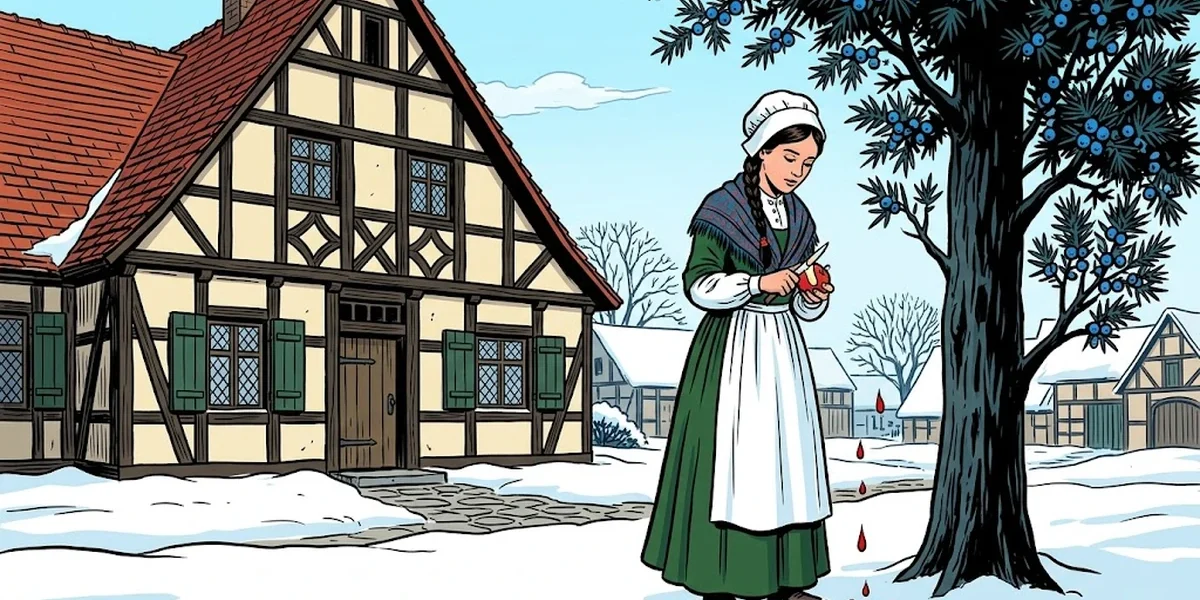
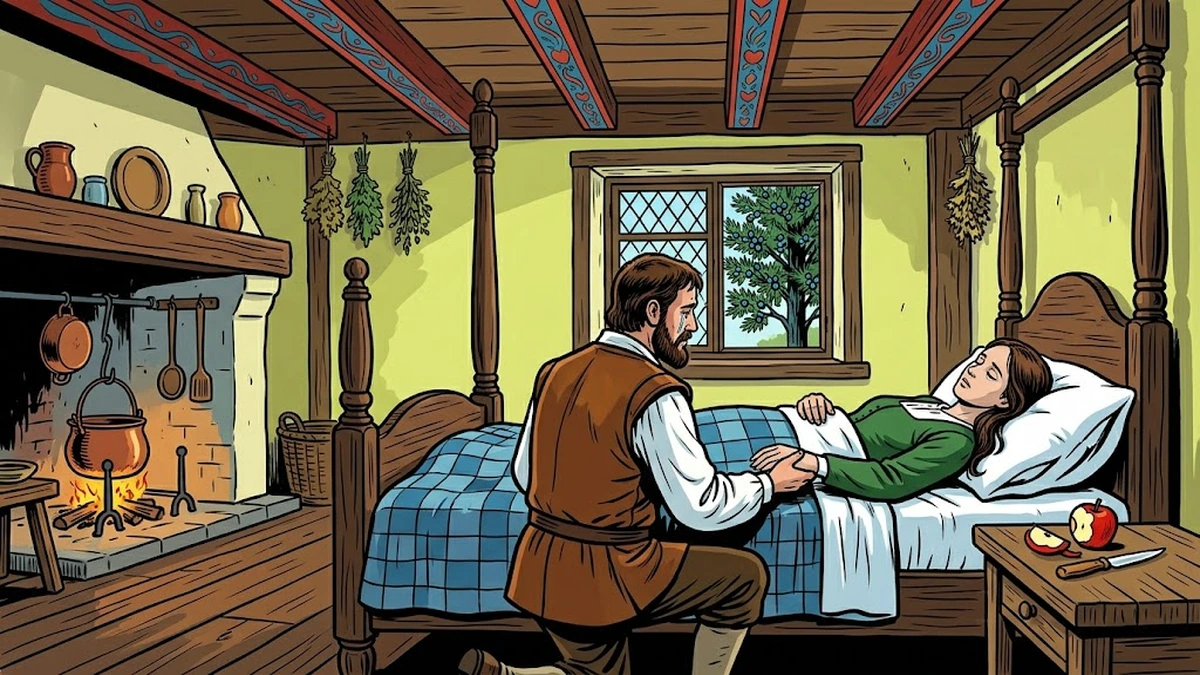
The tale opens “two thousand years or so” ago — Runge’s deliberate biblical cadence — with a wealthy man and his pious, beautiful wife who long for a child. One winter morning the wife stands beneath the juniper-tree (Machandelboom) in the courtyard peeling an apple; she cuts her finger, and three drops of blood fall onto the snow. The image — red on white, framed by the dark green juniper — is the same talismanic triad that opens KHM 53 (Snow-White) and which folklorists since Max Lüthi (Das europäische Volksmärchen, 1947) have identified as the iconic Märchenfarbe, the fairy-tale color formula. The woman whispers, “Had I but a child as red as blood and as white as snow!” and her heart grows light. Through the months she watches the juniper bud, blossom, ripen, and she feels herself ripening with it. When the berries swell she eats greedily of them and falls grievously ill. To her husband she gasps a single instruction: bury me under the juniper-tree.
Seven months later she bears a son “as red as blood and as white as snow” — and in seeing him, her joy kills her. The husband buries her, as she asked, beneath the Machandelboom. The tree’s roots and the mother’s body become one, and from that union the entire moral architecture of the tale will later spring. Runge’s prologue is unique in Grimm: nowhere else does a story begin with so deliberate a fusion of vegetable, maternal, and resurrective symbolism. Marina Warner (From the Beast to the Blonde, 1994) reads the juniper as the displaced mother — protective, fertile, and ultimately judicial — a tree-spirit whose justice will close the tale’s circle.
The Stepmother and the Iron Chest
The widower remarries and fathers a daughter, Marlinchen (in some translations Marleenken or little Marlene), but the new wife is consumed by jealousy: the boy stands between her own daughter and the inheritance. Day by day her cruelty toward him swells, until one afternoon Marlinchen comes to her asking for an apple from the heavy-lidded iron chest. The stepmother gives her one — but when the boy returns hungry from school and asks for one too, a Devil-thought (böse Gedanken) climbs into her heart. “You shall have one,” she says sweetly, “but reach into the chest yourself.” As he bends to take the apple, she slams the iron lid down upon his neck, and his head rolls among the apples on the floor.
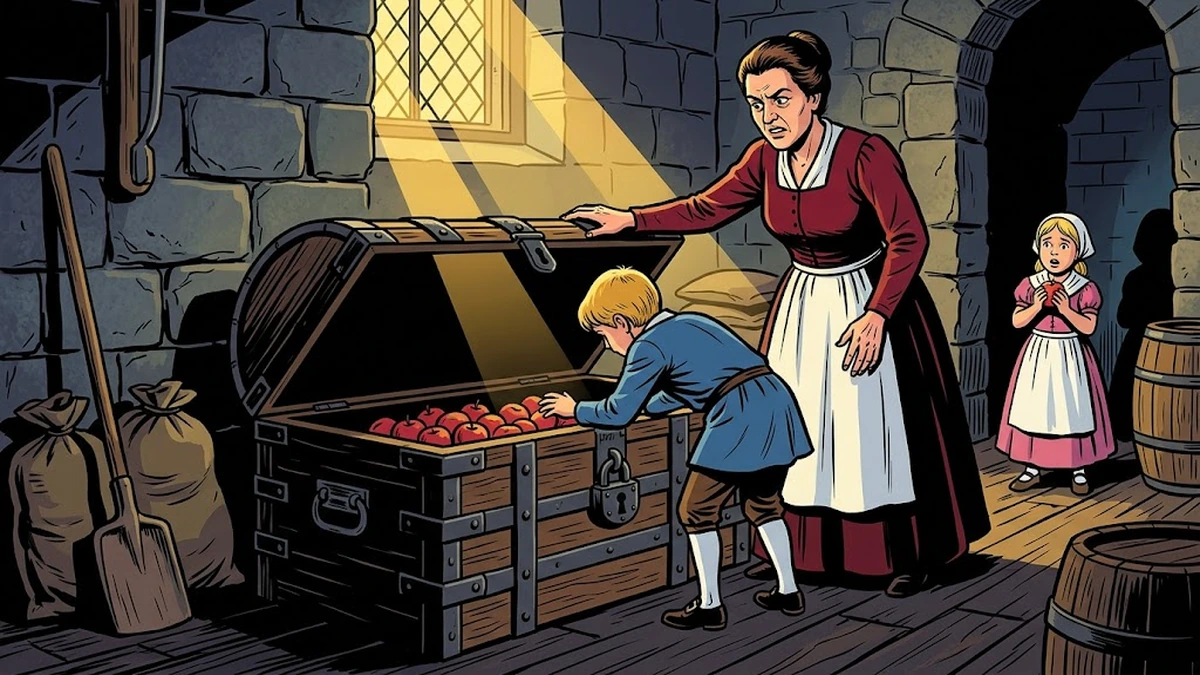
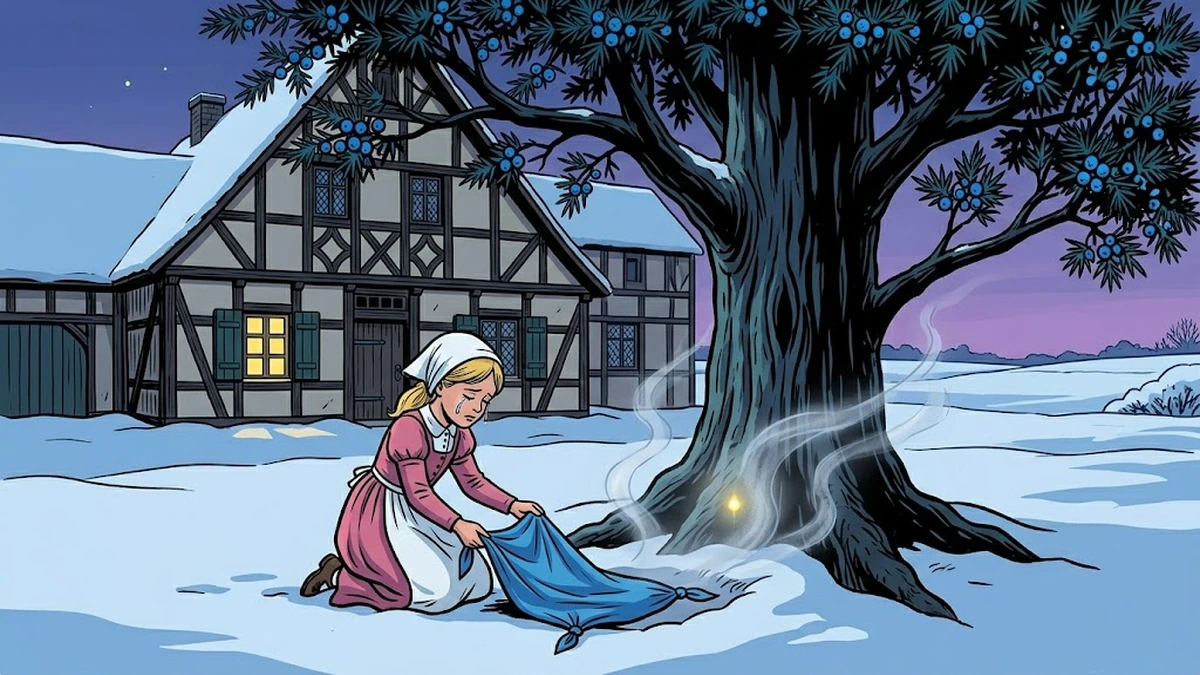
Terror seizes her — and then a dreadful cunning. She fetches a white kerchief, sets the boy’s head back on his shoulders, ties the cloth so the cut cannot be seen, places an apple in his hand, and props him on a stool by the door. When Marlinchen, frightened by his pallor, complains to her mother that the brother will not answer, the stepmother says, “Box his ear, then, if he will not speak.” The little girl strikes her brother’s cheek; the head rolls off; Marlinchen screams and weeps. The stepmother, calm as ice, declares: “What is done is done. We will make him into black puddings.” She chops the body into pieces, simmers it in the cooking-pot, and that evening the father returns, asks where his son is, and is told the boy has gone to visit his great-uncle. The father eats the black puddings hungrily, throws the bones beneath the table, and weeps strangely without knowing why. Marlinchen, sobbing in silence, gathers every bone into her best silken kerchief and carries them out to the courtyard. She lays the bones beneath the juniper-tree, and at her touch a great peace fills her — for though she does not yet understand it, the tree is already at work.
The Bird in the Juniper
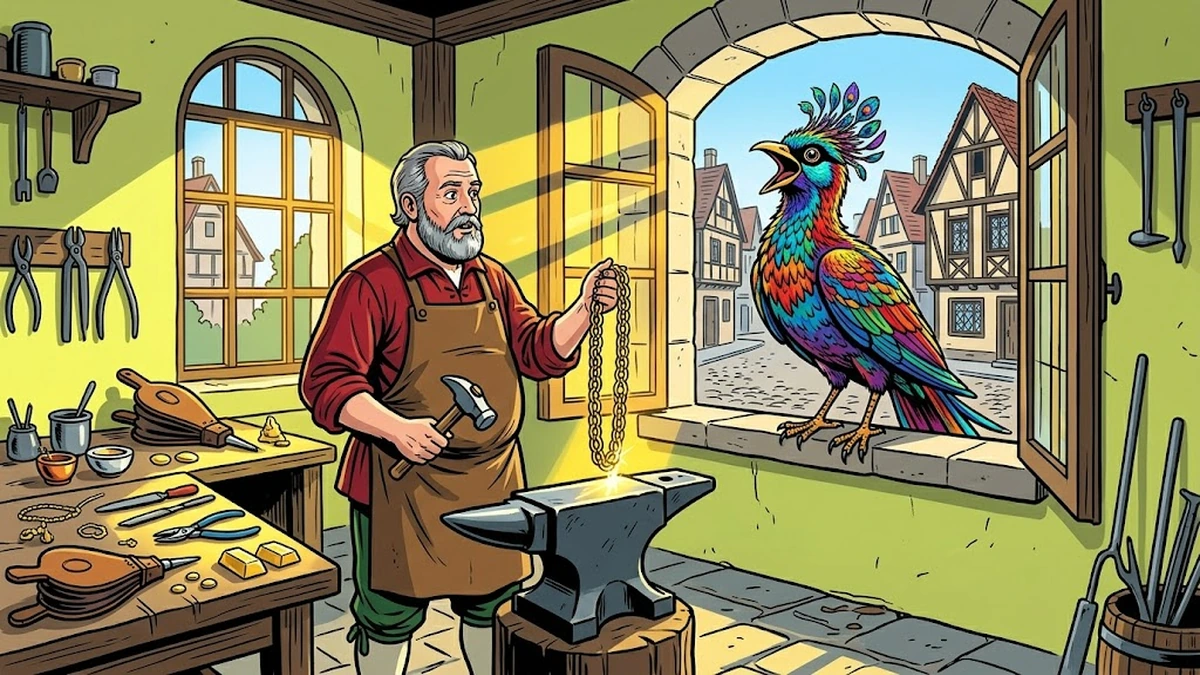
A mist rises from the juniper. Within the mist a flame leaps, and from the flame flies out the most beautiful bird ever seen — feathers of every colour, eyes of black fire. The bones beneath the tree are gone. The bird wheels into the sky singing a song that has become one of the most famous lyrics in European oral literature, preserved by Runge in its original Low German cadence:
“Mein Mutter, der mich schlacht’t,
Mein Vater, der mich aß,
Mein Schwester, der Marlenichen,
Sucht alle meine Benichen,
Bind’t sie in ein seiden Tuch,
Legt’s unter den Machandelbaum.
Kywitt, kywitt, wat vör’n schöön Vagel bün ik!”
— “My mother, she killed me;
My father, he ate me;
My sister, little Marlene,
Gathered all my bones,
Bound them in a silken cloth,
Laid them beneath the juniper-tree.
Kywitt, kywitt, what a fine bird am I!” (Runge MS, c.1806; KHM 47, Grimm 1812)
The refrain, with its onomatopoeic “Kywitt, kywitt” (the cry of the Northern lapwing, Vanellus vanellus), is one of the oldest stratified elements in Germanic folklore. Heinz Rölleke, dean of modern Grimm scholarship (Die Märchen der Brüder Grimm: Eine Einführung, 2004), notes that the song’s metrical structure — paired hemistichs of three stresses — matches the alliterative measure of mediaeval Germanic charm-verse, suggesting an oral substrate centuries older than Runge’s transcription. The bird flies first to a goldsmith hammering a chain, then to a shoemaker stitching red shoes, then to a mill where twenty millers’ apprentices are dressing a great millstone. To each it sings the song; from each it receives in reward a chain, a pair of red shoes, and the millstone — the three instruments of justice it will need to close the tale.
The Millstone and the Restoration
The bird returns to the juniper-tree and sings on the roof of the house. The father hears the song and his heart leaps with strange joy — “How fine the weather is outside!” he cries, and runs out, and the bird drops the gold chain neatly around his neck. Marlinchen runs out next, and the bird drops the red shoes at her feet, and her grief lifts. Then the stepmother stumbles out, her hair streaming, her face burning as if filled with fire, for she alone hears in the song a verdict spoken against her. The bird hovers above her, and lets the millstone fall.
It crushes her utterly. A great cloud of smoke and flame rises from the spot, and when it clears, the boy stands there alive, with Marlinchen at his side; they take their father by the hand, and the three go in to dinner together “and were very happy.” The juniper-tree, having delivered judgment, falls silent. Jack Zipes, in The Brothers Grimm: From Enchanted Forests to the Modern World (rev. 2002), reads the resolution as one of the purest expressions in folklore of poena talionis — the death of the murderer is delivered not by human hand but by the tree-mother herself, completing the cycle that began with three drops of blood on snow. Bruno Bettelheim in The Uses of Enchantment (1976) called the tale “a perfectly orchestrated symphony of death and rebirth,” and devoted more pages to it than to any other single Grimm story.
Moral
The Juniper-Tree teaches that murder cannot be hidden under iron lids or boiled away in cooking-pots: nature, memory, and the bonds between mother and child outlast the wickedness that tries to sever them. The bones gathered in love beneath the tree become a song; the song becomes a chain, a pair of shoes, and a millstone; and the millstone restores the broken world. The tale is not merely about justice — it is about the impossibility of forgetting. The juniper remembers. The bird remembers. The sister, weeping, remembers; and what is remembered cannot be undone.
“Min Moder, de mi slacht’t,
Min Vader, de mi att,
Min Swester, de Marleeniken,
Söcht alle mine Beeniken,
Un bindt sie in een sieden Dook,
Legg’t unner den Machandelboom.
Kywitt, kywitt, wat för’n schöön Vagel bün ik!”
— Philipp Otto Runge’s Pomeranian Plattdeutsch, as preserved verbatim by Wilhelm Grimm through every edition of Kinder- und Hausmärchen (1812–1857).
Why It Lasted
Two centuries after the Brothers Grimm sent it to press, The Juniper-Tree still terrifies and consoles in roughly equal measure. Tolkien, who almost never quoted Grimm in print, made it the touchstone of his argument that fairy-tale beauty arises precisely from the willingness to look unflinchingly at horror; Iona and Peter Opie placed it in The Classic Fairy Tales (1974) as one of the “twenty-four pillars” of the Western tradition; the Quay Brothers’ 1990 stop-motion film and many twentieth-century reworkings draw from it. The tale has lasted because every element — the three drops of blood, the iron chest, the kerchief of bones, the millstone, the bird’s bright eye — is a perfect emblem; because Runge’s Low German refrain has the haunting compression of a charm; and because, in the end, no other fairy story so completely insists that love between siblings, gathered up bone by bone, can rebuild the world.
Editorial History and Textual Sources
The textual history of Von dem Machandelboom is unusually well documented because Runge’s autograph manuscript survives in the Berlin Staatsbibliothek among the Achim von Arnim papers. Runge had collected the tale, together with its companion piece Von dem Fischer un syner Fru (KHM 19, “The Fisherman and His Wife”), from oral informants in the fishing villages of the Pomeranian coast some time before 1806. He transcribed both in his native Low German and sent them to von Arnim, who in turn forwarded them to Wilhelm Grimm in 1808 — some four years before the Grimms’ first volume appeared. Heinz Rölleke, in his critical edition of the Grimms’ first manuscript drafts (the so-called Ölenberg Manuscript, 1810), shows that the Grimms tinkered very little with Runge’s prose: they corrected a handful of regional spellings, smoothed two transitions, and otherwise let the painter’s lyrical paragraphs stand. This is one of only three or four tales in the entire collection where the Grimms preserved a non-Hessian dialect intact. The reason is partly aesthetic — Wilhelm believed Runge’s Plattdeutsch carried “the breath of the people” with a clarity their own translations could not match — and partly philosophical, for the Grimms regarded Low German as the surviving stratum of the oldest Germanic vernacular and therefore the closest extant kin to the language of the Heliand and the Hildebrandslied.
The English translation history begins with Edgar Taylor’s German Popular Stories (London: C. Baldwyn, 1823), where the tale appears as “The Almond Tree” — Taylor having decided that English children would not recognise the juniper as a fruit-bearing shrub. Margaret Hunt’s Grimm’s Household Tales (London: George Bell, 1884) restored the correct title and gave the first scholarly English rendering, with notes that explicitly identified Runge as the source and ATU’s predecessor — the index of Antti Aarne (1910) — as the key to its international comparison. The modern standard English translations are those of Ralph Manheim (Pantheon, 1977) and Jack Zipes (Bantam, 1987; rev. Princeton, 2014), the latter restoring the Low German refrain in parallel with English to preserve the prosodic shock of the original.
International Variants of ATU 720
The Aarne-Thompson-Uther index records ATU 720, “My Mother Slew Me, My Father Ate Me,” in over forty national folktale corpora across Europe, the Levant, and parts of Africa. The closest northern parallel is the Scottish ballad The Milk-White Doo (collected by Robert Chambers, Popular Rhymes of Scotland, 1842), in which a wicked stepmother kills the boy and serves him to the father; the sister gathers the bones beneath a tree, and the boy returns as a milk-white dove who sings the same accusing refrain. Italian collectors found the tale in Tuscany as L’Uccel Bel Verde (the bright-green bird), in Sicily as L’Acqua e lu Sali, and in the Abruzzi as La Bella e l’Albero. Russian variants such as Krapivnitsa (“the nettle-bird”) substitute juniper with rowan, the tree of Slavic protective magic, and replace the millstone with a falling icon-stone. The English ballad The Cruel Mother (Child 20) shares the murder-and-resurrecting-tree motif but ends differently. Across all variants the structural core is preserved: a child killed by a domestic relative, bones gathered by a loving sibling beneath a tree, transformation into a singing bird, and final retributive death of the murderer at the bird’s hand — a remarkable narrative stability across some thirty-five hundred kilometres of cultural geography.
Cultural Afterlives
The Juniper-Tree’s grip on the literary imagination is perhaps unique among Grimm tales. Goethe knew the bird-song from oral tradition before the Grimms ever printed it: Gretchen, in Faust I (lines 4412 ff.), murmurs a fragment of the same lyric in her prison-cell madness scene — “Meine Mutter, die Hur, / Die mich umgebracht hat!” — and modern Goethe scholarship (Rüdiger Safranski, 2013) traces the line directly to the Machandelboom refrain in its widespread oral form. Lou Reed set the bird’s song in his 1990 album Songs for Drella; The Quay Brothers made their celebrated 1990 stop-motion film The Comb (from the Museums of Sleep) as a free meditation on the tale; and Lorrie Moore’s short story “People Like That Are the Only People Here” (1997) carries the bones-beneath-the-tree image into contemporary parental grief. The American novelist Barbara Comyns’ 1985 novel The Juniper Tree reset the story in 1980s suburban London with the murder reframed as accidental, exploring how the moral architecture of the original survives even when its supernatural mechanics are stripped away.
You May Also Like
 Grimm's Fairy Tales
Ages 9-12
Grimm's Fairy Tales
Ages 9-12
The Story Of The Youth Who Went Forth To Learn What Fear Was
The Story Of The Youth Who Went Forth To Learn What Fear Was: A certain father had two sons, the elder of who was smart and sensible, and could do everything
 Grimm's Fairy Tales
Ages 9-12
Grimm's Fairy Tales
Ages 9-12
The Fisherman and His Wife: A Brothers Grimm Tale
The Fisherman and His Wife: A Brothers Grimm Tale: In a small cottage on the edge of a vast sea lived a fisherman named Heinrich and his wife Margaretta. The
 Grimm's Fairy Tales
Ages 9-12
Grimm's Fairy Tales
Ages 9-12
The Travelling Musicians
The Travelling Musicians: An honest farmer had once an ass that had been a faithful servant to him a great many years, but was now growing old and every day