The Gold-Giving Serpent
The Gold-Giving Serpent: A poor Brahmin farmer named Haridatta once rested in the shade after working in his field and saw a hooded serpent emerge from a
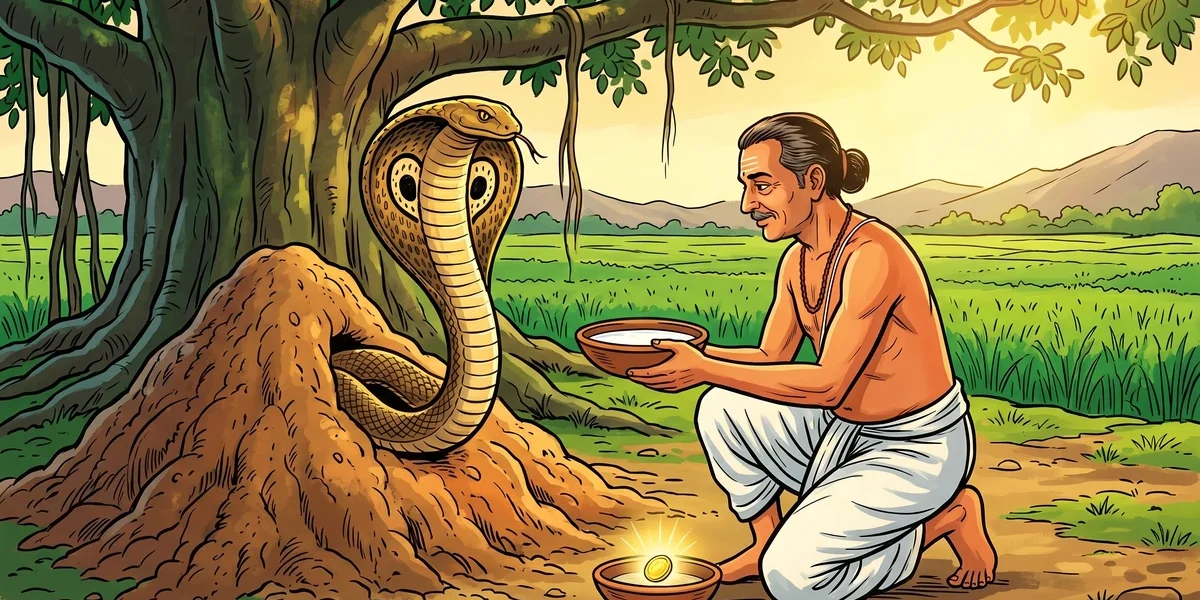
Every morning, the farmer brings milk to the anthill. Every morning, the great serpent who lives there leaves a gold coin. This is not magic; it is economics — the economics of a gift relationship, in which regular, respectful offering produces regular, generous return. Then the farmer dies, and his son looks at the anthill and thinks: if I kill the serpent, I can take all the gold at once. The Panchatantra, which is rarely sentimental, records the predictable result. The serpent bites him; he survives, but the relationship is over. No more gold. The story of the Gold-Giving Serpent is, at its root, a lesson in the difference between a sustainable relationship and the logic of extraction that destroys it.
I. The Naga as Guardian-Creditor: Serpent Ecology in Indian Thought
The serpent in Indian religious and folk imagination is not simply a dangerous animal. It is a being of the underworld with specific relationships to water, fertility, and the wealth that the earth holds below its surface. The naga (divine serpent) guards the anthill, the well, the tree, and the field — and the relationship between a human household and its local naga guardian is a relationship of reciprocal obligation, not mere supplication. The farmer who honours the naga with milk offerings is not begging; he is maintaining a contractual relationship whose terms — regular offering in exchange for regular blessing — are understood by both parties.
This ecological understanding of the naga relationship has deep roots in Indic thought. Agrarian communities across South Asia observed that certain natural sites — old anthills, tree roots, water sources — seemed to be particularly productive or lucky, and they attributed this productivity to the presence of a naga guardian whose goodwill needed to be maintained. The ritual ecology of naga propitiation — milk, turmeric, flowers, the avoidance of disturbing the anthill — is simultaneously a religious practice and a pragmatic land management ethic: treat the productive spots of your land with respect, and they will continue to be productive.
The gold coin that the serpent leaves is the story’s way of making this abstract relationship concrete and quantifiable. In the tale’s symbolic economy, the naga’s gold is not a supernatural gift but the narrated form of agricultural abundance: the household that maintains right relationship with the land’s guardian flourishes materially. The coin a day is the folk tale’s image of steady, sustainable prosperity — modest, regular, reliable, the product of relationship rather than raid.
II. The Son’s Calculus: Extraction vs. Sustained Yield
The son’s error is not greed in the simple sense — it is a specific failure of economic reasoning. He looks at the relationship between his father and the serpent and sees it through an extractive lens: if one coin a day for years is good, then all the coins at once is better. This is the logic of capital extraction — the substitution of a one-time lump sum for a sustained income stream — and it is almost always wrong in precisely the way the tale dramatises.
The extractive logic fails for two reasons. First, it destroys the relationship that was generating the value. The naga does not give gold because gold is lying around waiting to be taken; it gives gold as the expression of a relational good — the goodwill produced by sustained respectful exchange. There is no hoard in the anthill. When the son attacks the serpent, he is not failing to take the hoard; he is terminating the relationship that was producing coins one at a time. The gold stops not because the hoard is empty but because the relationship is over.
Second, the extractive approach transforms the relationship from one of mutual benefit to one of predation, and the serpent — who in this tale has its own agency and its own sense of what is owed — responds accordingly. The son survives the bite, but the relationship does not: he has demonstrated that he is not a partner but a threat, and the guardian withdraws. This is the folk tale’s precise ecological insight: extractive approaches to natural abundance do not merely take what is available; they destroy the conditions that produced the abundance in the first place.
III. The Father’s Wisdom: Patience and the Gift Economy
The father’s conduct in the tale — the daily offering, the patient acceptance of one coin rather than a lump sum, the sustained relationship over years — models a specific economic wisdom that the Indian tradition valorises under the concept of santushti (contentment with what comes regularly) as opposed to lobha (greed for more than what the relationship provides). The father is not passive or unambitious; he is choosing the long-term productivity of a maintained relationship over the short-term appeal of a one-time extraction.
This is the tale’s deepest lesson, and it speaks directly to the agrarian audience for which the Panchatantra was ultimately composed. Farmers who understood their relationship with their land, their water sources, and their local ecosystems as gift relationships — who gave back to the land as regularly as they took from it, who treated natural abundance as something to be sustained rather than extracted — were the farmers whose households flourished across generations. The son who wants to take all the gold at once is the metaphor for every farming practice that treats the land as a mine rather than a partner: productive until exhausted, then silent.
The Panchatantra’s commentary tradition notes that the tale also teaches about the irreversibility of damaged trust. The father does not merely pass on a profitable arrangement to his son; he passes on a relationship — a history of sustained mutual respect whose value is not visible in any single transaction but is embodied in the naga’s willingness to continue the exchange. When the son breaks that trust with violence, no apology or renewed offering can restore it. The serpent returns to its anthill, but not to the relationship. Damaged sacred relationships, like damaged ecological systems, may take generations to restore — if they restore at all.
“One coin a day, honourably given, builds a house. All coins at once, violently taken, builds a grave.”
— Saying from the Panchatantra commentary tradition
Why This Story Lasted
The Gold-Giving Serpent lasted because it accurately describes a dynamic that appears in every domain of sustained productivity: the gift relationship — between farmer and land, merchant and customer, ruler and people, person and tradition — that produces steady return when honoured and terminates when violated. The serpent’s gold is the folk tale’s image of every form of abundance that depends on relationship rather than possession, on sustained exchange rather than one-time extraction.
The tale also lasted because its warning is perpetually necessary. Every generation produces sons (and daughters, and institutions) who look at a functioning gift relationship and see in it an inefficiency — all that wealth tied up in a slow drip when it could be taken at once. The Panchatantra’s answer has been the same for seventeen hundred years: the drip is not the inefficiency; the drip is the relationship. Take the relationship, and the drip stops. That lesson has not become less urgent with time.
What is the moral of The Gold-Giving Serpent?
The primary moral is that sustainable relationships built on regular, respectful exchange produce lasting prosperity, while the attempt to extract all value at once destroys the relationship and eliminates the source of abundance. The farmer’s sustained daily offering maintains a gift relationship with the naga guardian; his son’s attempt to kill the serpent for immediate gain destroys the relationship irreversibly. The tale teaches patience over greed, sustained yield over extraction, and the importance of treating productive relationships with the respect they require to continue.
What is the significance of the naga (serpent) in Indian folk and religious tradition?
The naga (divine serpent) in Indian tradition is a guardian of the underworld and its resources — water, fertility, and underground wealth. Nagas guard anthills, wells, trees, and fields, and the relationship between a human household and its local naga guardian involves reciprocal obligations: regular offerings in exchange for prosperity and protection. This relationship has both religious dimensions (naga propitiation as devotional practice) and practical-ecological dimensions (treating productive natural sites with consistent respect).
How does this tale relate to modern ecological thinking?
The Gold-Giving Serpent anticipates modern ecological concepts like sustained yield and ecosystem services. The naga’s daily gold coin represents the steady productivity of a maintained ecosystem; the son’s attempt to extract all value at once mirrors extractive resource management that depletes the system generating the value. The tale’s core insight — that extractive approaches destroy the conditions that produced the abundance — is a founding principle of sustainable development thinking, though expressed in the folk tradition’s relational rather than technical vocabulary.
Why can the son not restore the relationship after the serpent bites him?
The Panchatantra tradition emphasises that damaged sacred relationships — like damaged trust in any domain — cannot simply be restored by resuming the original behaviour. The son has demonstrated that he is a threat rather than a partner; the naga, who has its own agency and assessment of the relationship, has updated its evaluation accordingly. Even if the son returned to daily milk offerings, the naga would not resume the exchange, because the relationship itself has been violated, not merely paused. This irreversibility is part of the tale’s warning about the cost of extraction.
What is the concept of santushti in Indian ethics?
Santushti (contentment) is a virtue in Indian ethical thought, contrasted with lobha (greed). Santushti is not passivity or lack of ambition but the wisdom to recognise that sustained, modest returns from a maintained relationship are more valuable than the one-time extraction of everything available. The father’s daily acceptance of one gold coin rather than demanding the hoard is an expression of santushti — and the tale frames this not as weakness but as the economic wisdom that builds multi-generational household prosperity while its opposite (the son’s lobha) destroys it.
Frequently Asked Questions
**Q: Why is this story important?**
You May Also Like
 Aesop's Fables
Ages 3-5
Aesop's Fables
Ages 3-5
Valiant Vicky The Brave Warrior
Valiant Vicky The Brave Warrior: Once upon a time there lived a little weaver, by name Victor Prince, but because his head was big, his legs thin, and he was
 Aesop's Fables
Ages 3-5
Aesop's Fables
Ages 3-5
Infant God Krishna Kills Demoness Putana
Infant God Krishna Kills Demoness Putana: Long ago, the kingdom of Mathura was ruled by the cruel king Kamsa. A prophecy had warned him that Devaki’s eighth
 Aesop's Fables
Ages 3-5
Aesop's Fables
Ages 3-5
The King Of Crocodiles
The King Of Crocodiles: Once upon a time a farmer went out to look at his fields by the side of the river, and found to his dismay that all his young green