The Ghost Who Was Foiled
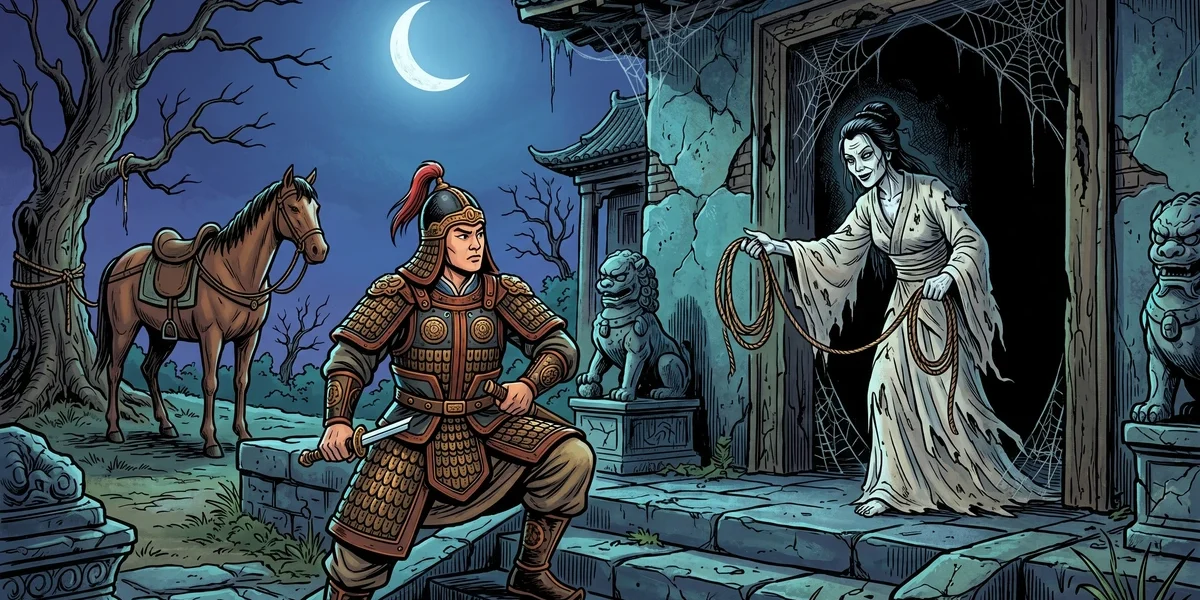
The Ghost Who Was Foiled: There are ghosts of many kinds, but the ghosts of those who have hung themselves are the worst. Such ghosts are always coaxing other
Origin & Tradition
“The Ghost Who Was Foiled” belongs to the vast and richly differentiated tradition of Chinese ghost narratives — stories in which gui (鬼, ghosts) encounter living humans with consequences that illuminate the folk theology of death, the afterlife, and the relationship between spiritual power and human psychology. The story appears in Richard Wilhelm’s Chinesische Volksmärchen (1914) and reflects the classical Chinese understanding that ghost power is not absolute but conditional — specifically, that it is largely dependent on the emotional state of the living person the ghost confronts. Ghost encounters are a staple of the literary supernatural tradition, from the earliest accounts in Gan Bao’s Sou Shen Ji (搜神記, c. 348 CE) through the extraordinary flowering of ghost fiction in Pu Songling’s Liaozhai Zhiyi (c. 1740) and on into the ghost-drama tradition of the Yuan theatre. In all these traditions, the quality most admired in a human confronted by the supernatural is not strength or weapons but dan (膽, courage, gallbladder-fortitude) — the physiological-spiritual capacity to face the uncanny without flinching.
Part I — The Ghost’s Setup
The ghost in this story — as in most Chinese ghost tales — is not a random supernatural predator but a being with a specific relationship to the location it haunts and to the humans it targets. Chinese ghost theology holds that gui arise from those who died with unresolved grievances (yuan, 凫) or without the proper funerary rites that would ensure their passage to the underworld bureaucracy and eventual reincarnation. The ghost remains tethered to the earthly plane by the weight of its unfinished business, haunting the spaces associated with its life or death and seeking either resolution or, in malevolent cases, to extend its misery to the living.
This particular ghost has established a pattern of successful haunting: it has driven previous occupants from a house, terrified travellers on a specific road, or disrupted a particular location through a series of increasingly alarming apparitions. It has learned from these successes. It knows the repertoire of terrifying phenomena — the sudden cold, the inexplicable sound, the shapeshifting form, the face glimpsed in darkness — that reliably triggers human flight, and it deploys these tools with the confidence of a specialist. The stage is set for a confrontation with someone who will not respond according to the established script.
Part II — The Fearless Foiling
The human protagonist who encounters the ghost is distinguished, above all else, by an apparent incapacity for the expected reaction. When the temperature drops, he reaches for another blanket rather than a weapon. When the eerie sound occurs, he investigates rather than flees. When the apparition appears in its most alarming form, he addresses it directly — with curiosity rather than terror, with questions rather than screams. The ghost, accustomed to instant capitulation, finds itself in the uncharted territory of a human who will simply not play its role.
The story’s comedy — and it is genuinely comic in the best versions — arises from the progressive frustration of the ghost’s expectations. Each escalation of supernatural effect is met not with the intended terror but with some form of cheerful, practical, or even contemptuous response that further depletes the ghost’s arsenal. The ghost tries its most frightening face; the human remarks on its appearance with mild aesthetic interest. The ghost produces unnatural cold; the human lights a fire and offers to share it. The ghost attempts physical manifestation; the human, unimpressed, addresses it with the matter-of-fact authority of someone who has seen stranger things before breakfast. By degrees, the ghost’s confident predation collapses into bewilderment and, finally, into a retreat that is essentially humiliating.
The mechanism of the ghost’s defeat is not ritual, not magical objects, not divine intervention — it is simply the human’s refusal to supply the emotional fuel on which ghost power runs. In the most elegant versions of the story, the ghost explicitly acknowledges this: it admits that it has no means of affecting a person who will not be affected, that its power is purely reflexive — that it amplifies and weaponises the fear it finds in its target and is left effectively powerless when no fear is present to amplify.
Part III — Dan and the Physiology of Courage
The Chinese word for courage, dan (膽), literally means “gallbladder.” This is not a metaphor in the casual Western sense but a reflection of Chinese medical theory: in traditional Chinese medicine (TCM), the gallbladder (dan) governs the capacity for decision-making, initiative, and the ability to act under conditions of uncertainty or fear. A person with “big gallbladder” (dan zi da, 膽子大) is courageous; a person with “small gallbladder” (dan xiao, 膽小) is timid. The gallbladder stores jing zhi (精汁, refined bile), which in TCM theory is also the physical substrate of spiritual fortitude — the substance that allows a person to maintain psychological coherence when faced with the destabilising presence of the supernatural.
This physiological dimension of courage explains why the foiling of the ghost is not simply a matter of individual personality but of cultivated bodily-spiritual condition. The fearless hero has, in the Chinese medical-spiritual framework, a well-maintained gallbladder — robust dan qi (gallbladder energy) that prevents the ghost’s cold, disorienting presence from disrupting his physiological equilibrium. Ghosts, in this framework, operate through an attack on the human’s hun (魂, the ethereal soul, associated with the liver-gallbladder axis) — they attempt to dislodge the hun from its proper seat through shock and terror, creating the physical symptoms of ghost encounter: cold sweat, trembling, inability to think clearly, flight. The person with strong dan qi cannot be dislodged; his hun stays seated; the ghost’s attack finds no purchase.
This medical-cosmological framework renders the story’s lesson both more specific and more practical than a simple injunction to “be brave.” Bravery, in the Chinese understanding, is cultivatable — it is a function of one’s physical health, spiritual practice, and moral condition. The Confucian tradition held that the morally cultivated person (junzi, 君子) possesses natural fearlessness not as a separate virtue but as a consequence of integrated self-cultivation: someone who has aligned their inner life with moral order has nothing to be ashamed of and therefore nothing that darkness can exploit. The Daoist tradition similarly holds that the person in harmony with the Tao experiences fear as a signal rather than a state — useful information to be processed rather than an overwhelming condition to be surrendered to.
Part IV — The Ghost’s Lesson
What distinguishes the best Chinese ghost-foiling stories from simple “brave person defeats monster” narratives is their attention to the ghost’s own perspective and the possibility of its redemption. The ghost who is foiled — thoroughly defeated, its arsenal exhausted, its power exposed as the hollow amplification of borrowed terror — frequently undergoes a form of release. Stripped of the pretence of power, the underlying grievance or unfinished business that created the ghost becomes visible. The human who would not be frightened is often also the human who can address this underlying need — who can promise proper burial, intercede with a living family, carry a message, or simply acknowledge the injustice that left the ghost stranded between worlds.
In this reading, the ghost’s foiling is not simply a victory for the human but a form of liberation for the ghost: the terrifying front it has maintained, which prevented any genuine encounter, finally falls, and what is left is not a monster but a person in need. The fearlessness that defeated the ghost now becomes the compassion that resolves it. This double movement — from confrontation to care, from resistance to assistance — is characteristically Chinese in its refusal to simply exterminate the supernatural threat and its insistence on understanding and resolving the social and moral conditions that produced it.
“The ghost had a hundred frightening faces and every one of them worked — until this person, who had met more frightening things in the waking world and survived them all. What can darkness do against someone who has already looked at it and chosen to keep walking?”
Why This Story Lasted
“The Ghost Who Was Foiled” persists because its central insight is experimentally verifiable in ordinary human experience: the thing we dread most is almost always less terrible than the dread itself. The ghost, stripped of the terror it induces, is revealed as something manageable — a grievance, an unresolved situation, a need. The monster under the bed, subjected to the flashlight of calm attention, turns out to be a pile of clothes. This is not to minimise the real dangers of the world, but to identify where the greatest danger usually lives: not in the dark outside but in the dread inside.
The story also persists as a satisfying inversion of power. Ghosts — like all bullies, all tyrants, all sources of illegitimate terror — depend on the compliance of their victims. The person who simply will not comply has discovered the most fundamental form of freedom: the freedom that cannot be taken away because it consists in a refusal rather than a possession. No ghost can haunt the person who will not be haunted; no tyrant can fully rule the person who will not be ruled inside. The foiled ghost is the universe’s reminder that the most powerful weapon against any form of coercive terror is the steady, unimpressed gaze of someone who has decided to look clearly at what is actually there.
You May Also Like
 Chinese Folk Tales
Ages 9-12
Chinese Folk Tales
Ages 9-12
The Dangerous Reward
The Dangerous Reward: Once upon a time a man named Hu-Wu-Bau, who lived near the Great Mountain, went walking there one day. And there, under a tree, he met a
 Chinese Folk Tales
All Ages
Chinese Folk Tales
All Ages
Rose Of Evening
Rose Of Evening: On the fifth day of the fifth month the festival of the Dragon Junk is held along the Yangtze-kiang. A dragon is hollowed out of wood, painted
 Chinese Folk Tales
All Ages
Chinese Folk Tales
All Ages
Kwang-Jui And The God Of The River
Kwang-Jui And The God Of The River: China is a land where the great masses of the people have to toil and struggle incessantly in order to obtain even the bare