The Four Brothers
Four brothers each have different talents: strength, keen sight, speed, and kindness. Together, they prove that teamwork and friendship overcome any challenge.

Four brothers. Four different skills. One impossible task that none of them could accomplish alone. The Four Brothers tale belongs to one of the most widely distributed quest-tale types in world folklore — the story of complementary specialists who must cooperate to achieve what specialisation alone cannot. In the Indian tradition, this tale carries an additional philosophical charge: the question of how different forms of knowledge relate to each other, and whether any single mastery is self-sufficient without the others.
I. The Logic of Distributed Knowledge: Why Four Brothers?
The four-brothers structure is not arbitrary. Across the world’s folk traditions, four represents a minimal complete set — the four directions, the four seasons, the four elements, the four varnas (social functions) of Indian society. A tale about four brothers who each master a different skill implicitly maps those skills onto a complete model of human competence: together, the four brothers are a whole person; separately, each is brilliant but partial.
In Indian versions, the skills typically assigned to the four brothers reflect the major categories of practical and intellectual mastery valued by the tradition. Tracking (the ability to read the natural world’s signs), healing (the ability to restore the body), archery or combat (the ability to act decisively and with force), and craft or construction (the ability to create and repair) are common assignments. These four map, loosely, onto the four goals (purusharthas) of Indian life — artha (acquisition and intelligence), dharma (right action), kama (energy and desire), and moksha (transcendence and restoration). The four brothers are, in this reading, an allegory of the complete human being.
The philosophical point is sharp: each brother’s skill is genuinely excellent — each has gone into the world and mastered his art completely. But each mastery, taken alone, is insufficient for the task the story presents. The tracker can find the problem but cannot solve it; the healer can restore what is damaged but cannot prevent the damage; the warrior can fight but cannot locate what he must fight; the craftsman can create but needs direction. Completion requires all four, working in sequence and in coordination. This is the folk tale’s answer to the ancient question of which knowledge is most important: all of them, and none of them in isolation.
II. The Reunion and the Test: Cooperation Under Pressure
The structural hinge of the Four Brothers tale is the reunion — the moment when the four, who have been developing their skills separately, come back together and encounter the task that will test whether their complementary knowledge can be made to cooperate. This reunion is narratively satisfying because it resolves the tension of the opening separation: the tale begins by dividing what should be whole, and its climax consists of making that whole functional again.
The test the brothers face is almost always one that requires the skills in a specific sequence. The tracker first identifies the situation; the warrior addresses the immediate danger; the craftsman repairs the damage; the healer restores the victim to full health. Each step is necessary; each depends on the previous one being done correctly. This sequential dependency is the tale’s model of how knowledge actually works in practice: not in parallel, each discipline operating independently, but in sequence, each building on what the other has done.
The debate that often follows the brothers’ success — which of us deserves the credit? which skill was most important? — is the tale’s most philosophically interesting moment. Each brother has a legitimate claim: without the tracker, nothing would have been found; without the warrior, nothing would have been saved; without the craftsman, nothing would have been restored; without the healer, the victim would have died anyway. The folk tale typically resolves this debate by refusing to resolve it — by distributing the reward equally, or by having an outside authority declare that the question itself is unanswerable, because all four were necessary.
III. The Indian Philosophical Frame: Chatur-Vidya and the Whole Person
The Indian tradition has a name for the ideal of complete knowledge: chatur-vidya — the fourfold learning, encompassing different domains of knowledge that together constitute wisdom. The specific content of the four varies by tradition: some texts enumerate the four Vedas; others the four goals of life; others the four types of knowledge (sacred, secular, craft, and practical). But the underlying idea is consistent: wisdom is not a single discipline mastered to its depth but a competent engagement with the full range of human knowledge and practice.
The Four Brothers tale is a folk dramatisation of this ideal. The brothers’ reunion and cooperation models what chatur-vidya looks like in practice: not one person claiming all knowledge, but a community of specialists who can communicate across their specialisations and coordinate their different forms of excellence toward a shared goal. This is, in contemporary terms, the folk tale’s model of interdisciplinary collaboration — and the tale’s implicit argument that no discipline can afford to ignore the others if the problems to be solved require all of them.
There is also a darker reading available in some versions of the tale: the debate over credit that follows the brothers’ success can curdle into genuine conflict, fracturing the cooperation that made success possible. When specialisation produces not complementarity but rivalry — when each expert insists on the priority of his knowledge over the others’ — the whole that the four brothers constitute falls apart. This cautionary undertone is the tale’s acknowledgment that distributed knowledge is powerful only as long as the distribution is accompanied by willingness to cooperate, and that the ego of the specialist is as dangerous to collective achievement as any external threat.
“The one who knows all four cannot do what the four who know one each can do together.”
— Saying from the North Indian storytelling tradition
Why This Story Lasted
The Four Brothers tale lasted because the problem it addresses — how to combine different forms of expertise in pursuit of a shared goal — has never become less urgent. Ancient and medieval audiences understood it as a lesson about the division of labour, the value of specialisation, and the necessity of cooperation. Modern audiences can read it as a lesson about interdisciplinary work, team dynamics, and the danger of disciplinary ego. The folk tale’s vocabulary changes; its structural insight does not.
The tale also lasted because it is hopeful in a specific and grounded way. It does not claim that cooperation is easy, or that specialists naturally get along, or that the debate over credit will always be resolved gracefully. It claims only that the task can be done — that the four, if they will cooperate, can accomplish what none can accomplish alone. This is a modest hope but a real one, and real modest hope is among the most durable of folk tale gifts.
What is the moral of The Four Brothers folk tale?
The primary moral is that complementary forms of knowledge and skill, combined in cooperation, can achieve what none of them could accomplish alone. Each brother’s mastery is genuine but partial; only their cooperation makes the impossible task possible. The tale also implicitly warns that the debate over credit — which skill was most important — is both understandable and ultimately unanswerable, since all four contributions were necessary. Cooperation, not rivalry between specialisations, is the tale’s recommended wisdom.
What does the number four represent in folk tale symbolism?
In folk tale symbolism across many traditions, four represents completeness — the four directions, four seasons, four elements, and in Indian tradition the four varnas (social functions) and four purusharthas (goals of life). A group of four brothers each with a different skill implicitly maps onto a complete model of human competence: together they constitute a whole person or a complete society. This symbolic completeness is why four, rather than three or five, is the most common number for the complementary-skills tale type.
What is chatur-vidya in Indian tradition?
Chatur-vidya (literally “fourfold learning”) refers to the ideal of complete knowledge encompassing different domains — variously defined as the four Vedas, the four goals of life (purusharthas), or four types of knowledge (sacred, secular, craft, and practical). The underlying idea is that wisdom is not a single discipline mastered in isolation but competent engagement across the full range of human knowledge. The Four Brothers tale is a folk dramatisation of this ideal: the brothers’ cooperation models what chatur-vidya looks like in practice — different excellences coordinated toward a shared goal.
How is the Four Brothers tale distributed across world folklore?
The complementary-skills brother quest is one of the most widely distributed tale types in world folklore, appearing across South Asia, Europe, the Middle East, and East Asia. The specific skills vary by culture — European versions often feature a tracker, a sharpshooter, a healer, and a thief; Indian versions frequently emphasise tracking, healing, archery, and craft. The common structural feature across all versions is the sequential dependency of the skills in solving the central problem, and the debate over credit that follows the brothers’ success.
What happens when the brothers argue over credit in these tales?
In versions where the brothers’ debate over credit becomes a serious conflict, the tale’s cautionary note becomes prominent: the same cooperation that made success possible is threatened by the ego of the specialist who insists on the priority of his knowledge. Some versions resolve the debate with an outside authority (a king, a sage) declaring all contributions equally necessary; others leave the debate unresolved as a reminder that the question of which knowledge is most important has no good answer. In the darkest versions, the conflict fractures the brothers’ alliance, suggesting that the gains of cooperation can be quickly undone by rivalry over recognition.
Frequently Asked Questions
**Q: Why is this story important?**
You May Also Like
 Aesop's Fables
Ages 3-5
Aesop's Fables
Ages 3-5
An Island and Art, Why? – Stories In Art
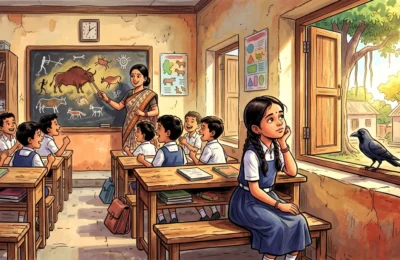
An Island and Art, Why? – Stories In Art: Bhavna sat restlessly on the wooden bench in her classroom, feet hanging in mid-air; she was shorter than most of her
 Aesop's Fables
Ages 3-5
Aesop's Fables
Ages 3-5
The Five Wise Words Of The Guru
The Five Wise Words Of The Guru: Once there lived a handsome young man named Ram Singh, who, though a favourite with everyone, was unhappy because he had a
 Aesop's Fables
Ages 3-5
Aesop's Fables
Ages 3-5
The Lion and the Mouse: Friendship Across Worlds
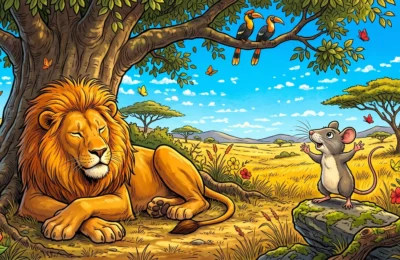
The Lion and the Mouse: Friendship Across Worlds: The savanna stretched endlessly beneath the African sun, a landscape of golden grasses and scattered acacia