The Fisherman and His Wife
A talking fish grants the fisherman's wife ever-greater wishes—cottage, castle, king, emperor, pope—until she asks to rule the sun and loses all.
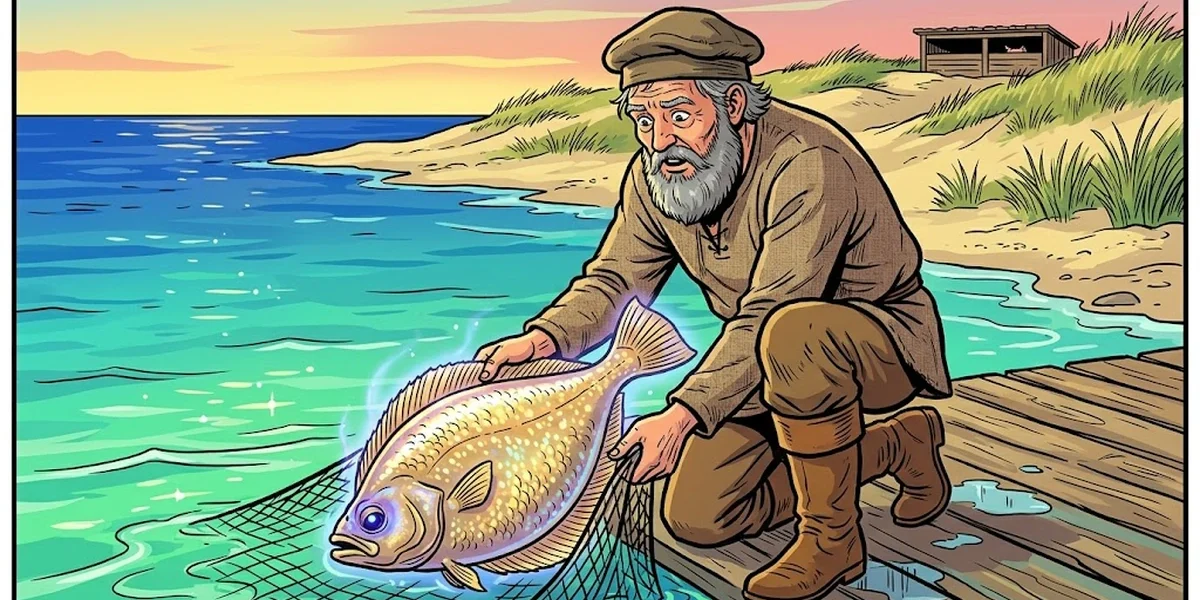
A fisherman and his wife kept house in a pigsty beside the sea. Every day he took his rod to the shore. Once, while he watched the bright water, the float plunged hard; he hauled in and found a huge fish on the hook. The creature spoke: it was no ordinary catch but a prince under a spell, and it begged to be set free in the waves. The fisherman wanted no quarrel with a talking catch; he tossed it back. It shot to the depths and left a red trail on the surface.
Home again, he told his wife about the speaking fish and how he had freed it. She scolded him for asking nothing. Their pigsty was filthy and wretched, she said; he must return and demand a snug little cottage.
He did not much like the business; however he went to the shore. The water looked all yellow and green. He stood at the edge and said:
Fish of the sea,
Come listen to me!
My wife Ilsabill
Wants her own will,
And has sent me here with a wish to fill!
“Well,” said the fish, “what does she want?” “Ah,” answered the fisherman, “my wife says that when I had caught you I ought to have asked you for something; she does not like living in a pigsty any longer; she wants a snug little cottage.” “Go home, then,” said the fish; “she is in the cottage already.” So he went home and saw a snug little cottage with a porch, a bit of garden with flowers and vegetables, poultry, and a cow. His wife stood at the door, took him by the hand, and said, “Come in and see how much better this is than the nasty pigsty.” They went in; there was a neat parlor, bedroom, kitchen, and pantry with all sorts of good things. Outside was a little yard with hens and ducks, and the garden full of fruit and vegetables. “How happy we shall be!” said the fisherman. “We will try to be,” said his wife.
All went well for a week or fortnight; then she said, “Husband, this cottage is far too small, and the yard and garden are so little. The fish might have given us a larger house. Go and tell him we want a great stone castle.” “Wife,” said he, “this cottage is good enough; why should we want a castle?” “Go along,” said she; “the fish will do it readily.” The fisherman’s heart was heavy, but he went. Now the water was quite purple and dark blue and rushed up so high that it frightened him. He stood and said the charm. “Well, what does she want now?” said the fish. “Ah,” said he, “she wants to live in a great stone castle.” “Go home; she is standing before the door.” He went, and there stood a great stone castle. His wife was at the gate; she took him by the hand and they went in. Halls and chambers were hung with rich carpets and crowded with golden chairs and tables; servants waited; the pantry and kitchens were full of everything good. Under the house were stables for horses and cows; in the courtyard all kinds of carriages; in the garden flowers and trees and fruits and a park half a mile long with deer and rabbits and flocks. “Is this not very fine?” said she. He said yes, and they should stay there and be happy. “We will think about that,” she said.
Next morning as she woke she stared from the bed at the fine country and said they must be king—ask the fish. He said he did not want to be king; she said if he would not be, she would. He went; the sea was darkish gray and smelled foul, and the waves rushed high. He repeated the charm. “What does she want now?” “Alas,” he said, “she wants to be king.” “Go home; she is king already.” He found a palace with a soldierly guard at the gate; within, marble halls and golden ornaments; his wife sat on a high throne of gold and diamonds with a golden crown and a sceptre, and on each side stood ladies-in-waiting. He looked at her and said, “Wife, are you now king?” “Yes,” said she. “Well,” he answered, “it is a fine thing to be king.” “I am king,” she said, “and I am not happy; I must be emperor.”
He begged her to stay king—they would wish for nothing further; she stormed that she would be emperor and he must go. He went with a heavy heart. The sea was black and piled into great waves; a sharp wind blew; he was frightened and said the charm. “What does she want now?” “Alas, she wants to be emperor.” “Go home; she is emperor already.” He found her on a loftier throne with a greater crown, princes and dukes for servants. He said it was a fine thing to be emperor. She said she was still not content—she would be pope. He cried that pope was next to God; she would not listen. He went. The wind tore, the hills shook, trees fell, the sky was black with storm, and the sea ran in black waves with crests of foam. He could scarcely stand, yet called the charm. The fish made her pope. He found her in a vast cathedral on a papal throne, with kings kissing her slipper.
He thought they would stop now. But at night she saw the moon rise and said she must make the sun and moon rise and set at her command—she would be like God. He fell on his knees and begged her not to ask that; she drove him out in a fury. At the shore a great storm was up: the houses and trees tossed, hills moved, rocks rolled into the sea, the sky was black with thunder and lightning, the waves mountains high with crests of foam like the mast of a ship. He could hardly hear himself, yet cried the charm. “What does she want now?” said the fish. “Alas,” he said, “she wants to be like God.” “Go home,” said the fish; “she is sitting in her old pigsty.” And there they are living to this very day.
Where this story comes from
The Brothers Grimm published this German tale in Low German as Von dem Fischer un syner Fru; it is number 19 in Margaret Hunt’s 1884 translation and is not an Indian story. The English text followed here is the Project Gutenberg version based on Edgar Taylor and Marian Edwardes.
The Grimms’ note says it was written down in the Pomeranian dialect by the painter Runge of Hamburg and sent to them by Arnim as early as 1809. In Hesse they heard a shorter form about little Husband Domine and little Wife Dinderlinde, whose wish-granting fish also sends them back where they started.
Read the original: Grimms’ Fairy Tales, tr. Edgar Taylor and Marian Edwardes (Project Gutenberg #2591, The Fisherman and His Wife)
Best for ages 6–8 with an adult reading aloud: repeated wishes, frightening storms and a couple’s conflict. Discuss the difference between needing safe shelter and demanding unlimited power.
Reading the story closely
The first wish answers an actual need: the couple live in a filthy shelter. Later wishes move from comfort to status, and finally to control over the sun and moon. Treating every wish as equally greedy would miss that progression. The sea registers the escalation before the fish refuses, while the fisherman repeatedly objects but still carries each request.
Draw one strip of sea for each visit and label it with the wish, using the text’s changing colors and movement. Mark the point where a wish starts determining other people’s lives. Then consider the ending: both spouses lose their home, although their roles in asking were different.
Talk about it
- How does the sea change each time the fisherman goes back to the fish?
- Why do you think the fisherman keeps doing what his wife asks, even when he is frightened?
- If you could ask the magic fish for just one thing, what would it be, and why would you stop there?
Related stories
- The Goose That Laid Golden Eggs — an Aesop fable about wanting more and more and losing everything
- The Golden Bird — a Grimm prince who keeps ignoring good advice and pays for it
- The Turnip — two Grimm brothers, a giant turnip and a lesson about greed and envy
Frequently Asked Questions
What did the talking fish grant?
Why did the wife lose everything?
Where did the fisherman and his wife end up?
You May Also Like
 Grimm's Fairy Tales
Ages 9-12
Grimm's Fairy Tales
Ages 9-12
Lily and the Lion
Lily asks only for a rose in winter; her father steals one from a lion's garden—and she must follow her enchanted husband through seven years of wandering.
 Grimm's Fairy Tales
Ages 9-12
Grimm's Fairy Tales
Ages 9-12
The Wedding of Mrs Fox: First Story
An old fox fakes death to test his wife; only a nine-tailed suitor is accepted—until he leaps from under the bench with a cudgel.
 Grimm's Fairy Tales
Ages 9-12
Grimm's Fairy Tales
Ages 9-12
Hansel and Gretel
Abandoned in the forest, Hansel and Gretel find a house of bread and sugar—and Gretel turns the witch's own oven against her.