Sun Moon And Wind Go Out To Dinner
An Indian folk tale where Sun and Wind's selfishness brings curses while Moon's kindness earns eternal blessings.
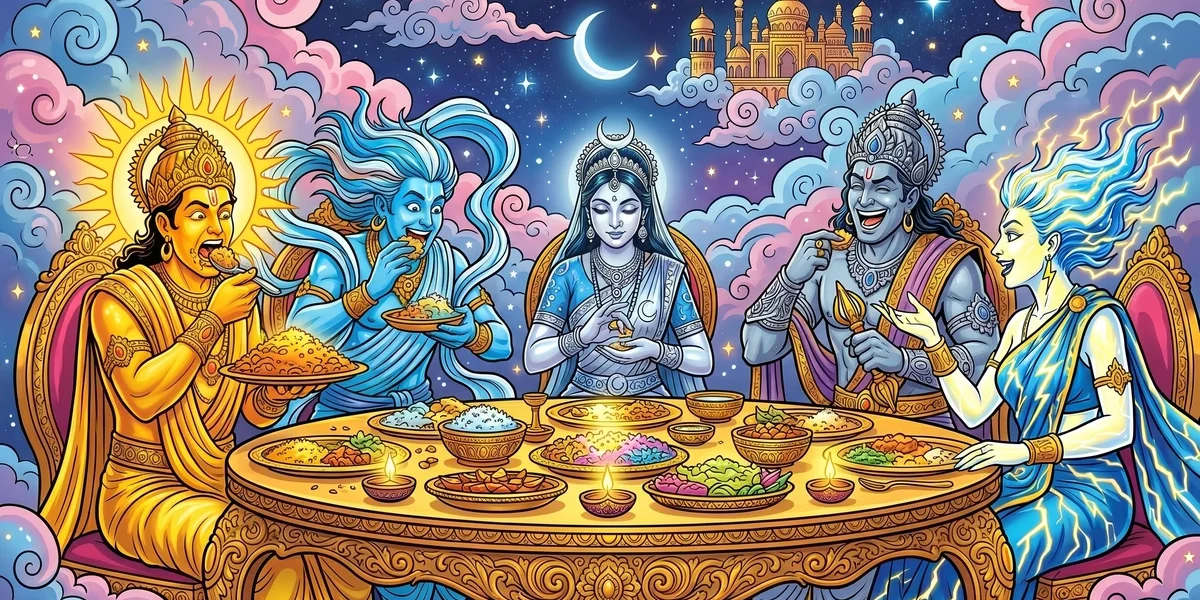
Sun, Moon, and Wind Go Out to Dinner: Celestial Kinship and the Ethics of Remembered Sharing
The Personification of Celestial Forces: A Cross-Cultural Tradition
The personification of natural forces — sun, moon, wind, rain, thunder — as beings with personalities, relationships, and moral character is one of humanity’s oldest and most persistent narrative strategies. In the Vedic tradition, the sun (Surya), moon (Chandra/Soma), and wind (Vayu) are among the most ancient and important deities, each with their own character, mythology, and ritual significance. Surya is radiant and sometimes harsh; Chandra is associated with the cool, the reflective, and the rhythmic cycle of time; Vayu is associated with breath, prana, and the invisible but pervasive force of life.
The South Indian folk tale of Sun, Moon, and Wind going to dinner takes these cosmic forces and places them in an entirely domestic and human frame: they are siblings, they have a mother, they go out for a meal together, and their behavior at that meal has consequences — both for each other and for the observable phenomena of the natural world. The tale belongs to a widespread type of etiological story — a story that explains why things in the natural world are the way they are — but it frames the explanation through a moral lesson rather than through cosmological conflict.
The domestication of cosmic forces in this tale is not trivialisation — it is one of folk literature’s characteristic strategies for making the vast and impersonal comprehensible and morally legible. The sun is not merely an astronomical object; it is a being with a character that we can evaluate. The moon is not merely a satellite; it is someone who remembers their absent mother and saves food for her. The wind is not merely a meteorological phenomenon; it is someone who fails to remember. In this way, the tale teaches children to read the natural world as morally inhabited — as a space in which character is expressed and consequences follow from choices.
The Dinner and the Omission: What Was Forgotten and Why It Matters
The tale’s narrative is built around a meal and what the three siblings do with the experience of that meal. They go out to dinner — in some versions, at a great feast; in others, at a simpler gathering — and they eat. The question the tale poses is: do they think of their mother, waiting at home? Do they bring something back for her? Do they remember, in the midst of their own pleasure, that someone who matters to them is absent from that pleasure?
In the tale’s structure, the Sun and Wind eat their fill and bring nothing home. The Moon, alone among the three, saves a portion for their mother. When they return, the mother asks each what they have brought her. The Sun and Wind have nothing. The Moon offers what was saved.
The moral logic of the tale is about the quality of presence in the midst of pleasure: the Sun and the Wind, in the full enjoyment of the feast, did not carry their absent mother in their minds. They were not, in this specific sense, fully present to their own family — their pleasure was complete and self-contained, undisturbed by the thought of what the mother at home might be missing. The Moon’s portion for the mother represents something different: a form of love that does not forget its objects when other pleasures are at hand, that carries the absent person as a continuing presence even in their absence.
“The Moon remembered. In the midst of feasting, in the midst of all that brightness, it held one small thought: there is someone at home who has not eaten. This is what love looks like when no one is watching — not grand, just attentive.”
The Mother’s Justice: The Star-Children as Consequence
The tale’s denouement involves the mother’s response to the Sun’s and Wind’s forgetfulness, and its cosmological consequences. In the traditional telling, the mother curses the Sun: because he shone so brightly and ate so much without thinking of her, his children — the sunbeams — shall always be so fierce and scorching that no one will want to hold them. This is why the sun’s light is too harsh to look at directly, too hot to hold or approach. The Sun’s thoughtlessness has been encoded in his relationship to his own offspring.
The Wind is similarly cursed: because he blew about and ate without remembering, his children shall be unwelcome — people will turn away from the wind’s children as they turn away from the wind itself. And the Moon, who remembered and brought food, is blessed: her children shall be soft and cool and beloved, and people will always be glad to see them. The stars — the Moon’s children — are mild and beautiful, jewels in the night sky that no one finds harsh or unwelcome.
This etiological structure — the explanation of natural phenomena through ancestral moral choices — is characteristic of many of the world’s most ancient stories. The stars are gentle because the Moon was thoughtful; the sun’s rays are harsh because the Sun forgot. The moral order and the natural order are not separate in this cosmology: they are the same order, and the character of the celestial beings has left its mark on the character of the natural world we inhabit.
Filial Piety and Matritva: The Moral of the Remembered Share
The tale’s moral centres on what Indian tradition calls matritva — the quality of the relationship with the mother, specifically the acknowledgment of the mother’s foundational care and the ongoing obligation of gratitude it creates. In virtually every Indian philosophical and social tradition, the relationship to the mother is regarded as the paradigmatic relationship of unconditional giving and the archetypal site of the obligation of gratitude. Manusmriti declares: “The teacher is worth ten teachers; the father worth a hundred teachers; but the mother is worth a thousand.” The mother’s gift — gestation, birth, nursing, care — is so foundational that it cannot be fully repaid; the child’s response to it is a lifelong orientation of honour and attention.
The Sun and Wind have received this foundational care and forgotten it in the moment of feast. The Moon has received the same care and carried it with them into the feast — not allowing the pleasure of the present to dissolve the ongoing obligation of the past. This is what the tale valorises: not grand gestures of filial piety but the small, continuous, habitual acts of attention to those who have given us what we most fundamentally needed. The portion saved at the feast is a small thing; the quality of character it represents is the largest thing there is.
For children, the story works on a simple and immediately accessible level: remember the people at home when you are enjoying something they are missing. Bring something back. Don’t let pleasure make you forget. The cosmic scale of the tale — Sun, Moon, Wind, stars — makes this lesson feel important rather than merely polite. The children who hear this story know, on some level, that the Moon’s thoughtfulness is written in the night sky as the gentle light of stars, and that this is a dignity worth aspiring to.
Why This Story Lasted
Sun, Moon, and Wind Go Out to Dinner has been told and retold across generations of South Indian families because it does something rare and valuable: it anchors a moral lesson in a cosmological observation, turning the night sky into a continuous reminder of a human virtue. Every time a child looks at the stars and is told they are the Moon’s children — soft and cool and beloved because the Moon remembered its absent mother — the lesson is reinforced without lecture. The story makes the sky into a moral teacher, and keeps the teaching alive as long as there are stars to look at. Few stories are as economically and permanently effective as this.
Frequently Asked Questions
Where does the story of Sun, Moon, and Wind Going to Dinner come from?
The story was recorded by Mary Frere in her 1868 collection “Old Deccan Days, or Hindoo Fairy Legends Current in Southern India” — one of the earliest scholarly collections of South Indian folk tales. Frere collected the stories from her family’s Indian servants and associates in the Deccan region (modern Maharashtra, Telangana, Karnataka). The Sun, Moon, and Wind tale is one of the collection’s best-known stories and has been widely anthologised since. Its oral roots likely extend considerably further back than the 1868 recording.
Why does the Moon save food for the mother while the Sun and Wind do not?
The tale does not explain the reason for the difference — it simply observes it, which is the characteristic method of folk etiological tales: they explain what resulted from a difference in character, not why the characters differ in the first place. The Moon’s thoughtfulness is presented as an inherent quality that the Sun and Wind lack. In the tradition of celestial personification, the Moon is often associated with qualities of reflection, coolness, and cyclic attentiveness (the Moon’s changing phases are themselves a form of regular remembering and forgetting, waxing and waning), while the Sun is associated with directness and intensity and the Wind with restlessness and movement — qualities that are consistent with their respective forgetfulness and attentiveness in the tale.
What is an etiological tale and how common are they in Indian folk tradition?
An etiological tale (from the Greek aitia, “cause”) is a story that explains the origin or nature of something in the natural or social world — why the sky is blue, why the tiger has stripes, why the crow is black, why the stars are soft and the sun is harsh. Etiological tales are extremely common in Indian folk tradition, appearing in regional story collections, in the Puranas, and in the great epics. They serve both educational and cosmological functions: they make the natural world comprehensible by attributing its features to the choices and character of the beings who shaped it, and they reinforce moral lessons by grounding them in observable natural phenomena that the child will encounter throughout their life.
What does the story teach about sharing and family obligation?
The story teaches that the capacity to remember absent others in the midst of one’s own pleasure is a mark of genuine love and character. The Moon’s saving of food for the absent mother is presented not as an extraordinary sacrifice but as the natural expression of a loving disposition — the simple habit of carrying the people who matter to you with you even when they are not physically present. The mother’s reward of the Moon and punishment of the Sun and Wind makes explicit that this quality has lasting consequences: characters formed by remembering or forgetting their obligations to those who care for them become beings who are either welcomed or avoided. The lesson is both intimate (remember your family) and cosmic (this quality shapes who you become).
How can parents use this story to teach children about consideration for others?
The story is particularly effective as a teaching tool because it combines an engaging narrative (celestial siblings going to a feast) with a permanently visible reminder (the stars in the night sky). Parents can use the story by connecting it to specific everyday situations: when a child comes home from a party or a meal at a friend’s house, asking “did you bring anything back for someone who couldn’t come?” or “did you think about anyone who was missing the fun while you were enjoying yourself?” The story makes the habit of remembered sharing feel connected to something beautiful and enduring rather than being a mere social obligation — which makes it more likely to become an internalized value rather than an externally enforced rule.
Frequently Asked Questions
**Q: Why is this story important?**
You May Also Like
 Aesop's Fables
Ages 3-5
Aesop's Fables
Ages 3-5
Celebrating Shakespeare Shakespeare Pays A Visit To Globe Theatre
Celebrating Shakespeare Shakespeare Pays A Visit To Globe Theatre: It had been four hundred and fifty years or was it more? Shakespeare had for gotten. Living
 Aesop's Fables
Ages 3-5
Aesop's Fables
Ages 3-5
The King and The Drum – An Indian Folktale
The King and The Drum – An Indian Folktale: Long ago there lived a king somewhere in the central part of India. He was very proud of his looks. He spent hours
 Aesop's Fables
Ages 3-5
Aesop's Fables
Ages 3-5
Boy Cried Wolf
An Aesop's Fable story. A boy's cries of wolf are ignored when the wolf finally comes. Lies destroy trust forever.