Sim Chung
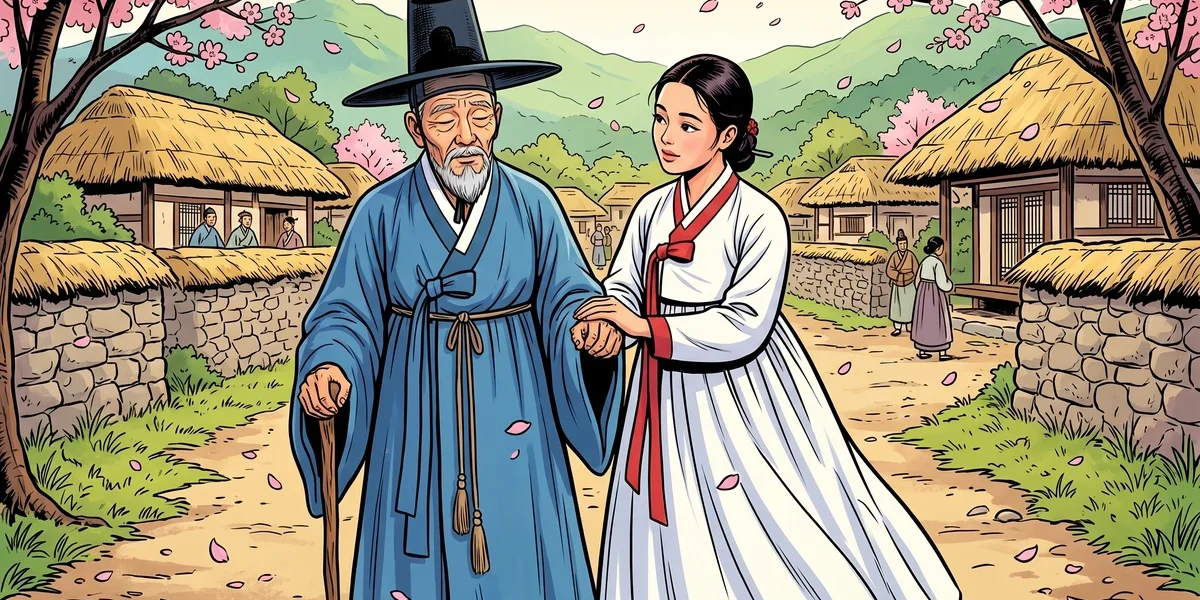
Sim Chung: THE DUTIFUL DAUGHTER. Sim, was highly esteemed in the Korean village in which he resided. He belonged to the Yang Ban, or gentleman class, and when
The Daughter Who Gave Everything and Lost Nothing
Among the five great pansori works of Korean literary tradition, Simcheongga — the Song of Sim Cheong — occupies a position of particular emotional centrality. It is the story most likely to make audiences weep, and it has been doing so for centuries. This is not because it is a tragedy — it ends in restoration and reunion — but because the path to that restoration runs through a sacrifice so complete, so willingly undertaken, so utterly devastating in its particular kind of love, that the resolution it earns can only be understood as cosmic acknowledgement: the world restoring what the world could not afford to let go.
Sim Cheong is a blind man’s daughter. Her father, Sim Bong-sa, lost his sight before her birth; she was raised by him alone after her mother’s early death, and the love between them has been shaped by mutual dependence and mutual devotion across the full course of her young life. When Sim Bong-sa, in a moment of spiritual desperation, promises three hundred sacks of rice to a Buddhist temple in exchange for restored sight — a promise he immediately recognises he has no means to fulfil — his daughter makes the decision that drives the rest of the story: she will provide the rice. The only way she can do so is by selling herself.
Beat I — The Economy of the Impossible Vow
The structural engine of the Sim Cheong story is a promise made before the means to fulfil it existed. Sim Bong-sa’s vow to the temple is impulsive, born of longing rather than calculation. He knows the moment it leaves his mouth that he has committed to something beyond his capacity. In Joseon’s religious ecology, such a vow was not merely a statement of intention but a contractual obligation with the divine — its breach would carry spiritual consequences that further darkened an already difficult existence.
Sim Cheong does not berate her father for his imprudence. She receives the information of the vow and the scale of the offering — three hundred sacks of rice — and begins, quietly, to consider what she has available. The accounting she arrives at is stark: she has her labour, her care, her presence, and her body. None of these, in the ordinary economy of a poor household, are worth three hundred sacks of rice. But the extraordinary economy of sacrifice — the value assigned by those who need the sacrifice — offers another calculation.
She learns that sailors who must cross a particularly dangerous sea passage perform ritual offerings to the sea god — and that the most efficacious offering, the one most likely to ensure safe passage, is a young woman. The sailors will pay three hundred sacks of rice for such an offering. Sim Cheong makes the arrangement. She does not tell her father until the transaction is complete and the time of departure is close. When she tells him, his grief is absolute. Hers, the narrative is careful to note, is equally absolute — but differently contained. She has already made the decision. What remains is to hold it.
Beat II — The Descent and What It Revealed
The moment of Sim Cheong’s entry into the sea is the moral and emotional pivot of the entire story. She stands at the prow of the boat, the sailors waiting, her father’s sight purchased and secured in the sacks of rice already delivered to the temple. The narrative lingers here — in the pansori performance, this moment receives its longest and most elaborately ornamented musical passage — because what is happening is not merely the death of a young woman but the completion of an act of love so thoroughgoing that it has used up every resource available to the one who performs it.
Sim Cheong jumps. Or rather, she steps. The distinction matters in the story’s moral logic: she does not fall, does not hesitate at the edge and then lose her footing. She chooses, with full awareness of what she is choosing, to give herself entirely. The completeness of the gift is what the story identifies as its cosmically significant quality. A love that gives most of itself, holding something back in reserve, is a finite love operating within ordinary moral economy. A love that gives everything — holding nothing in reserve, not even the self that is doing the giving — has exited the ordinary moral economy entirely and entered a domain where different principles operate.
What happens next in the narrative is presented as supernatural but is understood in the story’s logic as consequential rather than arbitrary: the sea god, moved by the completeness of what has been offered, does not allow it to be wasted. Sim Cheong is received into the underwater palace, tended by sea spirits, and eventually returned to the surface world inside a great lotus flower, which is sent as a gift to the king. She becomes queen. Her father, whom she has not seen since her descent into the sea, is eventually found among the blind men invited to a royal feast — a feast organised specifically to find him, because she has not forgotten the original purpose of her sacrifice. When he hears her voice, when he recognises her presence, his sight returns. The transaction that began with three hundred sacks of rice has resolved into something no amount of rice could have purchased.
Beat III — Hyo and the Logic of Complete Sacrifice
The concept of hyo (효) — filial piety — is the founding Confucian virtue in the Korean ethical tradition. The first and most fundamental of the five relationships (father-son, ruler-subject, husband-wife, elder-younger, friend-friend) is the parent-child bond, and the child’s obligation of respect, care, and devotion to the parent is the moral bedrock on which all other obligations are built. Hyo in its ordinary expression is demanding enough: sustained attentiveness to the parent’s needs, subordination of one’s own comfort to the parent’s wellbeing, the maintenance of the relationship through all the difficulties that family life generates over time.
But the Sim Cheong story is not about ordinary hyo. It is about hyo taken to its logical extreme — to the point where the child has nothing left to give. This extreme is identified in Korean folk tradition as cosmically efficacious in a way that ordinary virtue is not. The principle is not unique to Korean tradition — variants of it appear across world religious and folk literatures — but the Korean formulation is distinctive in its emphasis on the completeness of the self-expenditure rather than on the dramatic nature of the sacrifice. Sim Cheong’s sacrifice is not spectacular in the sense of being violent or public. It is complete in the sense of leaving nothing in reserve. It is this completeness — the utterly unhedged quality of the giving — that the sea god and the cosmos recognise and respond to.
This logic has a demanding implication for those who receive it: ordinary love — love that gives much but holds something back, that makes significant sacrifices but retains the self — operates in the ordinary moral economy and receives its appropriate ordinary returns. The extraordinary moral economy, in which the cosmos itself becomes responsive, is activated only by the extraordinary sacrifice — the one that uses up not just resources and comfort but the very self that is performing the giving. The story does not recommend this as a general practice. It presents it as a rare and specific truth about what love at its utmost can accomplish.
Beat IV — The Restored Sight and What It Means
The story’s resolution — Sim Bong-sa’s sight returning when he hears his daughter’s voice — is not presented as a miracle in the sense of an unexplained anomaly. It is presented as the completion of a pattern that has been building since the moment Sim Cheong made her arrangement with the sailors. The vow made to the temple, the sacrifice made to the sea, the return through the lotus, the queenship, the feast, the reunion — each step is consequential, one following from the previous through a logic that is moral rather than mechanical. The blindness that began the pattern is the last element to be resolved because it was the last element to be fully addressed by the cascade that Sim Cheong initiated.
In the pansori performance of Simcheongga, the moment of the father’s sight returning is typically the emotional peak of a performance that has been building toward it across hours of singing. Audiences who have heard the story many times still respond to this moment with the specific emotion that Korean tradition calls heung (흥) — a rising joyful exhilaration that carries within it the relief of a long burden set down. The blindness and the sacrifice and the separation and the restoration have all been present throughout; the moment of reunion and sight is when they resolve into a single completed movement.
“What the daughter gave to the sea, the sea could not keep. What love completes, the world must restore.” — Korean reflection on the Sim Cheong legend
The story of Sim Cheong has lasted across centuries of Korean cultural life because it articulates something that ordinary moral language struggles to reach: the specific quality of love that has exhausted its own resources, that has nothing left to calculate with, and that in this exhaustion becomes something other than ordinary virtue — something that the world, the sea, and the cosmos find themselves unable to simply absorb and be done with. The daughter who gave everything becomes the queen who finds everything. The father’s darkness ends in light. The sacrifice that looked like destruction turned out to be the most complete form of preservation available. The story does not explain how this works. It simply shows it, with a clarity that makes audiences weep — and weep again, having heard it a hundred times — because somewhere in the pattern of complete giving and complete restoration, something true about love is being named.
Frequently Asked Questions
What is the moral of Sim Chung?
The story’s central moral is that filial love taken to its completion — to the point where nothing is held in reserve, where the self is entirely expended in the parent’s service — becomes cosmically efficacious in a way ordinary virtue cannot be. Sim Cheong’s sacrifice is not merely admirable; it is the action that initiates the cascade of restoration. The moral also contains a harder teaching: that love which hedges, which calculates what it can afford to give, operates in the ordinary moral economy; only complete giving enters the domain where the cosmos becomes responsive.
What happens in Sim Chung?
Sim Cheong’s blind father vows three hundred sacks of rice to a Buddhist temple in exchange for restored sight — a promise he cannot fulfil. Sim Cheong sells herself to sailors as a ritual sea offering to provide the rice. She is thrown into the sea but is received by the sea god into an underwater palace and eventually returned to the surface world in a great lotus flower, which becomes a gift to the king; she becomes his queen. She organises a feast for blind men throughout the kingdom to find her father. When Sim Bong-sa attends and hears his daughter’s voice, his sight is restored.
What is hyo and how does it function in this story?
Hyo (효) is the Confucian virtue of filial piety — the child’s obligation of respect, care, and devotion to the parent, understood in Korean tradition as the foundational moral relationship from which all others derive. In ordinary expression hyo means sustained attentiveness to the parent’s needs and the subordination of one’s own comfort to the parent’s wellbeing. The Sim Cheong story explores hyo at its extreme: the complete sacrifice of self for the parent’s sake. Korean tradition understands this extreme as cosmically efficacious rather than merely morally admirable — the completeness of the self-expenditure activates a response from the natural and cosmic order that ordinary virtue does not.
Why does the sea god protect Sim Cheong?
In the story’s moral logic, the sea god’s protection of Sim Cheong is not arbitrary supernatural intervention but a consequential response to the quality of what has been offered. The completeness of Sim Cheong’s sacrifice — the utterly unhedged nature of her giving — is what the sea god recognises and responds to. A sacrifice performed reluctantly, or with something held in reserve, or as a calculated exchange for benefit, operates in the ordinary moral economy. Sim Cheong’s sacrifice exhausts its own resources completely; it is this completeness that places it in a domain where the sea’s response — preservation rather than dissolution — is the consequential outcome.
How has the Sim Cheong story influenced Korean culture?
Simcheong-jeon is one of the most widely known and emotionally resonant texts in Korean cultural life, adapted across every available medium — pansori performance, novel, film, ballet, opera — and taught in schools as a foundational work of Korean literature. Its themes of filial sacrifice and cosmic restoration have been invoked repeatedly during periods of national hardship as a framework for understanding collective suffering and the hope of eventual restoration. The character of Sim Cheong has become a cultural archetype for selfless love and the moral power of complete commitment, referenced in everyday Korean speech as shorthand for filial devotion taken to its utmost expression.
You May Also Like
 Korean Folk Tales
Ages 6-8
Korean Folk Tales
Ages 6-8
The Soldier Of Kang-Wha
The Soldier Of Kang-Wha: [The East says that the air is full of invisible constituents that, once taken in hand and controlled, will take on various forms of
 Korean Folk Tales
Ages 6-8
Korean Folk Tales
Ages 6-8
Cursed By The Snake
A proud magistrate kicks over a sacred snake and learns that nature — and the spirit in it — always remembers.
 Korean Folk Tales
Ages 6-8
Korean Folk Tales
Ages 6-8
The Propitious Magpie
The Propitious Magpie: People say that when the magpie builds its nest directly south of a home that the master of the house will be promoted in office.