Retribution
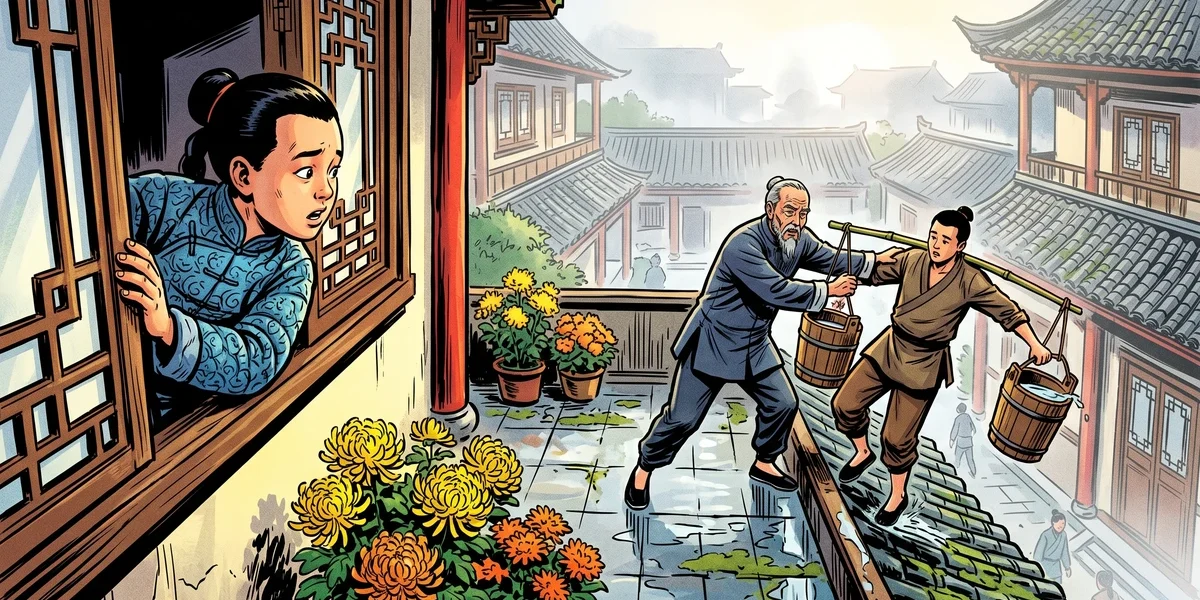
Retribution: Once upon a time there was a boy named Ma, whose father taught him himself, at home. The window of the upper story looked out on the rear upon a
Origin and Tradition
Retribution belongs to the bao ying (報應 — karmic retribution, literally “responding-to-what-was-given”) narrative tradition, one of the most extensive and enduring genres in Chinese popular moral literature. This tradition, which draws simultaneously on Buddhist karma doctrine, Daoist cosmic justice theology, and Confucian social ethics, produced an enormous body of short narratives whose explicit purpose was to demonstrate that evil acts generate inevitable negative consequences — not through the arbitrary intervention of an angry god but through the natural moral logic of the universe, which operates according to principles as reliable as physical law.
The primary literary vehicle for the bao-ying tradition was the shanshanshu (善書 — morality book or “good book”), a genre of popular religious publication that flourished from the Song dynasty through the late Qing period. Shanshanshu compiled bao-ying narratives alongside moral maxims, Buddhist and Daoist teaching extracts, and records of miraculous events to produce comprehensive manuals of popular religious ethics. The most influential examples include the Taishang Ganying Pian (太上感應篇 — Treatise of the Most Exalted on Response and Retribution), attributed to the Daoist deity Taishang Laojun, and the Buddhist-influenced Yuli Chaozhuan (玉歷鈔傳 — Record of the Jade Register), which detailed the administration of karmic justice in the underworld courts of the Ten Kings of Hell.
The Narrative: Evil Acted, Justice Delayed, Retribution Certain
The structure of the bao-ying tale is remarkably consistent across its many variants: an act of moral transgression — cruelty to the vulnerable, betrayal of trust, dishonest appropriation of another’s goods or livelihood, callous disregard for life — appears initially to succeed. The transgressor prospers, at least for a time; the victim suffers; and the apparent injustice of this outcome is presented with enough narrative realism to make the reader feel its full weight. This initial imbalance is not narrative clumsiness but deliberate moral design: the story must establish that the transgressor’s prosperity is genuine and substantial before the retribution that follows can carry its full moral force.
The retribution itself unfolds through several characteristic mechanisms, reflecting the multiple strands of cosmological thinking that the shanshanshu tradition wove together. The Buddhist mechanism is karmic: the evil act creates a moral debt that must be repaid in this life or a future one, through illness, financial ruin, the loss of children, or reincarnation in a state of suffering. The Daoist mechanism is bureaucratic: the underworld courts of the Ten Kings (十殿閻羅, Shi Dian Yan Luo) maintain meticulous records of every human deed, and their functionaries dispatch retribution in exact proportion to the severity of the offence. The Confucian mechanism is social: the person of genuinely evil character eventually reveals himself through accumulated behaviour, destroys the network of trust and relationship that sustained his material success, and finds himself isolated and unprotected at the moment of crisis.
The Cosmic Ledger: Heaven’s Accounting and Its Administrative Machinery
The bao-ying tradition rests on a specific and elaborately developed image of moral causation: the tian cao (天曹 — Heavenly Register) or gong guo ge (功過格 — merit-and-demerit ledger), a cosmic accounting system in which every human deed — including thoughts and intentions — is recorded and eventually balanced. This image, developed most systematically in the Daoist tradition, imagined heaven’s moral administration as a bureaucracy structurally analogous to the Chinese imperial administrative system: with inspectors (shenming, 神明) who record deeds, supervisors who periodically audit the records, and judicial officers who administer consequences.
The God of the Stove (灶君, Zao Jun) — whose image was found in virtually every Chinese household — was believed to ascend to heaven each year at the new year to report on the household’s conduct to the Jade Emperor. The God of the Earth (土地公, Tu Di Gong) maintained local records for his district. The Ten Kings of Hell adjudicated cases that reached the underworld’s courts. This elaborate administrative machinery was not merely metaphorical to Chinese popular religious consciousness; it was understood as a real, functioning system whose workings were occasionally made visible through miraculous events and whose records were permanently and perfectly maintained. The bao-ying tale gave narrative evidence for the system’s operation, providing case studies that confirmed its reliability.
“The net of heaven is vast; its meshes wide — yet nothing slips through.”
— Laozi, Tao Te Ching, Chapter 73; foundational text of the bao-ying tradition
Delay, Generation, and the Long View of Cosmic Justice
One of the most philosophically significant aspects of the bao-ying tradition is its frank acknowledgment of the delay between transgression and retribution — a delay that could extend across multiple generations or lifetimes. This acknowledgment was both theologically honest and pastorally necessary: ordinary observation showed clearly that evil actors often prospered in this life, and any moral cosmology that denied this fact would have been immediately dismissed as naive. The tradition’s response was to extend the timeframe of justice beyond the individual life: what is not balanced in this lifetime will be balanced in future incarnations or in the punishment courts of the underworld.
The most troubling version of this delayed justice involved family retribution (jiazu bao, 家族報): the children or grandchildren of evildoers suffering the consequences of ancestral wrongdoing. While this could seem unjust by modern individualist standards, Chinese cosmological thinking understood the family as a moral unit rather than a mere collection of individuals: the acts of ancestors shaped the moral environment and cosmic circumstances into which their descendants were born, and the consequences of evil ramified through the family network across time. This understanding created strong incentives for moral conduct not merely for oneself but for one’s descendants — the transgressor who might be willing to risk personal retribution was expected to hesitate at the prospect of bringing suffering on his children and grandchildren.
Why This Story Endured
The bao-ying retribution tale endured because it addressed the most fundamental challenge to any morally ordered world-view: the manifest prosperity of the wicked and the suffering of the innocent. Every human culture that believes in a moral order must provide an account of why that order permits, or at least tolerates, the apparent triumph of evil in the short term. The Chinese tradition’s account — patient, systematic, bureaucratically meticulous, operating across generations and lifetimes — was particularly thoroughgoing: it left no loophole, acknowledged no exceptions, and extended its reach beyond death and into future rebirths.
Contemporary scholars of Chinese popular religion, including Barend ter Haar in his study of the Jade Register tradition and C. K. Yang in his analysis of Chinese religious life, have identified the bao-ying narrative as central to the coherence of Chinese moral community across its long history. In the absence of powerful institutional mechanisms for enforcing moral conduct, the shared belief in cosmic retribution provided a functional substitute: the conviction that heaven’s justice would eventually prevail, however long the delay, maintained moral seriousness even in circumstances where earthly consequences for wrongdoing were absent. Retribution is thus not merely a dramatic tale but a theological testimony — evidence submitted to the court of popular belief in support of the claim that the universe is, finally, just.
You May Also Like
 Chinese Folk Tales
Ages 9-12
Chinese Folk Tales
Ages 9-12
The Legend of Nian
The Legend of Nian: Long ago, before the dynasties grew great and the kingdoms sprawled across the land, there existed a creature of terror known as Nian.
 Chinese Folk Tales
Ages 9-12
Chinese Folk Tales
Ages 9-12
King Mu Of Dschou
King Mu Of Dschou: In the days of King Mu of Dschou a magician came out of the uttermost West, who could walk through water and fire, and pass through metal
 Chinese Folk Tales
Ages 9-12
Chinese Folk Tales
Ages 9-12
Yang Gui Fe
Yang Gui Fe: The favorite wife of the emperor Ming Huang of the Tang dynasty was the celebrated Yang Gui Fe. She so enchanted him by her beauty that he did