Re-uniting old friends through social media
Re-uniting old friends through social media: The air was very clear and the long morning shadows distinct through the windows. Rays of sun shining through them

Re-uniting Old Friends: Anagnorisis Digitalis and the Resilience of Genuine Bond
Anagnorisis: The Ancient Art of Recognition
In his Poetics, Aristotle identified anagnorisis — recognition after a period of ignorance or separation — as one of the most powerful devices in dramatic narrative. The moment of recognition, he argued, produces the greatest emotional impact in tragedy precisely because it arrives as a reversal: what was unknown becomes known; what was separate is reunited; what was lost is found. The most famous classical examples are the recognition scenes in Homer’s Odyssey — Odysseus recognised by his dog Argos, by his nurse Eurycleia through the scar on his thigh, and finally by Penelope herself — and the recognition sequences in Sophocles and Euripides, where the discovery of identity resolves plots that have been building for years.
Aristotle classified anagnorisis into several types: recognition through tokens or marks (the scar, the ring), recognition through memory (a shared experience recalled), recognition through reasoning (deduction from available evidence), and recognition through direct sensory encounter (hearing the voice, seeing the face). Each type produces its distinctive emotional quality. The recognition through memory — when two people, encountering each other again, recall a shared past — is perhaps the richest, because it involves not just the discovery of identity but the discovery of what has been preserved across the gap of time.
Social media has created a new context for anagnorisis — what might be called anagnorisis digitalis: the experience of recognising, in a profile picture or a name in a suggested connection, someone from one’s past. The encounter is different from the classical recognition scene in important ways: it is typically asynchronous, mediated by technology, and often tentative (one hesitates before clicking “connect”). But the underlying emotional structure is the same — the moment of recognition, the sudden awareness that a person one had thought lost to time is still in the world, still findable, still potentially recoverable as a relationship.
What Old Friendship Preserves: Memory, Identity, and the Witness of the Past
The reunion of old friends is not merely a pleasant social event. It is, at its depth, an encounter with one’s own past self — an experience of the witness function that long friendship uniquely provides. An old friend knows who you were before you became who you are. They remember the version of you that existed before the accumulating decisions and circumstances that have shaped your current self — before the career, the marriage, the children, the losses, the compromises and achievements that have made you into today’s person.
This is why reunions with genuinely old friends — people who knew you at fifteen, at twenty, at a formative period — often have a quality of coming home that reunions with more recent acquaintances do not. The old friend holds a version of you that you may have half-forgotten; their recognition of you includes recognition of the earlier self, the potential self, the self that was becoming before it had fully become. There is both pleasure and unsettledness in this: pleasure because the earlier self may have had qualities that subsequent experience has diluted; unsettledness because some of what was left behind was left behind for reasons.
The Indian philosophical tradition speaks of smriti — memory, specifically the memory that preserves the connection to one’s origins, one’s teachers, one’s formative influences. Smriti is not mere recall but the living continuity between past and present self. Old friendship is one of the primary vehicles of smriti in adult life: the friend who knew you when reminds you of the thread that runs through your becoming, the continuity that persists beneath the surface changes of identity.
“The friend who knew you before you knew yourself holds a part of you that no one else can hold. When they recognise you again, they recognise something you may have forgotten — and give it back.”
The Technology of Re-connection: Digital Bridge and Human Depth
Social media has genuinely altered the landscape of friendship reconnection in ways that are not reducible to its documented vices (distraction, comparison, approval-seeking). The capacity to find a name from twenty years ago, to see that the person is alive and well and findable, and to reach out with a tentative message — this is a genuinely new human capability, one without a precise historical precedent. The letter was once the medium of reconnection, but it required knowing an address; the telephone required a number; social media requires only a name and a platform, making reconnection possible across separations of time and geography that would previously have been permanent.
This capability has produced real and documented goods: the estranged siblings who find each other, the childhood friends who discover they live in the same city, the mentor and student who were separated by a move and reconnect decades later, the members of a scattered community who reassemble around a shared history. These reunions would not have happened without the technology; the friendships that were recovered would have remained lost.
The challenge that digital reunion creates is one of depth: the initial recognition is immediate, but the reconstruction of genuine friendship is slow. The profile page reveals that someone is alive, findable, and broadly doing what; it does not reveal whether the friendship will survive the encounter with who both people have become. The old friend you remember may have changed in ways that make the old friendship irretrievable. Or — the discovery that sustains the reunion story as a narrative type — they may have changed in ways that make the friendship richer than it was before.
The Resilience of Genuine Bond: What Survives the Gap
The deepest question raised by the reunion of old friends is about the nature of the bond itself: what exactly is it that survives the gap of years, the divergence of life paths, the accumulation of separate experience that makes two people into strangers in so many respects? And why is it that some old friendships can be resumed after decades with an ease and warmth that belies the years of separation, while others — with people one knew just as well — feel irretrievably distant?
Psychologists who study friendship across the lifespan have noted that the friendships most likely to survive long separations are those built on what researchers call “dormant ties” with high original strength — bonds that were formed around genuine shared values, experiences, and mutual understanding rather than mere propinquity or circumstance. The childhood friend you were close to because you lived next door may not survive a reunion; the childhood friend you were close to because you both loved the same things and understood each other’s strangeness probably will.
The Sanskrit concept of suhridam — the true friend, literally “the one with a good heart toward you” — captures something of this distinction. The suhrid is not merely an agreeable companion but a person of genuine goodwill toward one’s deepest self, independent of the immediate circumstances of the relationship. This quality — which is really a quality of character rather than of the relationship’s history — is what survives separation. The suhrid’s goodwill does not expire during the gap years; it waits, dormant but intact, for the moment of reconnection to activate it again.
For children hearing stories about reunion, the lesson is both simple and profound: genuine friendship is a form of commitment that does not require constant maintenance to remain real. The friend who knew you, truly knew you, is still your friend across the years of separation. This is not sentimentality — it is a claim about the nature of genuine knowing, which, once achieved, has a kind of permanence that mere association does not.
Why This Story Lasted
Reunion tales — from Odysseus returning to Ithaca to the prodigal son to the schoolmates who find each other in old age — have persisted across every storytelling tradition because they address one of the deepest human needs: the need to be known, and to be known continuously across time. The reunion story affirms that genuine bonds do not dissolve with distance or time; that the people who truly knew us remain our witnesses even in their absence; and that the moment of recognition — anagnorisis — is among the most emotionally powerful experiences human life offers. Social media has given this ancient story a new vehicle, but the story it tells is one that every generation has told before.
Frequently Asked Questions
What is “anagnorisis” in literary tradition?
Anagnorisis (ἀναγνώρισις) is a Greek term, used by Aristotle in his Poetics, to describe the moment of recognition — typically the discovery of a character’s true identity after a period of ignorance or disguise. Aristotle considered it one of the most powerful elements of tragedy, particularly when combined with peripeteia (reversal of fortune). Classic examples include Odysseus revealing himself to Penelope after twenty years of separation, Oedipus discovering his true parentage, and the reunion scenes in Shakespeare’s late plays. In modern usage, anagnorisis refers more broadly to any moment of significant recognition or discovery of hidden identity or truth.
Why do reunions with old friends feel so different from meeting new people?
Reunions with genuinely old friends invoke what psychologists call the “witness function” of long friendship: the old friend holds a version of you from the past, a knowledge of who you were before you became who you are now. This creates a distinctive kind of recognition that meeting new people cannot replicate — the sense of being seen by someone who knows your history, who remembers the earlier versions of you, and who can reflect back a continuity of identity that newer relationships do not have access to. Research on friendship across the lifespan finds that this “being known” function of old friendship is distinct from and irreplaceable by the pleasures of new friendship.
Can social media truly rebuild deep friendships, or only superficial reconnection?
Social media reliably enables initial reconnection — finding a lost contact and making the first reach — but the rebuilding of deep friendship requires the same things it always has: sustained mutual investment, honest communication, shared experience over time, and genuine mutual interest in each other’s lives. Research on “dormant ties” (relationships that have lapsed but not been severed) suggests that reconnecting with old friends who had strong original bonds can produce surprisingly rapid re-establishment of intimacy — the original knowing is still latent and can be reactivated. But the platform is the bridge, not the destination; the depth of the reunion depends on what the two people choose to build once the initial connection is made.
What is “suhridam” in Indian friendship philosophy?
Suhridam (सुहृदम्) is a Sanskrit term for a genuine friend or well-wisher, literally meaning “one with a good heart toward you.” The concept appears in the Mahabharata, Bhagavad Gita, and Arthashastra among other texts. A suhrid is distinguished from a mere acquaintance or circumstantial associate by the quality of genuine goodwill — the suhrid wishes well for your deepest self, not just your immediate interests. The Bhagavad Gita (5:29) describes Krishna as “the suhrdam sarva-bhutanam” — the true friend of all beings. In human friendship, the suhrid relationship is the rarest and most valuable, and the one most likely to survive the separations that ordinary friendship does not.
What can children learn from stories about reuniting with old friends?
Reunion stories teach children several enduring lessons about friendship: that genuine bonds do not dissolve automatically with distance or time; that the people who truly know us remain our witnesses even in absence; that maintaining friendships takes investment but that genuine friendships can survive periods of dormancy; and that reconnection with old friends is worth the vulnerability of reaching out even after long gaps. More broadly, reunion stories help children understand that their present friendships are investments in their future — that the friends they make genuinely and deeply now may be the ones who know and ground them across the long arc of their lives.
Frequently Asked Questions
**Q: Why is this story important?**
You May Also Like
 Aesop's Fables
Ages 3-5
Aesop's Fables
Ages 3-5
The Close Alliance A Tale Of Woe
A farmer’s bullocks lead him into a crocodile-infested river—a parable of how bad companions drag the virtuous toward ruin.
 Aesop's Fables
Ages 3-5
Aesop's Fables
Ages 3-5
The Magic Fiddle
The Magic Fiddle: Once upon a time there lived seven brothers and a sister. The brothers were married, but their wives did not do the cooking for the family.
 Aesop's Fables
Ages 3-5
Aesop's Fables
Ages 3-5
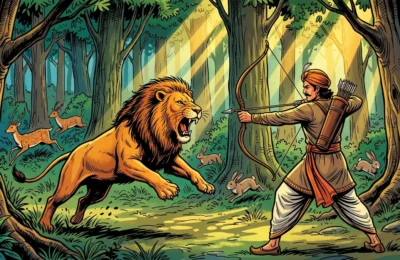
The Bowman And The Lion | Aesop’s Fables
The Bowman And The Lion | Aesop’s Fables: A skilled bowman once decided to go hunting deep in the forest. He was known for his accurate aim and all the animals