Prince Lionheart And His Three Friends
Prince Lionheart And His Three Friends: Once upon a time there lived a King and Queen who would have been as happy as the day was long had it not been for this
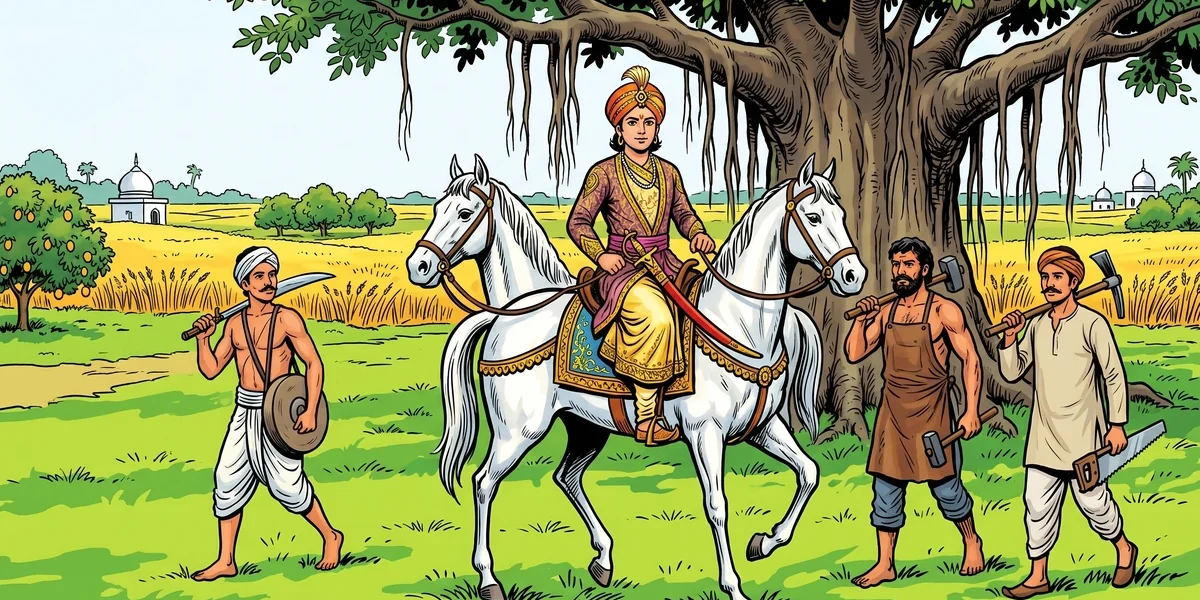
Prince Lionheart and His Three Friends — Panchatantra, Book II: Mitra-samprapti (The Gaining of Friends)
This tale belongs to the tradition of the Panchatantra‘s second book, compiled by Vishnu Sharma around 300 BCE, which is specifically concerned with the conditions that produce genuine, durable friendship — and with the political and personal value of alliances built on character rather than convenience. Prince Lionheart and his three animal companions — a crow, a mouse, and a deer — represent the ideal friendship as the Panchatantra conceives it: cross-species, asymmetric in capacity, formed in conditions of mutual vulnerability, and tested through shared danger. The story echoes the famous Panchatantra frame of Chitragriva (the dove-king), Hiranyaka (the mouse), the crow Laghupatanaka, and the deer Chitrānga — one of the tradition’s most celebrated cross-species friendships.
Beat I — The Prince in Exile and the Friends He Finds
Prince Lionheart was a young ruler’s son who had been sent into the forest by palace intrigue — cast out by jealous ministers before he had come into his inheritance, stripped of guards and attendants, left to navigate a world he had been raised to command but had never been required to survive in directly. The forest was nothing like the palace. Its rules were older, plainer, and less forgiving.
He found his first friend through need: a crow named Subuddhi — “Good Intellect” — who had observed the young prince’s arrival in the forest with the particular attentiveness of an intelligent bird assessing a new element in his environment. The crow saw a young human who was clearly lost, clearly in danger, and clearly not stupid. He approached. They talked, as the Panchatantra allows its animals to talk with humans, and the crow offered what he could: knowledge of the forest, its paths and its dangers, its water sources and its safe resting places. In return he received company, which intelligent animals living alone in forests value as much as humans do.
The mouse came next — Hiranyaka’s kin in character if not in name, a quick, observant creature who lived in a burrow near the prince’s chosen shelter and who had the sharp teeth and sharper mind that made him useful in practical emergencies. The deer followed — a graceful animal who could run faster than anything the forest held, and whose speed became the group’s primary asset in situations requiring escape. Four companions: a prince who could think and plan, a crow who could see from above and counsel from experience, a mouse who could cut bonds and navigate small spaces, and a deer who could outrun any pursuit.
Beat II — The Test of the Alliance
The prince’s enemies from the palace did not forget him. When word came that he was alive in the forest, they sent hunters — skilled trackers with nets and snares designed to take a man alive and return him for the ministers’ purposes. The hunters set their traps on the forest paths and waited.
The crow, flying high, saw the hunters and their preparations from above and returned immediately to warn the group. This is the crow’s function in the alliance: aerial intelligence, early warning, the view that no ground-bound creature can achieve. The group had time to alter their path — but in the altered path, the deer stepped into a snare the crow had not seen from above, hidden beneath leaves at an angle that defeated his angle of view.
The mouse went to work immediately on the snare’s cords — his teeth precise and tireless, cutting through the braided fiber with the methodical speed of an animal who has done this before. While he worked, the crow kept watch from the air and the prince stood guard at the ground level. The deer remained still, knowing from experience that struggling against snares tightens them. The roles the alliance had built through months of shared difficulty operated without instruction: each member did what only they could do.
The deer was freed. The group moved quickly. The hunters arrived at the sprung snare and found nothing but cut cord and tracks leading in four directions simultaneously — a crow’s flight feathers, mouse tracks, deer hooves, and human footprints — a scatter of departure that told them everything about what they were dealing with and nothing useful about where any of it had gone.
Beat III — On the Architecture of Effective Friendship
The Panchatantra is precise about what makes this friendship work. It is not affection alone — though the tale presents genuine warmth among the four. It is the combination of affection with complementary capacity. Each member of the alliance possesses something the others lack: the crow has height and vision; the mouse has access to small spaces and cutting power; the deer has speed; the prince has the planning mind that coordinates the other three. Remove any one of these and the alliance has a gap that cannot be filled by more of the others.
This is the Panchatantra’s argument about friendship in Book II: genuine friendship — the kind worth building and worth maintaining — is not the friendship of similar people who reinforce each other’s existing strengths. It is the friendship of different people whose differences make them collectively capable of things none could achieve individually. The hunters who came for the prince were defeated not by any one member of the group but by the combination — the crow’s warning, the mouse’s teeth, the deer’s speed, the prince’s coordination.
The Arthashastra of Kautilya makes the same argument in terms of alliance-building: a king should seek allies whose strengths complement his weaknesses rather than allies who are simply similar to him. Alliances of similarity create redundancy; alliances of difference create resilience. The prince in the forest, surrounded by creatures nothing like him, is Kautilya’s argument made visible.
Beat IV — What Exile Taught the Prince
Prince Lionheart eventually returned to his kingdom — the Panchatantra does not leave its heroes permanently displaced — and when he did, he carried with him something the palace education had not provided: the knowledge of what genuine alliance looks like when stripped of politics and protocol. In the forest, his friends had helped him because they valued the relationship, not because they feared his power or sought his favour. In the palace, every courtier’s help would be conditional on calculations the prince now knew how to see.
He became, the tale implies, a better king for the exile — not despite the difficulty but because of it. The forest had offered him something courts rarely provide: allies who had nothing to gain from loyalty except the satisfaction of the friendship itself. This experience, the Panchatantra suggests, is the most valuable education available to a prince: to have been helped when he had nothing to offer in return, and to remember what that help looked and felt like.
“The friend who helps you when you have nothing to offer is the measure against which all other friendships are correctly evaluated.”
Why This Story Has Lasted 2,300 Years
Prince Lionheart and His Three Friends endures because it presents friendship not as sentiment but as a working system — four different capabilities, held together by genuine mutual regard, that produce collective outcomes impossible to any of the members individually. The Panchatantra’s genius is to make this visible through the mechanics of survival: the snare requires the mouse’s teeth to open; the approach of the hunters requires the crow’s height to detect; the escape requires the deer’s speed to complete; the coordination requires the prince’s mind to organize. Friendship, here, is not a feeling. It is an architecture. And this architecture, built in a forest among creatures who had nothing to give each other but their complementary capacities and their genuine regard, is the Panchatantra’s answer to the question of what friendship is actually for.
About the Panchatantra
The Panchatantra (“Five Treatises”) was composed by Vishnu Sharma circa 300 BCE as a compendium of nītiśāstra — statecraft, ethics, and worldly wisdom — expressed through interlocking animal and human fables. Book II, Mitra-samprapti (“The Gaining of Friends”), explores the conditions that produce genuine friendship: vulnerability, complementary capacity, mutual help freely given. Translated into Pahlavi in the 6th century CE and subsequently into Arabic, Hebrew, Latin, and all major European languages, the Panchatantra became one of the most widely read books in the pre-modern world.
Frequently Asked Questions
**Q: Why is this story important?**
You May Also Like
 Panchatantra Stories
Ages 3-5
Panchatantra Stories
Ages 3-5
The Turtle that fell off the Stick
The Turtle that fell off the Stick: Never fail to listen to the advice of your friends.” There lived a turtle called Kambugriva in a lake, who had two swans as
 Panchatantra Stories
Ages 9-12
Panchatantra Stories
Ages 9-12
The Story of the Four Learned Fools
The Story of the Four Learned Fools: In a certain town, there lived four Brahmins whohad become great friends. They were all extremely naiveby nature. The
 Panchatantra Stories
Ages 6-8
Panchatantra Stories
Ages 6-8
The Foolish Sage And The Jackal
The Foolish Sage And The Jackal: In a monastery far away from human habitation lived a saint called Deva Sarma. He amassed a lot of wealth by selling clothes