Morozko: The Frost King’s Test
Morozko: The Frost King's Test: Morozko: The Frost King’s Test In a remote village nestled among white birch forests, there lived a widower with two daughters.
Origin: Russian (East Slavic). Recorded by Alexander Nikolayevich Afanasyev (Александр Николаевич Афанасьев) in Народные русские сказки (Narodnye russkie skazki, “Russian Folk Tales”, St Petersburg 1855–1863, tale no. 95). First English translation by W. R. S. Ralston in Russian Folk-Tales (London 1873) as “Frost”; further translations by Leonard A. Magnus, Verra Xenophontovna Kalamatiano de Blumenthal (Folk Tales from the Russian, Chicago 1903), Post Wheeler 1912, and Norbert Guterman in the Pantheon Books Russian Fairy Tales (New York 1945), preface by Roman Jakobson. ATU 480 “The Kind and the Unkind Girls” (Uther FFC 284–286, Helsinki 2004); SUS 480 in the East Slavic catalogue (Barag–Berezovsky–Kabashnikov–Novikov, Leningrad 1979). Stith Thompson motifs Q2 Kind and Unkind, S322.4.2 Cruel stepmother orders stepdaughter to be killed, F420.1.4 Spirit of cold, and D2144.5.1 Magic person produces frost.
The Tale
In a remote village ringed by white birch and silver fir, there lived a widower with two daughters. His first wife had given him a daughter called Marusha — gentle as spring rain, kind as the summer sun, and possessed of that quiet courage which is more rare among the strong than among the weak. But the widower married again, and the woman he brought into his house had a heart as cold as the well stones in January and twice as hard. With her came her own daughter, Masha, vain and idle, who spent her days admiring her reflection in the polished samovar and the bottoms of brass pans.
From the day the stepmother crossed the threshold, Marusha’s life turned bitter as scorched birch bark. While Masha lounged by the great clay stove in fine wool sarafans, Marusha rose before the cockerel to break the ice on the trough, to carry water from the village well, and to scrub the plank floor until her hands cracked. Her stepmother gave her the thinnest gruel and the smallest piece of black bread, yet Marusha never complained. Often she could be heard singing softly as she worked — the old harvest songs her mother had taught her before the second snow took her away.
Into the Killing Forest
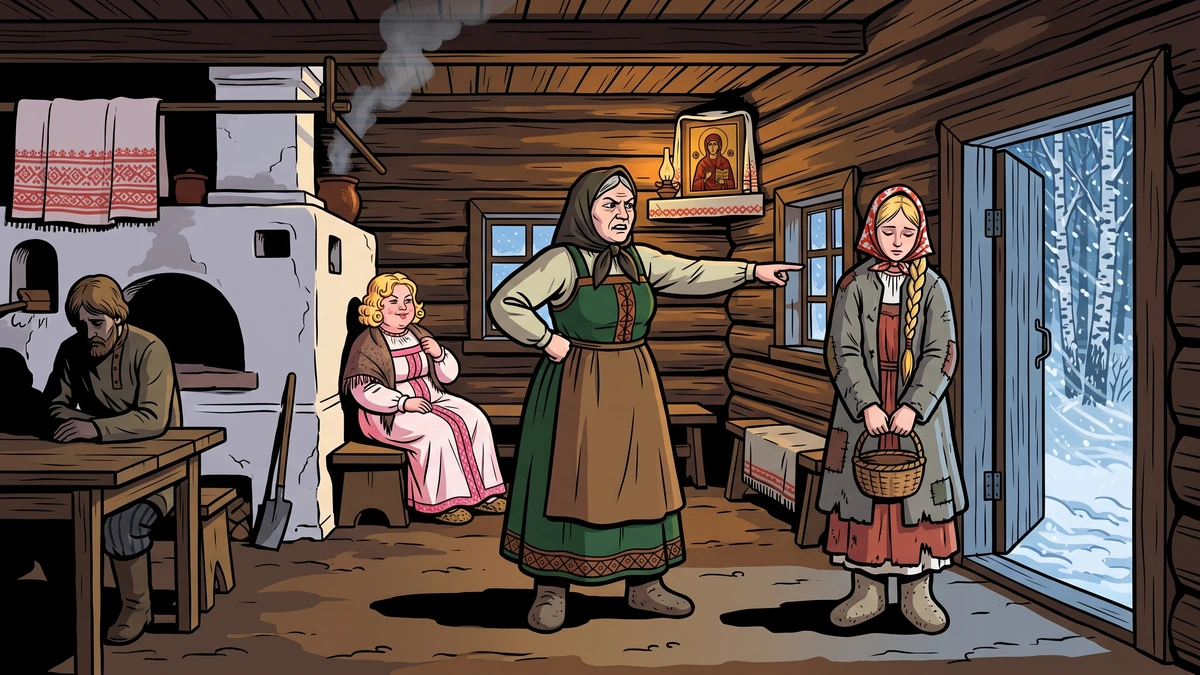
One harsh winter, when the snow lay deeper than memory and the wind howled like wolves at the door, the stepmother’s cruelty reached its terrible peak. “This child eats food needed for her betters,” she declared, her voice dripping false sweetness. “She must go into the forest at dawn to gather cloudberries. If she does not return with a full basket by nightfall, she shall have no supper for a week.” The widower, weakened by old grief and worn down by his second wife’s constant complaints, nodded without protest. As Marusha tied her thin patched coat against the cold, her stepmother whispered, “If you return empty-handed, perhaps you will not need to return at all.”
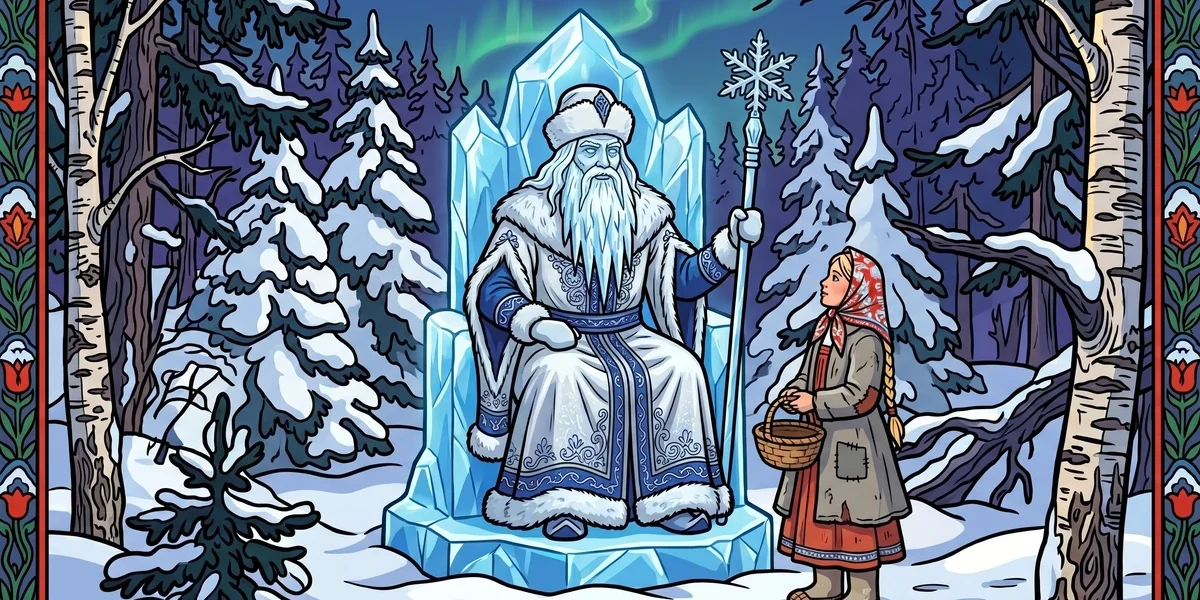
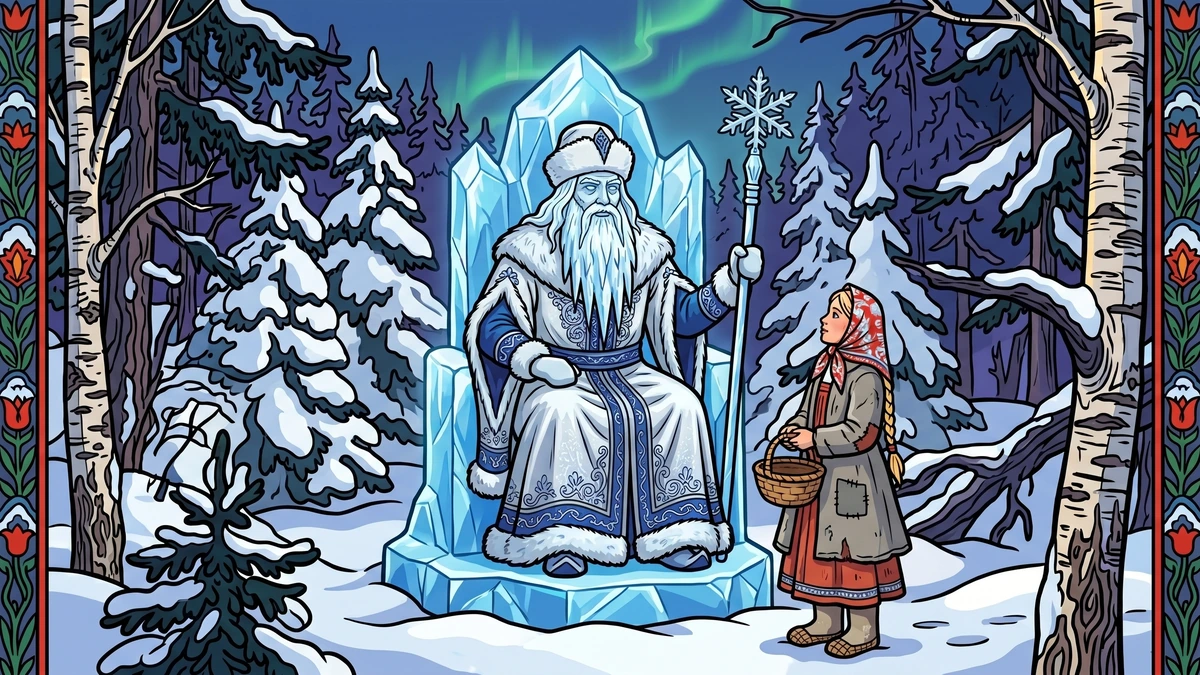
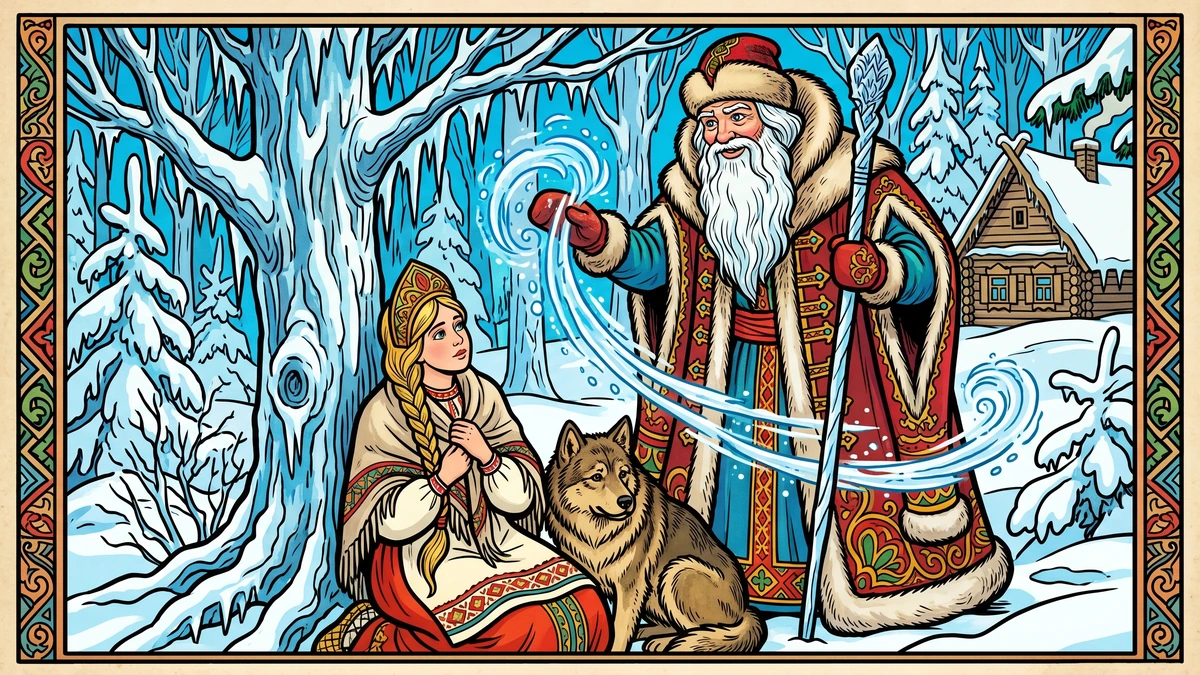
Into the forest went Marusha, where the snow grew deeper with each step, where icicles hung from the fir branches like daggers, and where no cloudberries had ever bloomed in such a season of killing frost. For hours she walked, searching in vain, her fingers turning waxen and her lips blue. As dusk drew its lilac shawl across the snow, she came upon a small clearing where smoke rose strangely from the snow itself. There, seated upon a throne of ice carved from a single glacier, sat Morozko — Морозко, the Frost King himself. His beard was a fall of icicles that chimed in the wind, his eyes were the blue of a frozen lake at midnight, and his crown was a circlet of northern lights that flickered and shifted as he breathed.
“Why do you enter my domain, little mortal?” Morozko asked, his voice like the cracking of ancient ice in spring. “Do you not know that I am death itself to your kind?” Marusha, though trembling, bowed politely. “I do not fear you, King of Frost. My stepmother sent me to gather cloudberries — an impossible task, I know — but I will not return until I have searched every corner of your forest.”
The Three Tests
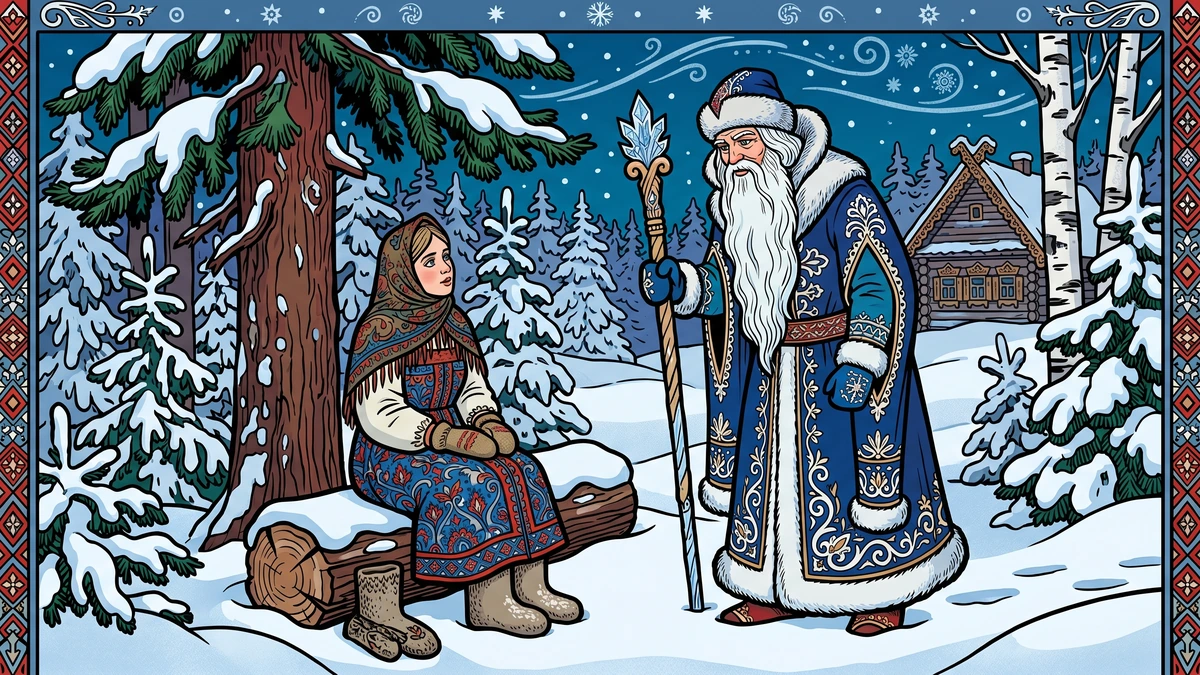
Morozko leaned forward, and his breath turned the air white. “Tell me, child — are you warm enough? Is my presence not unbearable?” Marusha answered honestly: “Your presence is strange, my lord, but not cruel. The true cold in this world comes not from frost and snow but from unkind hearts and bitter words. Your cold at least is honest and pure.” The Frost King smiled, and where his lips turned upward the snow glittered like cut diamonds. The first test had been a test of patience; she had endured it without bitterness.
On the second day she returned, as he had bidden her, and a fierce blizzard arose; visibility fell to a few paces. “Are you afraid, child? Will you not cry out for help?” But Marusha stood firm and said, “I am afraid, my lord, but I trust in you. Your realm is harsh but fair, and I do not believe you will let me perish.” This was the test of faith, the cardinal virtue Afanasyev’s peasant informants associated with the long Orthodox Lenten fasts. She did not flinch.
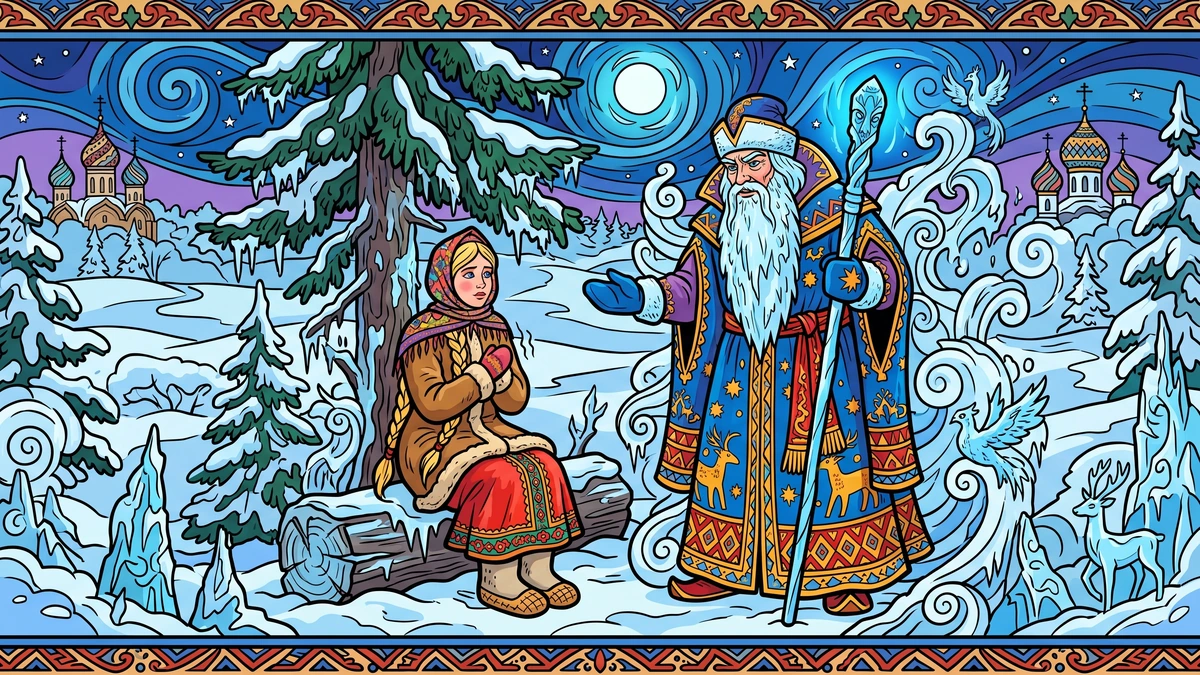
On the third day the Frost King withdrew his protective warmth entirely. Marusha’s lips turned ashen, her breath came in shallow gasps, and frost crept along her thin coat in pale spirals. “Last chance, child,” said Morozko. “Return home now, and I shall trouble you no more. Your suffering ends today.” But Marusha lifted her head with quiet pride. “I thank you for the offer, my lord, but I will not shame myself by fleeing at the final test. You have been just, in your own way. I will see this through.” This was the test of loyalty to one’s word, what Russian peasants called cestnost’ — being whole, unfractured, true.
Reward, Folly, and the Frozen Stepsister
Morozko rose from his throne, and a light brighter than the winter sun blazed forth. “You have passed all three tests, child of courage. Patience under comfort, faith under fear, loyalty under the very breath of death — these are the virtues I honour above all others.” He raised his hand, and a warmth flowed through Marusha’s veins like liquid fire. Her tattered coat became a dress of fine white linen trimmed in sable; her worn lapti slippers transformed into soft kid boots; on her head he placed a crown of ice-white flowers that would never wilt. A chest of silver coin appeared at her feet, and a basket of cloudberries red as winter rubies. “Return to your home,” said Morozko, “and know that I shall watch over you all your days.”
When Marusha came back radiant from the forest, the stepmother’s heart curdled with envy so potent it nearly strangled her. “See what the forest has given to that worthless girl?” she shrieked at her daughter. “Tomorrow you will go and demand even greater treasures!” The next morning Masha set out, dressed in her warmest wool and her finest fur, carrying meat and wine. When she reached the clearing and saw the Frost King upon his throne she laughed aloud. “At last I have found you, old man of the frost! I have come to claim greater gifts than my fool of a sister received. See how beautiful I am? Surely you will wish to reward my beauty.”
Morozko’s eyes grew cold — not the honest chill of winter, but the terrible freezing malice that gathers around a heart proud of its own ice. “You speak as if beauty were a virtue, and as if the world owed you tribute. Tell me, child — are you warm enough?” “Warm?” scoffed Masha. “I am sweltering! Your frost is weak and pathetic!” He inclined his head, and the temperature rose; the snow at her feet turned to slush, and her fine wool clung wet and heavy. Then the cold returned, fiercer than before, and the sweat upon her skin froze to a glassy crust. Through hour after hour the Frost King tested her — heat, then cold, then howling wind, then breath-stopping stillness — and at every turn Masha complained, demanded comfort, insulted him, and refused his courteously offered chances to go home. By dawn the villagers found her at the forest’s edge, frozen as solid as a wayside post, her face twisted into an expression of eternal discontent.
The Father’s Awakening
Marusha’s father, witnessing these events, understood at last the poison his second wife had brought into his home. He drove her from the house with nothing but the clothes on her back, and he asked his daughter’s forgiveness for his long weakness. Marusha, with the gentle kindness that had defined her all along, embraced him and said, “I forgive you, father. Grief makes us weak, and loneliness makes us foolish.” In time she married a kind young woodcutter from a neighbouring village; it was said that at the wedding the Frost King himself sent an honour guard of winter spirits in silver kaftans to bless the union. Marusha lived to a great age, and the basket Morozko had given her never emptied of cloudberries, even in the hungriest year.
Moral
«Что посеешь, то и пожнёшь.»
— Chto poseesh’, to i pozhnyosh’ — “What you sow, that you shall reap.” Vladimir Ivanovich Dahl (Владимир Иванович Даль), Пословицы русского народа (“Proverbs of the Russian People”), Moscow 1862, no. 5031.
The kind girl’s courtesy toward Morozko during her ordeal — though her stepmother had sent her to die — is rewarded with riches and a good marriage; the unkind sister’s pride and ingratitude earn her death by frost. The lesson Afanasyev’s informants stressed is not that suffering is itself ennobling, but that virtue tested in extremity reveals its quality, while pride tested under the same skies reveals only what was always there.
Why This Story Has Lasted
“Morozko” is the textbook Russian specimen of ATU 480, a tale-type Hans-Jörg Uther catalogues in over thirty national traditions, from Sicilian “Catarina the Wise” to Japanese “Hachikazuki” to the Cherokee “Spearfinger” cycle. The Grimm parallel is KHM 24 “Frau Holle” — published Berlin 1812, also a stepmother-tale in which the diligent girl is showered with gold and the lazy girl with pitch. Afanasyev himself, in his 1865–1869 commentary Поэтические воззрения славян на природу (The Slavs’ Poetic View of Nature), identified Morozko as a survival of pre-Christian Slavic winter veneration — the ancient Ded Moroz (Дед Мороз), Grandfather Frost, a personification not of cruelty but of the killing cold that purifies the fields for spring. Vladimir Propp, in Исторические корни волшебной сказки (Historical Roots of the Magic Tale, Leningrad 1946, chapter IV), reads the forest ordeal as the residue of an Iron Age boys-and-girls initiation rite: the children sent into the winter wood return either reborn (with new clothes, a new name, a new station) or not at all.
The tale has had an extraordinary afterlife in Russian art. Ivan Bilibin illustrated it in his classic 1932 emigré Conte russe series for the Boivin publishers in Paris, and the great director Aleksandr Rou filmed it for Soyuzdetfilm Studios in 1964 under the title Морозко; that film won the Golden Lion of Saint Mark at the 17th Venice Film Festival and remains a New Year staple in Russian-speaking households today. Sergei Prokofiev planned a Morozko ballet that he never completed; Nikolai Rimsky-Korsakov’s The Snow Maiden (Snegurochka, 1882), drawn from the same Afanasyev volume, names Morozko explicitly in the Prologue as Snegurochka’s father. In English the tale travelled into Andrew Lang’s Red Fairy Book (London 1890) as “The Story of King Frost” and from there into countless children’s collections; the modern reader who hears the words “an old man in the snow” before any moral is delivered is, very likely, hearing a faint echo of Marusha standing in that clearing in 1855.
Afanasyev’s collection — eight volumes in its first edition, 600 tales — was the Russian answer to the Brothers Grimm; it is to East Slavic folk literature what the Kinder- und Hausmärchen is to the German. Like Grimm, Afanasyev recorded his texts from peasant informants (in his case, mostly through the Russian Geographical Society’s network of provincial schoolteachers), and like Grimm he was occasionally accused of polishing his peasants’ Russian. The “Morozko” variant translated above is the cleaner of the two principal redactions; the rougher one, in which Morozko interrogates the girl with the famous formula “Тепло ли тебе, девица? Тепло ли тебе, красная?” (“Are you warm, girl? Are you warm, my pretty one?”), is the one Russian children still memorise in school. Whichever version one reads, the moral teeth are the same: the world is cold, the cold is fair, and what you carry into the frost determines what you carry home.
Frequently Asked Questions
Q1. Is “Morozko” the same story as “Father Frost”?
Yes. Morozko (Морозко) is the Russian name; English translators have rendered it as “Father Frost”, “Frost”, “King Frost”, and “Jack Frost” depending on the decade. The character is sometimes confused with Ded Moroz (Дед Мороз, “Grandfather Frost”), the Russian Christmas-and-New-Year gift-giver who descends from the same pre-Christian Slavic winter spirit. The fairy-tale Morozko and the festival Ded Moroz are kin, not twins: the tale Morozko tests; the festival Ded Moroz simply gives.
Q2. Where does the tale appear in Afanasyev?
In Alexander Afanasyev’s Народные русские сказки the tale appears as no. 95 (in the 1873 second critical edition, prepared by L. G. Barag and N. V. Novikov, the numbering remains 95). It is grouped with the other ATU 480 variants — including no. 96 “The Old Man Frost” and the lengthier no. 102 “Vasilisa the Beautiful” — that together form the heart of the Russian stepmother cycle. The first English translation was published by W. R. S. Ralston in 1873 in London; the Verra Xenophontovna de Blumenthal translation of 1903 in Chicago is the version most American children encountered in the early twentieth century.
Q3. What is ATU 480 and why does it matter here?
ATU 480 — “The Kind and the Unkind Girls” — is the international tale-type number assigned by Antti Aarne (1910), revised by Stith Thompson (1961), and re-edited by Hans-Jörg Uther (2004). A tale belongs to ATU 480 if it features a contrast between a diligent, courteous girl and an idle, rude one, in which a supernatural figure rewards the first and punishes the second. The type appears in over thirty traditions, from Grimm’s “Frau Holle” (KHM 24) to the Native American “Spearfinger” cycle; its consistent moral architecture — virtue rewarded under hardship, pride punished under the same hardship — is one reason folklorists use it as a textbook example when teaching the Aarne–Thompson system.
Q4. Why is the test conducted by a personification of winter?
Vladimir Propp, in Historical Roots of the Magic Tale (1946), argued that the Russian magic tale generally preserves the structure of an Iron Age initiation rite in which adolescent children were sent into the forest to face an ordeal administered by a being who had one foot in the world of the dead. Winter — the season in which agrarian Slavic societies were closest to starvation and death — is the natural emblem for that liminal threshold. Morozko, half ancestor and half god, is exactly the figure Propp’s analysis would predict: ambiguous, just, and dangerous, and entirely uninterested in flattery.
Q5. What is the cultural afterlife of the tale today?
The 1964 Soyuzdetfilm feature Морозко, directed by Aleksandr Rou (1906–1973), is broadcast on Russian state television every New Year’s Eve; Czech Television broadcasts the dubbed version, Mrazík, every Christmas Eve, and it has been a Czech national tradition since 1965. In English-speaking countries the tale circulates principally through Lang’s Red Fairy Book (1890) and the various Bilibin-illustrated reprints. Hayao Miyazaki has named the Rou film as an influence on the icy sequences of Castle in the Sky (1986), and the moral architecture of ATU 480 — the diligent girl rewarded under frost — surfaces in Disney’s Frozen (2013), in C. S. Lewis’s The Lion, the Witch and the Wardrobe (1950), and across Naomi Novik’s Spinning Silver (2018), which sets a deliberate ATU 480 plot in a deliberately Slavic frame.
You May Also Like
 Russian Folk Tales
All Ages
Russian Folk Tales
All Ages
Ivanoushka The Simpleton
Ivanoushka The Simpleton: [Illustration] In a kingdom far away from our country, there was a town over which ruled the Tsar Pea with his Tsaritza Carrot.
 Russian Folk Tales
Ages 6-8
Russian Folk Tales
Ages 6-8
Dimian The Peasant
Dimian The Peasant: [Illustration] Not long ago, or perchance very long ago, I do not know for sure, there lived in a village, some place in Russia, a peasant
 Russian Folk Tales
Ages 9-12
Russian Folk Tales
Ages 9-12
The Snow Maiden (Snegurochka)
The Snow Maiden (Snegurochka): In a remote village at the edge of the great Russian forests, where winter lasted longer than summer and snow lay thick upon the