Jack the Cunning Thief
Jack the Cunning Thief: here was a poor farmer who had three sons, and on the same day the three boys went to seek their fortune. The eldest two were sensible
Few tales in the Irish fireside repertoire flicker with so much mischievous warmth as “Jack the Cunning Thief,” a Wexford-bred romp about a farmer’s youngest son who out-thinks soldiers, steward, lord, and lady alike, all by the strength of a quick wit and a willingness to play the fool. Patrick Kennedy collected the story for his late-Victorian volume The Fireside Stories of Ireland (Dublin: McGlashan and Gill, 1870), one of the foundational printed sources of nineteenth-century Hiberno-English folktale. The narrative belongs to the international tale-type ATU 1525 “The Master Thief”, with strong overlap of subtype ATU 1525A “Tasks for a Thief”, an Aarne-Thompson-Uther category that catalogues hundreds of cousin-versions stretching from the Norwegian fjords to the Ukrainian steppe to Bengal. What sets the Irish telling apart is its sly, conversational voice — that distinctive Wexford inflection where a boy who cannot keep a snare tidy at home becomes, in a single rainy night, the foreman of six “ugly-looking spalpeens” and ringmaster of his own destiny.
The Crossroads and the Lonesome House
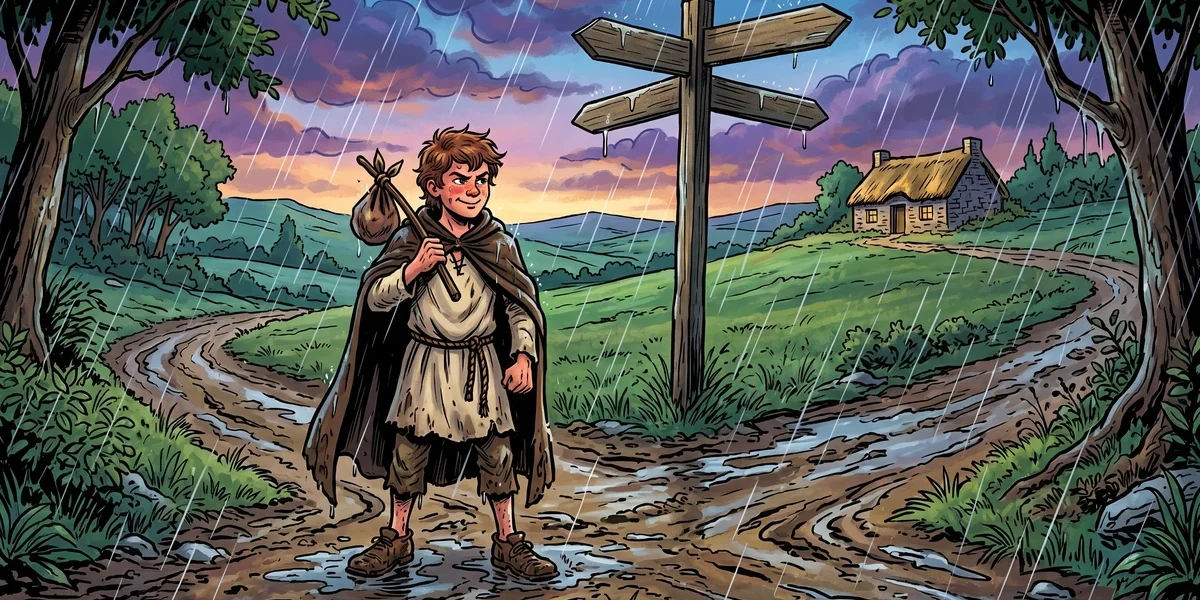
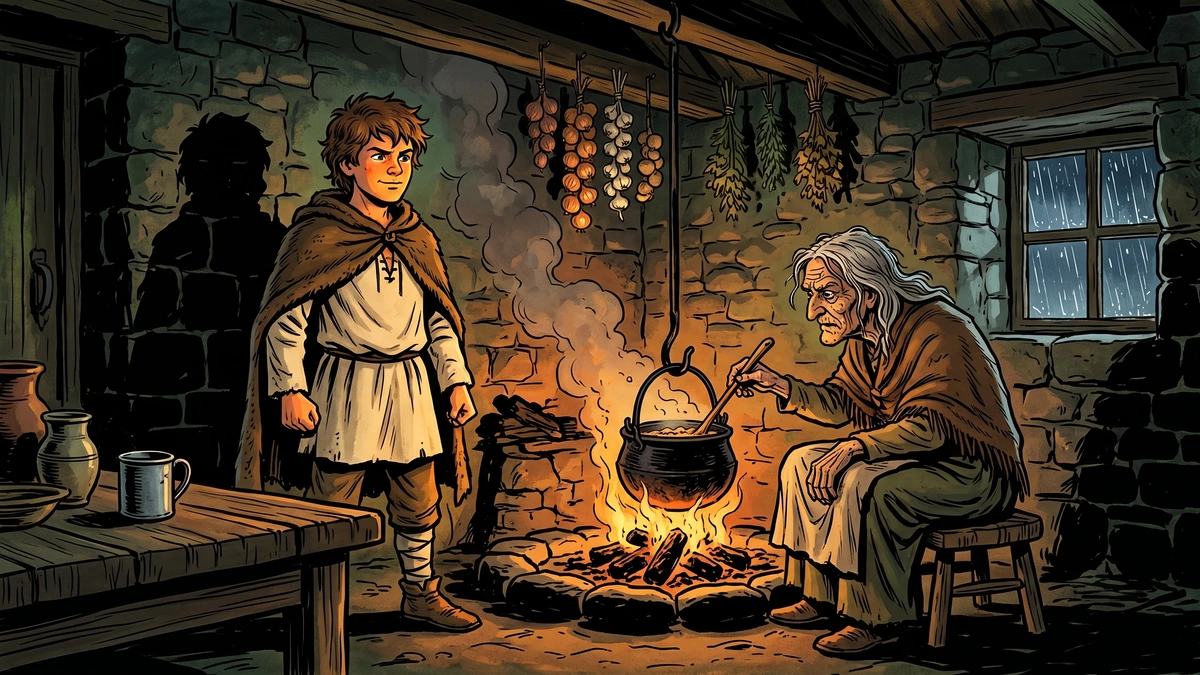
The opening movement of “Jack the Cunning Thief” is a textbook example of what folklorist Vladimir Propp would later call the departure function — the moment when the hero leaves the family hearth and crosses the boundary into the wider world. A poor farmer’s three sons walk out together to seek their fortune; the elder two, “sensible, industrious young men,” choose comfortable roads, while Jack, the youngest, chooses the lonesomest. This triadic structure, in which the third or youngest sibling succeeds where prudence has failed, is so common in Indo-European folktale that the Russian formalist Olrik labelled it the Law of Three and the Law of Final Stress in his 1909 essay on epic laws. Kennedy’s prose preserves the tension perfectly: rain falls, dusk gathers, and Jack, dripping and weary, knocks at the door of a house that an older listener already knew, by genre cue alone, must contain robbers.
The blear-eyed crone at the fire is not malevolent so much as resigned — a Cailleach-figure half a step removed from the supernatural threshold-keepers of older Gaelic legend. Her warning that the six masters of the house “skin you alive at the very least” is supposed to send any sensible traveller running, but Jack’s reply, cool as cream, is the hinge on which the whole story turns: “their very most couldn’t be much worse” than freezing in a ditch. In one breath he reframes danger as comfort, and in doing so he assumes the role he will hold for the rest of the tale — the one who controls the meaning of a situation rather than being controlled by it. By the time the six robbers return, find the boy in their bed, and demand to know who he is, Jack has already named himself: Master Thief. The robbers, who outnumber him six to one and could end him with a glance, instead bow to the title.
The Stolen Sheep and the Hanged Decoy
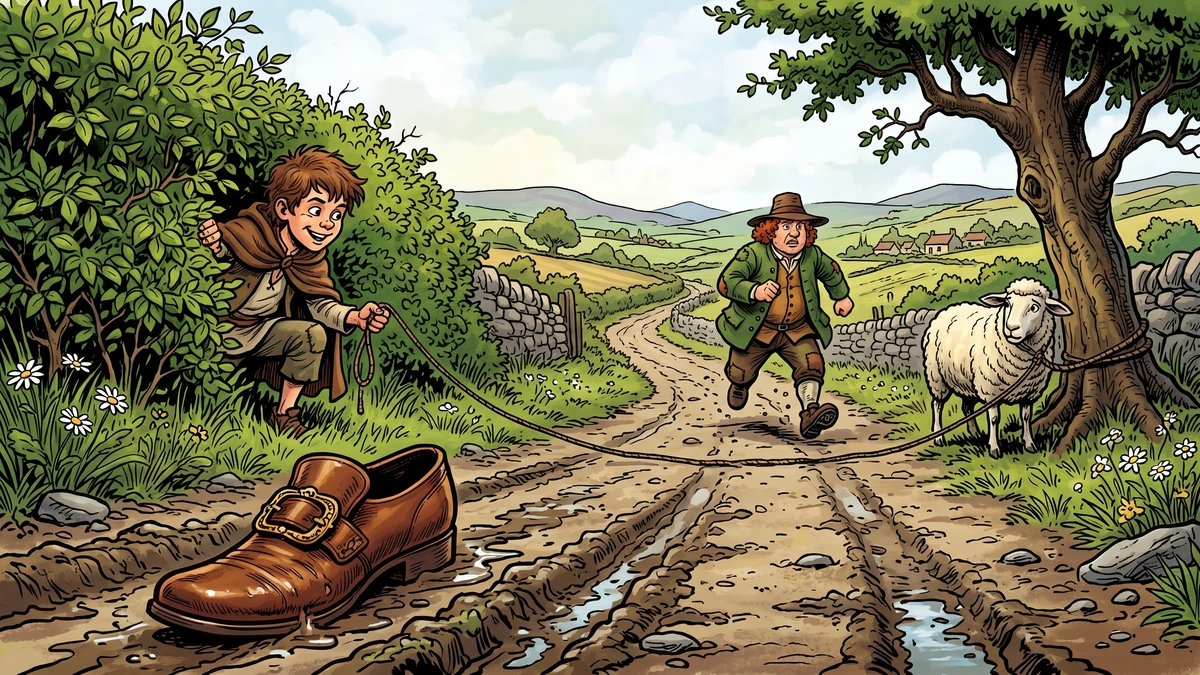
What follows is the section that classifies “Jack the Cunning Thief” most cleanly within ATU 1525 — the proving-trick, the demonstration that the apprentice has earned the title he claimed. In the Irish version the gang must steal a sheep from a farmer who is leading it past their hideout to market; the trick is famously old, and Kennedy’s audience would have recognised it from oral cousins long before they recognised Patrick Kennedy. Jack walks ahead and drops a single fine shoe in the road. The farmer notices, regrets that there is only one of a pair, and walks on. A little farther, Jack — having looped back through the hedgerows — drops the matching shoe. Now the farmer ties his sheep to a hawthorn, hurries back for the first shoe, and returns to find sheep, shoes, and stranger all gone.
The deception is light, almost playful, and the tale lingers on it for the same reason every trickster tradition lingers on the small-prize trick: it establishes that the hero’s victory is not muscular but mental. The trick of the dropped shoe occurs in some form in virtually every European Master Thief variant — Asbjørnsen and Moe record it in the Norwegian “Mestertyven”, and Bengali tellers transposed it onto a goat in the version Lal Behari Day printed in Folk-Tales of Bengal (1883). What makes Kennedy’s Wexford telling distinctive is the boy’s unshowy attitude afterwards. He returns to the cave, drops the sheep at the chief’s feet, and waits to be congratulated, “as a man might bring in turf.” The robbers, recognising mastery, are gracious. The episode closes with Jack as undisputed leader — a reversal so complete that the original chief now defers in everything, and the gang treats Jack as if he had been born to be obeyed.
The Three Tasks of the Lord
The middle movement of the story expands the narrative into its most recognisable ATU 1525A form: a great lord hears of the bold young thief and challenges him to perform three impossible tasks, on pain of being hanged if he fails. The tasks vary across the tradition, and Kennedy’s version stitches together the most beloved Irish episodes: Jack must steal the lord’s prize horse from a stable guarded by four soldiers, he must rob the lord and lady of the bedclothes from beneath them while they sleep, and he must steal the parish priest from his presbytery and deliver him bound in a sack. The Norwegian and German cousin-tales swap details — the Grimms’ KHM 192 “Der Meisterdieb” replaces the priest with the priest’s gold and substitutes a count for the lord — but the thematic skeleton is identical: aristocratic boast, peasant cunning, comic humiliation.
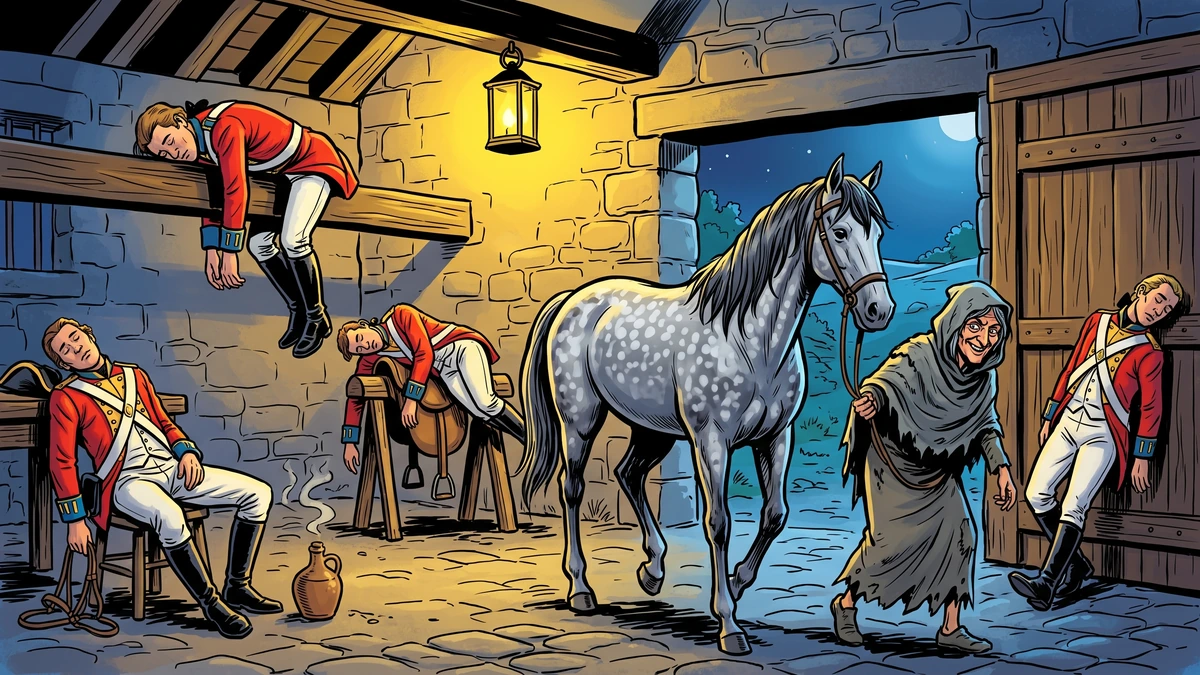
The horse-stealing trick is the centrepiece, and Kennedy renders it with delicious patience. Jack disguises himself as a beggared old crone, totters through the rain, and offers the cold soldiers a flask of poteen (whiskey) “for charity’s sake.” They drink, of course; the poteen is laced; they fall to snoring. Jack lifts each soldier off his post and arranges them in their original positions — one astride a beam pretending to ride the horse, one with the bridle in his hand, one stretched out on the saddle, one slumped against the door — and walks the horse out past them as quietly as a cat. When the lord arrives in the morning to gloat, he finds his tableau of vigilance frozen and meaningless, and the stable empty. The episode is as much theatre as theft, and Jack, behind every mask, is its director.
The Sack, the Priest, and the Lord’s Surrender
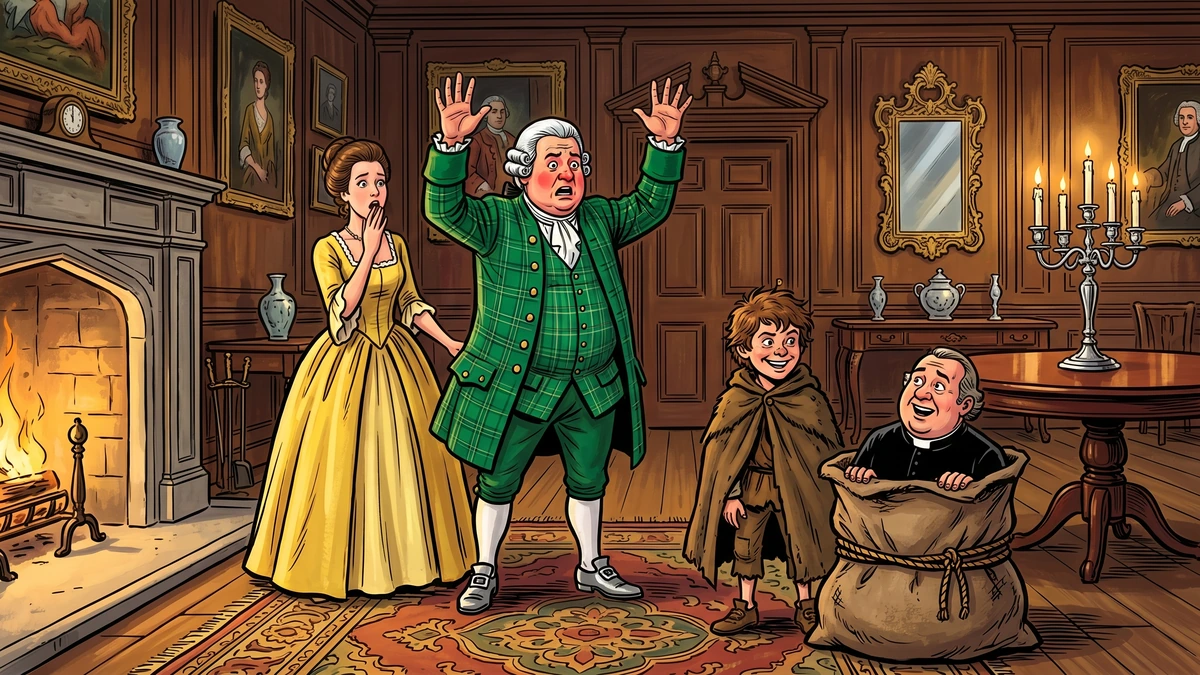
The third task is the moral hinge of the tale, the place where Kennedy’s Wexford telling departs from the colder northern variants and earns its particular Irish character. Jack must steal the parish priest and bring him bound. In the Grimm cousin-tale the count demands a clergyman delivered in a sack and the master thief accomplishes it with a comic ruse involving a graveyard at midnight, lighted candles, and a promise of heaven. Kennedy’s Jack adopts the same ruse but adds a peculiarly Irish softness: when the priest, terrified and bound, begs to know his fate, Jack assures him, in the voice of a country boy and not a demon, that no harm will come to him, and that the whole performance is to humble a vain landlord. The priest, half-laughing through his fright, plays along.
The lord, presented at last with the rumpled clergyman, recognises the depth of his defeat and capitulates. In some Irish redactions, including one printed by William Butler Yeats in Fairy and Folk Tales of the Irish Peasantry (London: Walter Scott, 1888) under the title “The Lad and the Devil,” the master thief is rewarded with the lord’s daughter and a portion of the estate. Kennedy is more austere: Jack receives money enough to set up his old father, his own freedom unmolested, and a reputation that travels to the next county before he does. The sack is untied, the priest blesses everyone with a half-stern, half-grateful smile, and the story ends with the kind of warm Wexford verbal shrug — “and that’s the end of Jack” — that signals to the listener that the dance is over.
Origin, Attribution, and Diffusion
The textual home of the present version is, as noted, Patrick Kennedy’s The Fireside Stories of Ireland (Dublin: McGlashan and Gill, 1870), a follow-up to his earlier Legendary Fictions of the Irish Celts (1866). Kennedy was a Wexford-born bookseller working out of Anglesea Street in Dublin, and his collections preserve a Hiberno-English oral idiom that would have been familiar in farmhouse kitchens of the south-east of Ireland in the early nineteenth century. He acknowledged his sources only generally — “from country relatives and old neighbours” — but modern folklorists have traced many of his tales to the Forth and Bargy district of County Wexford, an area where a distinctive Yola dialect persisted into living memory.
The international classification is firm: this is ATU 1525 “The Master Thief”, with strong subtype features of ATU 1525A “Tasks for a Thief” in Hans-Jörg Uther’s The Types of International Folktales (Helsinki: FFC 284-286, 2004). The Aarne-Thompson-Uther index lists hundreds of recorded variants. The most cited cousin-tales include the Norwegian “Mestertyven” of Asbjørnsen and Moe (Norske Folkeeventyr, 1843), the German “Der Meisterdieb” of the Brothers Grimm (KHM 192, added to the Kinder- und Hausmärchen for the 1843 edition from a tale heard in the Hessian dialect of Münster), the Bengali “The Adventures of Two Thieves” in Lal Behari Day’s Folk-Tales of Bengal (Macmillan, 1883), and Russian variants gathered by Alexander Afanasyev under the rubric “The Crafty Lad.” Folklorist Richard Dorson, in his 1959 essay on the type, summarised the scholarly debate: Alexander H. Krappe argued for an Egyptian origin in the Herodotean tale of Rhampsinitus and the thief who steals the king’s treasure (Histories II.121), while W. A. Clouston posited an Asiatic, possibly Indian, root. Stith Thompson concluded only that the type was “ancient, widespread, and irreducibly mobile.”
The Moral and What the Tale Lasted For
The closing flavour of “Jack the Cunning Thief” is not punitive but corrective. The thief is not condemned because he steals from those who deserve to be humbled — the boastful lord, the cruel landlord, the indifferent rich. He is celebrated because he steals well, with art, and because the world he steals from has long stopped paying attention to how it treats the poor. Kennedy’s narrator never says this in so many words; the tale, like most fireside tales, is too well-mannered to lecture. The point is left to the listener, who hears it in the inflection of every “Begor” and “Begonins” and laughs at the lord’s discomfort with the easy laugh of someone whose own grandfather might have been turned out of a Wexford cottage one cold November.
Mol an óige agus tiocfaidh sí — “Praise the young, and they will come on.” (Irish proverb of the kind Kennedy knew well, frequently quoted as the moral subtext of the Master Thief cycle in Hiberno-English oral tradition.)
Why It Has Lasted
What keeps “Jack the Cunning Thief” alive — what keeps every Master Thief alive, from the Norwegian forests to the bazaars of Cairo — is the specific pleasure of watching power outwitted by attention. Jack does not have wealth, lineage, weapons, or supernatural help. He has a mind that observes, a face that lies easily, and a willingness to be small until the moment of the trick. In a world full of stories where the king is rescued, the dragon is slain, or the prince inherits, the tale of the Master Thief is the one that admits, quietly, that ordinary people have always lived by their wits, and have always loved a story in which wit is enough. Kennedy’s Wexford voice gives this old, mobile tale a particular Irish flavour — wet roads, blear-eyed crones, soldiers drinking poteen, a priest in a sack — but the bones beneath are the same bones a Norwegian child or a Bengali grandmother would recognise instantly. That recognisability across cultures is the surest sign that the tale is not just folk entertainment but folk philosophy: a quiet old argument, told in laughter, that intelligence is the great equaliser, and that the lord who cannot see the beggar at his gate has already lost the contest before it begins.
You May Also Like
 Celtic Folk Tales
Ages 3-5
Celtic Folk Tales
Ages 3-5
The Selkie Wife: A Scottish Tale of Love and the Sea
The Selkie Wife: A Scottish Tale of Love and the Sea: On the rocky shores of Scotland, where the North Sea crashes against ancient cliffs, there lived a
 Celtic Folk Tales
Ages 9-12
Celtic Folk Tales
Ages 9-12
The Horned Women
The Horned Women: A rich woman sat up late one night carding and preparing wool, while all the family and servants were asleep. Suddenly a knock was given at
 Celtic Folk Tales
Ages 9-12
Celtic Folk Tales
Ages 9-12
The Story Of Deirdre
The Story Of Deirdre: There was a man in Ireland once who was called Malcolm Harper. The man was a right good man, and he had a goodly share of this world’s