How The Wicked Sons Were Duped
How The Wicked Sons Were Duped: A very wealthy old man, imagining that he was on the point of death, sent for his sons and divided his property among them.
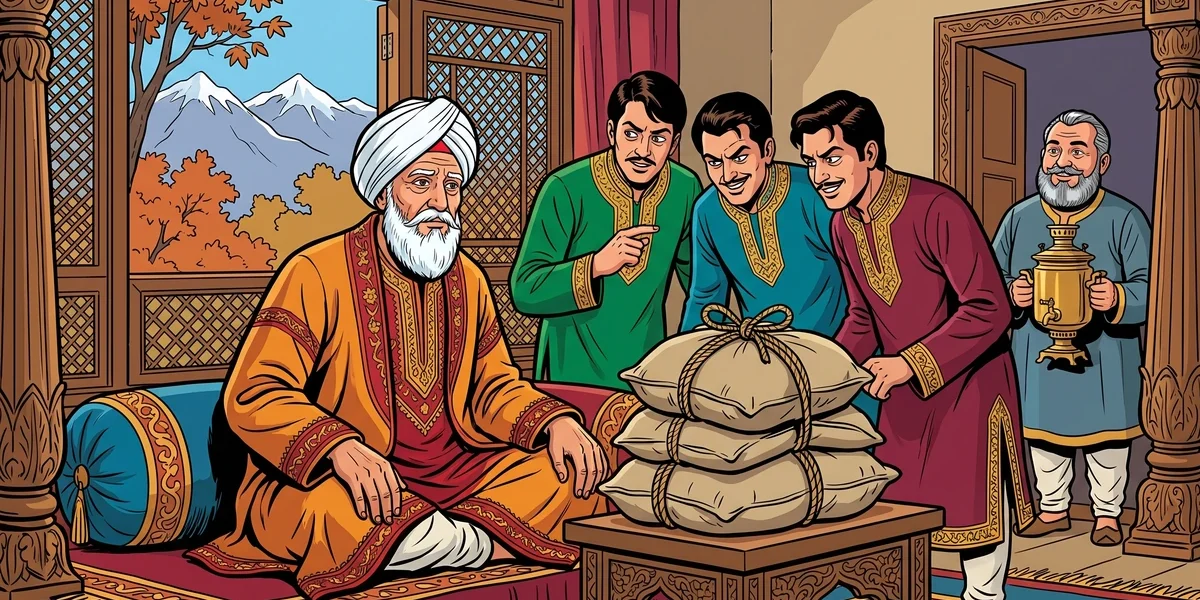
“Pootron pe jo bharosa kare, woh bhookha hi marta hai.”
— “He who depends on his sons for his daily bread shall die in want.” (Kashmiri proverb attributed by J. Hinton Knowles to the Pandit storytellers of Srinagar, c. 1885)
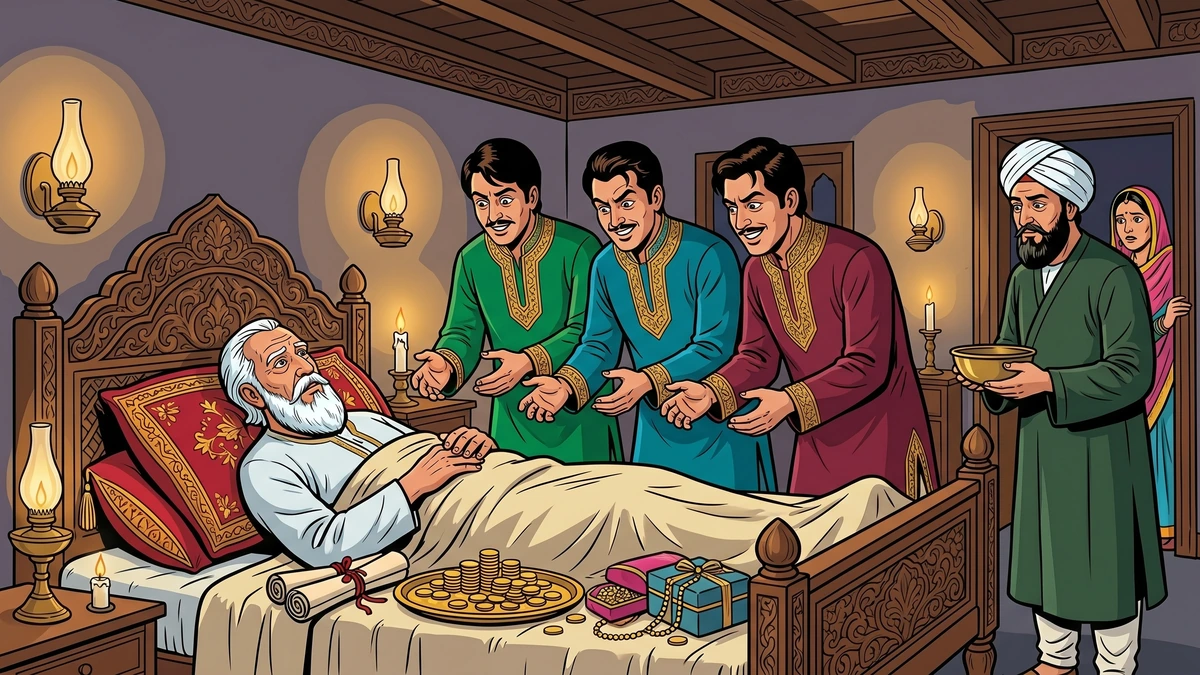
“How the Wicked Sons Were Duped” is the twentieth tale in Joseph Jacobs’s Indian Fairy Tales (London: David Nutt, 1892), where it occupies pages 100–101 in a brief, almost epigrammatic compass that belies the depth of the dharmic argument it carries. Jacobs reprinted the tale almost word for word from the version that the Reverend J. Hinton Knowles had set down four years earlier in his Folk-Tales of Kashmir (London: Trübner’s Oriental Series, 1888), where it is the eighth tale in the volume, occupying pages 8–9. Knowles — an Anglican missionary stationed at Srinagar from 1879 onwards — collected the tale from one of the Kashmiri Pandit storytellers whose oral hoard he transcribed over the better part of a decade, and whom he names in his preface only collectively as “the elders of the Pandit quarter.” The text reproduced here follows that 1892 Jacobs version, shorn of its faintly Victorian hedges and restored to the laconic Kashmiri rhythm of the original Pandit telling.
Folkloric classification of the tale has been settled, since Hans-Jörg Uther’s 2004 revision of the international index, under ATU 982 “The Suspected Inheritance” — sometimes catalogued under its older Aarne–Thompson designation AT 982 and the descriptive title “Pretended Treasure Bequeathed to Heirs”. Stith Thompson’s Motif-Index of Folk-Literature (rev. ed., Indiana University Press, 1955–1958) catalogues the constituent motifs as K1985 “Pretended treasure deceives wicked heirs”, J1146.1 “Father pretends to have buried gold; sons find only stones”, P233.6 “Sons disrespectful to old father”, and K1700 “Bluff: deception through bluff”. Theodor Benfey, in his magisterial Pantschatantra (Leipzig, 1859, vol. i, pp. 472–478), had already traced the type backwards to the Sanskrit Hitopadeśa and forwards into the European exempla tradition through the Latin Disciplina Clericalis of Petrus Alphonsi (c. 1110), in which the same plot appears as De truncis — “Concerning the Trunks”. The tale has cousins, by Benfey’s reckoning, in the Greek collections of Aesop preserved by Ben Edwin Perry (the closest analogue is Perry 42, “The Farmer and His Sons”, although that fable substitutes a vineyard for the bag of stones), and a Buddhist parallel in the Pali Játaka Book IV. Wendy Doniger, in The Hindus: An Alternative History (Penguin, 2009, pp. 280–282), identifies the tale-type as one of the oldest in the Indo-European stock, and notes its appearance in the Kathásaritsa´gara of Somadeva (Kashmir, eleventh century) under the heading vṛddhasya punāt śila — “the stones of the old man”.
What gives the Kashmiri version its peculiar moral ferocity, beyond its archaeological interest, is the elegance of its structural inversion. The wealthy old man begins by acting as if he were already dead — dividing his property among his sons in expectation of a death that does not come — and is in consequence treated by his sons as if he were already dead while he yet lived. The tale’s plot, in other words, is the slow unwinding of a single act of premature renunciation. The friend’s intervention, with its four bags of stones, restores the metaphysical balance: it persuades the sons to treat the old man as if he were alive (because they believe him to be wealthier than they had thought), although in truth he is closer to death than ever. The Pandit storytellers of Srinagar, who told this tale to their own grandfathers’ grandfathers, understood — long before any sociologist coined the phrase — that filial piety in a property-holding household is rarely about love and almost always about expectation. To remove expectation is to remove love; to restore expectation is to restore the imitation of love. The Kashmiri sons in this tale do not learn affection. They learn, briefly, to perform it.
The Premature Division and the Cruelty That Followed
In a small Kashmiri town whose name Knowles never gives (the Pandit storytellers, he writes in his preface, “always set such tales in a place that is just the next valley over from wherever the listener happens to live”), there lived a wealthy old man whose business in the bazaars of Srinagar had prospered for forty years. He had three grown sons, each married and with sons of his own; and one autumn morning, when the chinar leaves were turning over the lake at Dal and the first pinch of cold had settled on the mountains above the city, the old man fell ill. His Hakim — the Yunani-trained physician of his household — pronounced him to be on the point of death, and the old man, accepting the verdict with the calm of a Kashmiri merchant who had long ago made his peace with the ledger of his life, sent for his three sons and divided his property among them according to the strict Hanafi proportions which are the custom of the Valley.
The Hakim, however, was wrong. The old man recovered. The chinar leaves fell. Winter came down off the Pir Panjal range. Spring opened the almond trees on the slopes above Nishat Bagh. And every year that the old man went on living, his three sons grew a little more impatient that he had not yet completed the death he had so confidently announced. Knowles preserves the precise Kashmiri phrasing, which is one of the loveliest sentences in his volume: “They had vied with one another, in the days before, in the trying-to-please of their father; but now their property was in their hands, they cared not how soon he should leave them — nay, the sooner the better, for he was now only a needless trouble and a needless expense.”
The cruelty that followed was of the small, slow, daily kind that wears down an old man more efficiently than any single great blow. He was given the smallest room at the back of the eldest son’s haveli, with a window that looked out only on the latrine drain. His meals came late, and were served on the cracked enamelware that the kitchen kept for beggars. His grandchildren, who had once climbed onto his knees to be told the old hunting tales of his own father’s day, were now hurried past his door by their mothers with whispers about the old uncle’s cough. When he asked for a new pair of sandals, his eldest son told him that sandals could be patched. When he asked for a quilt against the Kashmiri winter, his middle son told him that quilts could be shared. When he asked, on the eve of Shivarátri, for the small ceremonial gift of money that Hindu fathers traditionally distribute on that night, his youngest son told him that the household ledger was tight that quarter. The old man understood that he had been buried alive in his own house, and that the sons who had once vied for his blessing now waited only for his last breath to free them of the trouble of him.
The Friend’s Visit, and the Four Bags of Stones
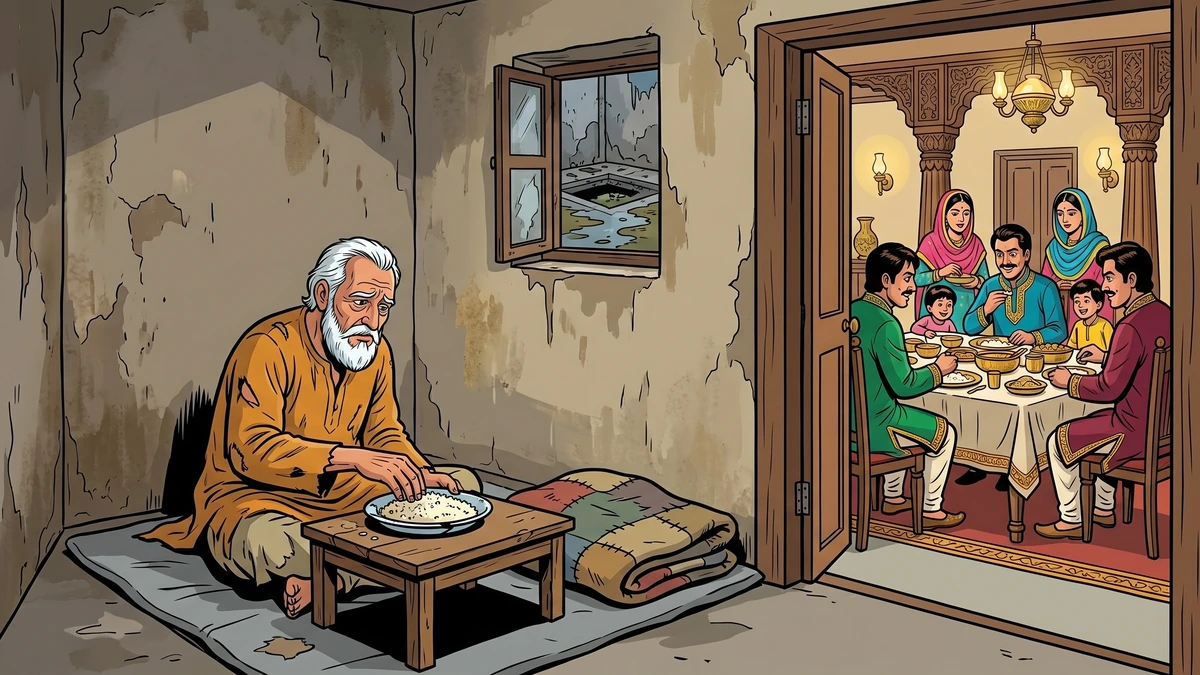
One afternoon, in the small bazaar that runs along the canal at Habba Kadal, the old man met a friend of his youth — a fellow merchant who had retired some years before to a smallholding in the Rainawari district. The friend, seeing the old man’s worn clothes and the slow shuffle of his step, drew him aside into the upper room of a tea-house, called for a brass samovar of saffron tea and a plate of Kashmiri walnuts, and made him sit and tell the whole long story of what the property-division had unmade. The old man, who had been carrying the weight of his sons’ contempt alone for three winters, set it down at last in front of his friend and wept.
The friend listened with the patience of a Kashmiri merchant who had seen many ledgers fail. He stroked his beard. He drank the saffron tea slowly. When the old man’s tears were exhausted he said only this: “Ghar ja, dost. Mere pas ek tadbeer hai. Char din ke baad main aaonga, aur tabhi sab kuch theek ho jayega.” — “Go home, friend. I have a stratagem. In four days I shall come to you, and then everything shall be set right.”
On the fourth day, in the early afternoon when the eldest son’s haveli was full of cousins and clerks — the hour, the friend had calculated, when the maximum number of household ears would be listening — the friend arrived at the old man’s gate carrying four heavy canvas bags slung over the shoulder of a porter. He climbed up to the old man’s small back room. The eldest son, his clerk, his middle brother, and two of the older grandchildren followed at a respectful distance, drawn by the sight of the bags. The friend, when he had set them down on the floor with a heavy clink that any Kashmiri merchant would recognise as the sound of metal on metal, addressed the old man in a deliberately raised voice that the listening sons could not fail to hear:
“Look here, friend. Your sons will get to know of my coming here to-day, and they will inquire of you what passed between us. You must pretend that I have come to discharge a long-standing debt of mine to you, and that you are several thousands of rupees richer than you had thought yourself to be. Keep these bags in your own hands; on no account let your sons get to them so long as you are alive. You shall soon find them changing their conduct towards you. Salaam. I shall come again soon to see how you are getting on.”
The friend bowed, took his porter, and left. The bags — in truth filled with stones from the Jhelum riverbed and a topping of smithy gravel — remained on the floor of the old man’s room. Knowles preserves, with the dryness of a Kashmiri Pandit moralist, the precise sound that the bags made when the eldest son, that very evening, knelt down beside them and shook one experimentally: khan-khan-khan, the heavy chink of coin on coin, indistinguishable to any ear not actually inside the canvas from the sound of four bags of silver rupees.
The Sons’ Sudden Devotion, and the Years That Followed
From that evening forward, the conduct of the three sons towards their father underwent the precise change the friend had foretold. The smallest back room with the latrine view was vacated within a fortnight; the old man was moved to the principal upper chamber of the eldest son’s haveli, the one with the carved walnut-wood ceiling and the window that opened over the jasmine garden. His meals began to arrive at the proper hour, served on the silver thali reserved for honoured guests. The grandchildren, by the spring of the following year, had again learned the trick of climbing onto his knees to be told the old hunting tales of his own father’s day. The eldest son’s wife asked after his cough. The middle son had a new pheran — the long Kashmiri winter robe — tailored for him in fine pashmina by the most skilled tailor in the Maharaj Ganj quarter. The youngest son, on the eve of the next Shivarátri, presented him with a heavy silk purse of ceremonial coins.
The old man, who was not a fool, observed all this with the wry inner eye of a merchant watching a market correction he had himself engineered. He did not change his behaviour towards his sons. He did not show particular gratitude for the new room, the new food, the new pheran, the new ceremonial coins. He did not soften when his grandchildren climbed onto his knees, although he told them the old hunting tales as patiently as he had ever told them. He kept the four bags in a carved walnut-wood chest at the foot of his bed, and locked the chest each night with a key he wore on a cord around his neck. He took the key off, the cycle says, only twice a year — once for the ritual washing on Shivarátri, and once for the autumn cleaning before Diwáli — and on each of those occasions the eldest son’s clerk found it strangely necessary to be in the room when the chest was opened, and craned his neck so far towards the contents that the old man eventually made him hold the lid.
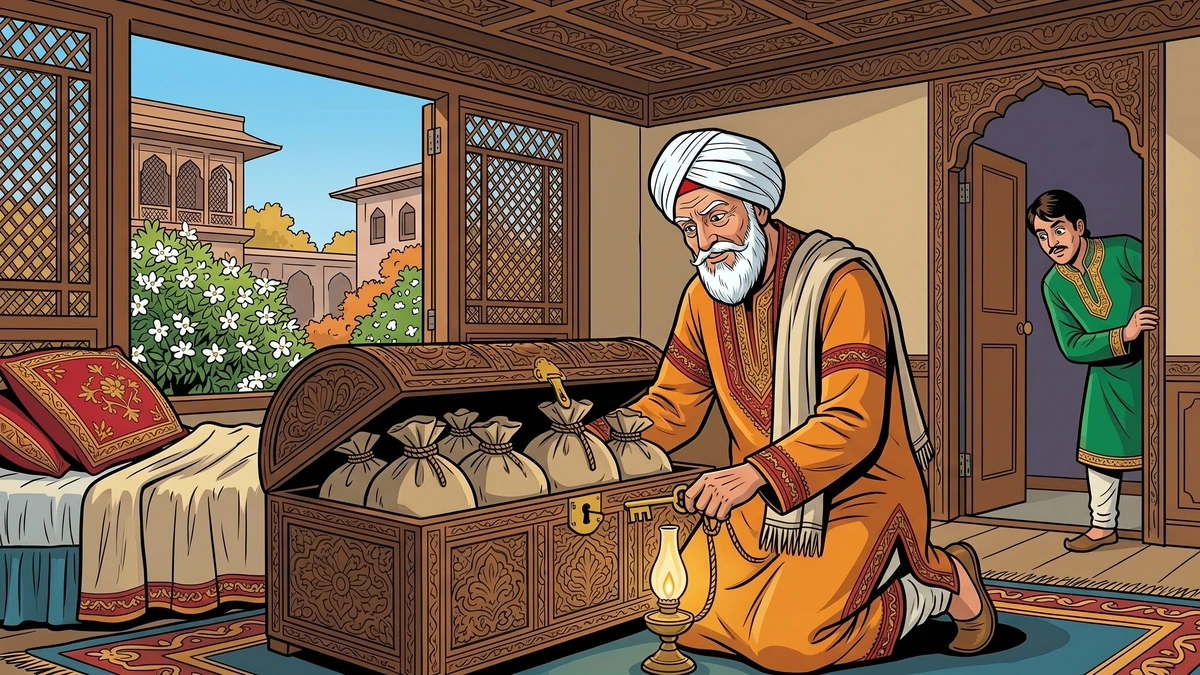
The performance, which on the friend’s stratagem had only been intended to last a season, lasted instead for many years. The old man’s friend visited him every few months and was given saffron tea in the principal chamber while the eldest son hovered and the middle brother sent in the best Kashmiri walnuts. The friend would smile faintly into his tea and say nothing about the bags. He had foreseen, perhaps, what the Pandit storytellers of Srinagar themselves had foreseen for centuries: that wicked sons, once persuaded that there is unexpected money in the old father’s chest, will keep up the imitation of devotion long past the point at which a real son would have wearied of pretending. Greed is, the cycle teaches us, a steadier engine than affection. It does not flag. It does not need to be fed by the warm response of its object. It needs only to be fed by the hope of eventual return.
The Death, the Opening of the Bags, and the Stones
The old man, attended faithfully in his last illness by the three sons who had once let his dinner come cold from the kitchen, died at last in the principal upper chamber of the eldest son’s haveli on a winter evening when the snow lay deep on the slopes above Hari Parbat. The Hindu funeral rites were observed with what Knowles, with the dry irony of a missionary observer, calls “an extraordinary correctness”. The body was carried to the cremation ground at the burning ghat of Karan Nagar with the full procession of Pandit relatives, conch-shells, and hired mourners. The thirteen days of shráddha were observed at the eldest son’s expense without a single corner cut. On the morning of the fourteenth day, when the last guest had been fed and the last brahmin had been thanked and dismissed, the three sons climbed the stairs to the principal upper chamber, removed the key (which, on the old man’s instruction, had been left on its cord around the throat of his corpse and so consigned to the fire), broke open the locked walnut-wood chest, and at last laid hands upon the four canvas bags that had been the engine of their performance.
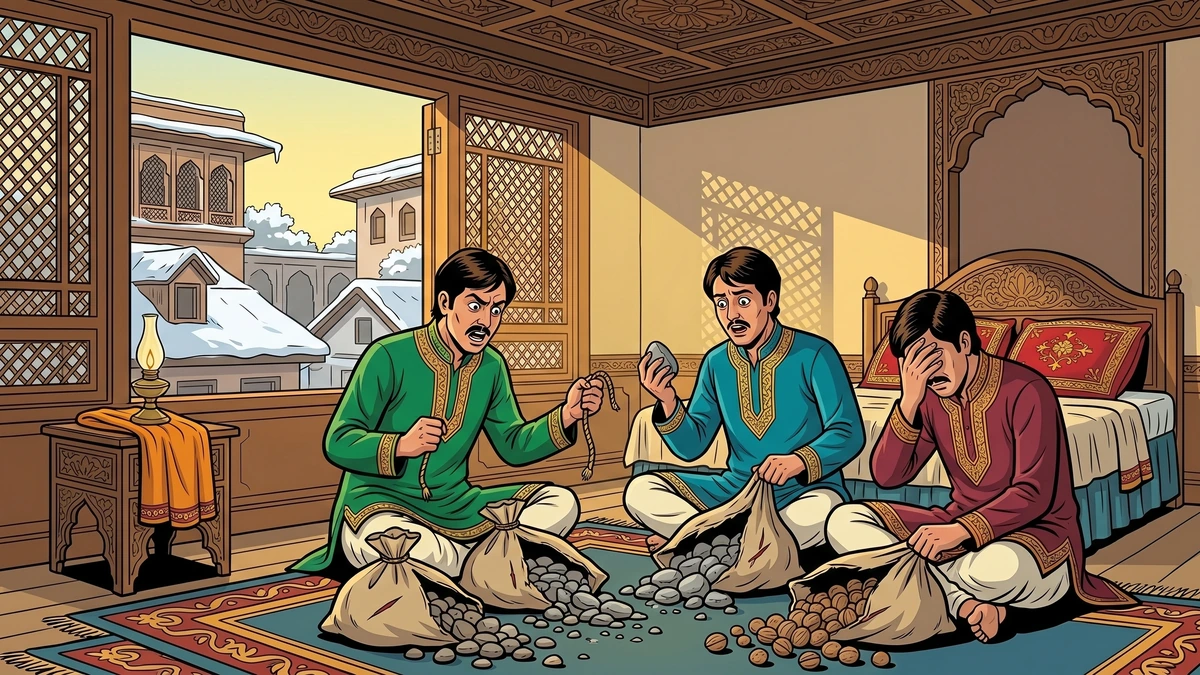
Knowles preserves, in the dryest Kashmiri storytelling tradition, the exact sequence of the discovery. The eldest son cut the cord on the first bag and emptied it onto the carpet. Out tumbled river-stones from the Jhelum bed. The middle brother, supposing some elaborate trick of concealment, cut the cord on the second bag and shook it out. More stones. The youngest son, by now in the high colour of a man who has discovered his decade has been wasted, cut both the third and fourth bags at once and emptied them with a single furious gesture upon the carpet. Stones, all of them — round white pebbles, grey shingle, a few larger boulders the friend had clearly lifted, with effort, from the riverbank just below Habba Kadal. Not a single rupee. Not a single anna. Not even, the cycle says, a copper paisa.
The three sons sat upon the carpet of their late father’s principal upper chamber, surrounded by the rubble of the trick that had purchased their decade-long performance of devotion, and understood at last what their father had understood from the day the friend had set the bags down. They had been duped. They had been bought, the Kashmiri Pandits would say, with the cheapest possible coin: the coin of their own greed. They could not even, in good conscience, be angry with the dead man — for the dead man had merely allowed them to deceive themselves. The cycle is precise about the silence that fell upon the three of them in that upper chamber. It was the silence, Knowles writes, “of three men who at last understand the true valuation that had always been placed upon their love.”
The Moral: The Currency of Filial Piety, and the Coin of Stones
The Kashmiri proverb that hangs over the closing pages of the tale — the saying the Pandit storytellers of Srinagar would have spoken in their closing exchange with the child or apprentice they were instructing — is the single most translated line in Knowles’s volume:
“Pootron pe jo bharosa kare, woh bhookha hi marta hai.”
— “He who places his trust in his sons shall die in hunger.”
The tale’s deeper teaching, however, lies not in this proverbial closing but in the structural symmetry of its plot. The old man begins by giving away the substance of his life prematurely — before death has actually claimed him — and is in consequence treated as a man already dead. The friend’s stratagem of the four bags reverses the error: by re-introducing the appearance of unexpected wealth, the friend re-introduces the appearance of life, and with the appearance of life is restored, briefly and falsely, the appearance of love. What the cycle teaches, and what every Kashmiri Pandit storyteller who passed the tale forward through the centuries understood without need of the underlining, is that filial devotion in a property-holding household is almost never the unconditional love it pretends to be. It is, far more often, a quiet calculation about expected inheritance, dressed in the costume of affection. The wise old father is the one who keeps the costume on the calculator, not the one who tries to dress love itself in clothes too fine for what it actually is.
The doctrinal background of this teaching is the Hindu legal-philosophical tradition of vánaprastha — the third áśrama or stage of life, in which the householder is supposed to retire from active management of his property and prepare himself for the final renunciation of sannyása. Wendy Doniger has noted (in The Hindus, 2009, pp. 280–282) that the Manusmṛti and the Yájñavalkya Smṛti both lay down strict rules about the timing and proportions of property-division, precisely because the premature transfer of wealth from father to sons was, even in classical Hindu jurisprudence, recognised as one of the principal engines by which the social fabric of the Hindu joint family could be dissolved. The Kashmiri Pandit storytellers, in their deceptively brief tale of the four bags of stones, were dramatising for ordinary householders a piece of legal-philosophical wisdom that the great smṛti texts had already laid down in technical language: do not abdicate your authority before you have abdicated your breath. Property in a man’s hand is the only durable surety of his dignity in his own house; and the moment he passes that surety to his heirs, he becomes — in the cold reckoning of every Indian joint-family ledger — an expense to be minimised rather than a presence to be honoured.
Why This Tale Has Lasted Twelve Centuries
“How the Wicked Sons Were Duped” has crossed cultures, languages, and millennia with the durability of an iron-bound chest. Its plot first appears in identifiable form in the Sanskrit Kathásaritsa´gara of Somadeva (Kashmir, c. 1070 CE), and its fullest medieval European cousin is the De truncis tale in Petrus Alphonsi’s Disciplina Clericalis of c. 1110 CE, where two trunks — one full of stones, one of bones — replace the four canvas bags. The tale appears, in slightly variant form, in the German Gesta Romanorum of the late thirteenth century, and is taken from there into the Italian Cento Novelle Antiche and the English Handlyng Synne of Robert Mannyng of Brunne (c. 1303). Its closest Greek cousin is the Aesopic fable Perry 42 “The Farmer and His Sons”, in which a dying father claims a treasure buried in the family vineyard and so persuades his sons to dig it over thoroughly, with the result that the vineyard yields a great harvest. Stith Thompson, in the Motif-Index, treats the two as siblings under the parent motif K1985 “Pretended treasure deceives wicked heirs”.
The tale’s persistence can be explained, the Pandit tradition would say, by the fact that it speaks to a permanent feature of the human household. As long as property must be passed from one generation to the next, and as long as the love of children for their parents is supplemented — or in some cases entirely replaced — by the expectation of inheritance, the wisdom of the four bags of stones remains directly applicable. Modern readers in Mumbai or Manhattan, who have never seen a canvas sack of river-stones in their lives, recognise the situation immediately when they encounter it: the elderly parent moved to the smallest room, the meals served late and cold, the sudden warmth of attention that returns the moment a long-lost trust account or a hidden insurance policy is rumoured. The Kashmiri Pandit storytellers, with their dry, four-page tale of an old merchant and his four bags of pebbles, had diagnosed the disease of the property-holding household with a precision that has not been surpassed by any modern sociologist. The medicine they prescribed — that an old father should keep the keys to his own chest until his last breath — is one that every wise grandparent, in every property-holding culture on earth, has always quietly understood.
Frequently Asked Questions
**Q: Why is this story important?**
You May Also Like
 Indian Folk Tales
A Story Weaver by Chance: Interview with Vani Balaraman
Interview with Bengaluru storyteller Vani Balaraman on Pratham Books Champions, Cuddles and Reads, and finding storytelling while juggling a tech career.
 Indian Folk Tales
All Ages
Indian Folk Tales
All Ages
The King Who Would See Paradise
The King Who Would See Paradise: Once upon a time there was king who, one day out hunting, came upon a fakeer in a lonely place in the mountains. The fakeer
 Indian Folk Tales
Ages 3-5
Indian Folk Tales
Ages 3-5
The Jogis Punishment
The Jogis Punishment: Once upon a time there came to the ancient city of Rahmatabad, a jogi of holy appearance, who took up his abode under a tree outside the