Chang’e and the Moon
Chang'e and the Moon: In ancient times, when the world was young and the heavens were still negotiating their final arrangement with the earth, there came a
Origin & Tradition
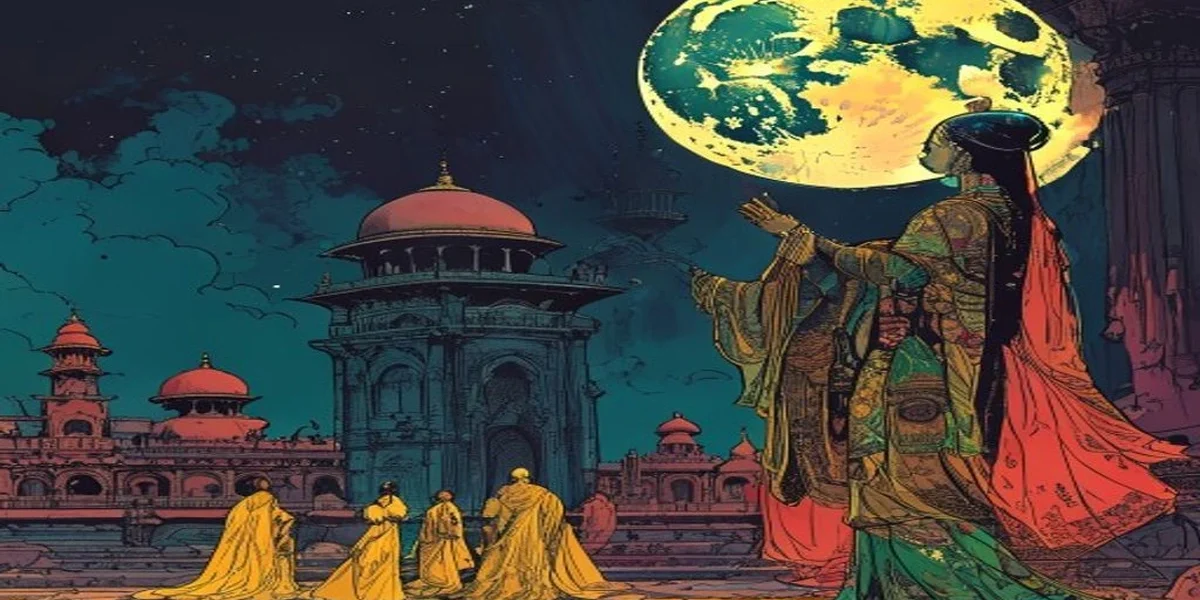
Chang’e (嫦娥) is the most celebrated figure in Chinese lunar mythology, her story woven into the fabric of one of China’s most beloved festivals. The earliest written traces of her appear in the Gui Cang divination text (c. 11th century BCE), where she is associated with the moon. The Huainanzi (c. 139 BCE) records the essential narrative: the solar archer Hou Yi, who had shot down nine of the ten suns threatening to scorch the earth, received the elixir of immortality from the Queen Mother of the West as reward; his wife Chang’e drank the elixir and ascended to the moon. Tang Dynasty poets — Li Bai, Du Fu, Li Shangyin — transformed the image of Chang’e alone in the cold lunar palace into one of the most resonant figures in Chinese literary tradition: the supreme emblem of lonely beauty and irreversible separation. The Mid-Autumn Festival (中秋节), observed on the fifteenth night of the eighth lunar month, institutionalised the response to her solitude: communal moon-gazing, the sharing of round mooncakes symbolising reunion, and the recitation of poetry across the distance that separates those who love each other.
Beat I — The Ten Suns and the Archer’s Reward
In primordial time, ten suns rose together in the sky — the ten children of the Emperor of Heaven and his consort Xihe, who drove each sun across the sky in turn, day by day. One mythic morning, all ten rose simultaneously. Rivers boiled. Forests burned. Crops turned to ash. The people prayed for deliverance.
Hou Yi (后羿) was a celestial archer of supreme skill, appointed by the Emperor of Heaven to descend to earth and address the catastrophe. He shot down nine suns, one by one, from the sky — preserving the last so that warmth and light would remain for the world. He is one of Chinese mythology’s great heroes of civilisational service: his act of archery saved the world not by force of conquest but by calibrated restraint, shooting nine and stopping at the tenth. The Emperor of Heaven rewarded him and his wife Chang’e with the elixir of immortality, obtained from the Queen Mother of the West (Xi Wang Mu), guardian of the peaches of immortality and the medicines of the celestial realm.
Hou Yi brought the elixir home and entrusted it to Chang’e. What happens next is the hinge of the myth — and Chinese tradition has never fully settled it. In the oldest versions, preserved in the Huainanzi, Chang’e simply took the elixir and flew to the moon. In later literary elaborations — particularly those that became standard in Tang and subsequent popular culture — a villain named Peng Meng (a student of Hou Yi who coveted the elixir) attempted to seize it by force; Chang’e, unable to protect it otherwise, drank the entire dose and ascended to the moon before he could take it. In this version her act is sacrificial: she protected the elixir at the cost of her own earthly life and reunion with Hou Yi.
Beat II — The Ascent and the Cold Palace
The elixir propelled her upward. She left the earth — left Hou Yi, left ordinary life, left the warmth of human habitation — and rose through the freezing reaches of the upper atmosphere to the moon, which the Chinese tradition called the Cold Palace of the Moon (广寒宫, Guang Han Gong). The name is exact: vast, cold, expansive, and fundamentally uninhabited. In the Tang imagination, the moon is white jade and crystal, immaculate and utterly still — a perfection that is indistinguishable from desolation.
Her companions in the Cold Palace are few and strange: a jade rabbit who pounds the elixir of immortality with a pestle for eternity; in some versions a cassia tree that a condemned man named Wu Gang chops at endlessly, its wood regenerating each night before he can complete his sentence. These companions are figures of perpetual, purposeless labour — the rabbit pounds medicine for a palace where the only immortal already has immortality; Wu Gang chops a tree he can never fell. Chang’e’s solitude is not merely loneliness; it is a kind of cosmic stasis. She is perfectly preserved, perfectly beautiful, perfectly alone.
Tang Dynasty poets understood this condition with pitiless precision. Li Shangyin’s famous quatrain imagines Chang’e contemplating her choice in the still of the lunar night, the wick of a candle burning blue, wondering whether “the heart is not regret / for having stolen the elixir in the deep sea of the sky.” The moon is simultaneously the emblem of perfection — full, round, luminous — and of irreversible separation. Its beauty is inseparable from its distance. What shines on the world from the Cold Palace is not warmth but cold light, not presence but the image of presence.
Beat III — Gu Du, Xiang Si, and the Festival They Founded
The central philosophical contribution of the Chang’e story to Chinese culture is its exploration of gu du (孤独, solitude, existential aloneness) and xiang si (相思, mutual longing across separation — a term that implies that the longing itself is shared, even when separated people cannot communicate). These two concepts, in tension with each other, generate the emotional structure of the Mid-Autumn Festival.
Chang’e’s solitude is absolute: she cannot return to earth; Hou Yi cannot follow her to the moon. The separation is not temporary, like the Niulang-Zhinu crossing on the magpie bridge once a year; it is permanent. This makes her the extreme case of gu du in Chinese narrative — the figure most completely cut off from ordinary human connection, preserved in isolation at the highest remove from the earth.
And yet. The same moon that represents her isolation is visible to everyone on earth simultaneously. On the fifteenth night of the eighth lunar month, when the moon is at its fullest and brightest, people who are separated from those they love — soldiers far from home, merchants in distant cities, students at foreign academies, daughters married into far households — can look at the same moon and know that the people they love are looking at it too. The moon is the one thing that is simultaneously present to separated people; it is the medium of xiang si because it is equally available to both sides of any separation.
This is the paradox at the heart of the Mid-Autumn Festival: one person’s irreversible isolation — Chang’e forever alone in the Cold Palace — became the occasion and the model for a communal practice of sharing separation. She gazes down from the moon; the people gaze up at her. They cannot reach each other, but they are looking at the same thing. That shared looking is itself a form of connection — not the connection of physical presence, but the connection of oriented attention, of xiang si made visible in the act of gazing together at the same light.
The round mooncakes that are the festival’s ritual food are explicitly shaped to evoke the full moon and the reunion (团圆, tuan yuan) it symbolises. The sharing of round mooncakes enacts the togetherness that separation makes difficult: by eating the same round thing under the same round moon, separated people perform a symbolic reunion that the physical distance cannot provide. Chang’e’s solitude founded this culture of practiced togetherness precisely because her isolation was so complete — it was the extreme against which tuan yuan could be defined.
Beat IV — The Ambiguity and Its Resolution
The question of whether Chang’e’s ascent was theft, self-sacrifice, or fate has never been definitively answered by Chinese tradition, and that ambiguity is itself instructive. In the oldest version, she takes the elixir — an act that can be read as selfish appropriation of Hou Yi’s reward, as a bid for personal immortality at the expense of their shared human life. In the later, more sympathetic version, she drinks it to prevent a villain from stealing it, her act reinterpreted as sacrifice. Both readings circulate simultaneously in Chinese popular culture; both have been operatically staged, painted, and versified.
The ambiguity is not a flaw in the tradition but a feature: it preserves the full moral weight of the narrative. If Chang’e is purely innocent, the story loses its tragic edge — she is simply a victim. If she is purely culpable, the story loses its pathos — she deserves what she gets. The tradition’s refusal to settle the question keeps alive the possibility that her choice was both understandable and costly, both reasonable under her circumstances and the cause of permanent loss. This is the same moral complexity that makes the Butterfly Lovers story more powerful than a simple tragedy of innocent victims: the narrative acknowledges that consequential choices are made in real circumstances, with real pressures, and that the consequences do not resolve the moral question of whether the choice was right.
What the tradition does settle is the response to Chang’e’s condition: not judgment but compassion and recognition. The festival that bears her story is one of the most joyful in the Chinese calendar — a celebration of reunion, family, and the beauty of the full moon. The appropriate response to Chang’e’s solitude is not to condemn her choice but to honour what it illuminated: the preciousness of togetherness, visible precisely because she stands apart.
“She gazes from the Cold Palace at the ten thousand lights below; the ten thousand lights below gaze up at her. Neither can reach the other. But they are looking at the same moon — and that shared looking is itself a kind of home.”
— Distilled from the Chang’e literary tradition, after Li Shangyin (Tang Dynasty)
Why This Story Has Lasted
Chang’e endures because she embodies a condition that every human being recognises: the irreversibility of certain choices, and the beauty that can emerge from isolation. She also grounds one of the most widely observed festivals in the world — the Mid-Autumn Festival is celebrated across East and Southeast Asia by over a billion people — giving the mythological narrative immediate practical relevance in the present. But beneath the festival’s joyfulness lies the story’s darker gift: the acknowledgment that beauty and loneliness are not opposites, that the most luminous things are often the most distant, and that the right response to an irreversible separation is not despair but the practice of looking together at the same light.
Frequently Asked Questions
What is the story of Chang’e and why did she fly to the moon?
Chang’e is the wife of Hou Yi, the archer who shot down nine of ten suns to save the earth from destruction. As a reward, Hou Yi received the elixir of immortality from the Queen Mother of the West. In the most common version of the story, Chang’e drank the entire elixir to prevent the villain Peng Meng from stealing it, and the dose propelled her to the moon, where she has lived alone ever since as its immortal guardian. In older versions, she simply stole the elixir herself. The tradition holds both versions simultaneously, preserving the story’s moral ambiguity.
What is the connection between Chang’e and the Mid-Autumn Festival?
The Mid-Autumn Festival (中秋节), observed on the fifteenth night of the eighth lunar month when the moon is at its fullest, commemorates Chang’e and her solitude. The festival’s central practice — communal moon-gazing — is a collective response to her isolation: the same moon that represents her separation from earth is the one thing equally visible to all separated people simultaneously. Round mooncakes symbolise the full moon and reunion (团圆); sharing them under the full moon enacts the togetherness that physical separation makes impossible. One person’s irreversible solitude founded a culture of communal longing.
Who is the jade rabbit that lives on the moon with Chang’e?
The jade rabbit (玉兔, Yu Tu) is Chang’e’s principal companion in the lunar palace. According to tradition, the rabbit pounds the elixir of immortality with a pestle for eternity — a task of perpetual, purposeless labour, since the only immortal in the palace already has immortality. The rabbit is one of the most recognisable figures in Chinese lunar iconography and appears in Mid-Autumn Festival imagery alongside Chang’e. The rabbit’s presence in the moon is also independently attested in ancient Chinese astronomical observation: the dark patterns on the full moon’s surface were read as the outline of a rabbit.
What does Chang’e symbolise in Chinese culture?
Chang’e embodies the twin poles of lunar imagery: perfect beauty and irreversible isolation. She is the supreme figure of gu du (existential solitude) in Chinese narrative — preserved in flawless isolation at the highest remove from ordinary life — and simultaneously the origin of xiang si (mutual longing across separation), since her condition gave rise to the cultural practice of using the moon as the medium through which separated people communicate their longing for reunion. Tang Dynasty poets made her the archetypal image of lonely perfection: beautiful, cold, distant, and utterly alone.
Is Chang’e a villain or a hero for taking the elixir?
Chinese tradition deliberately preserves both possibilities. In the older version she takes the elixir herself, which reads as selfish; in the later version she drinks it to protect it from a villain, which reads as sacrificial. Neither reading has definitively displaced the other, and this ambiguity is not a flaw but a feature: it preserves the story’s full moral weight. If she is purely innocent she becomes a simple victim; if she is purely culpable she loses her pathos. The tradition’s refusal to settle the question keeps alive the recognition that consequential choices are made under real pressures, and that the consequences do not resolve the moral question of whether the choice was right.
You May Also Like
 Chinese Folk Tales
Ages 6-8
Chinese Folk Tales
Ages 6-8
The Weaving Maiden Crosses The Silver River
Once a year, a star-maiden walks across a bridge of magpies to meet the boy who keeps the stars' cattle.
 Chinese Folk Tales
All Ages
Chinese Folk Tales
All Ages
The Reward Of A Benevolent Life
The Reward Of A Benevolent Life: On the banks of a river flowing through the prefecture of Tingchow, there stood a certain city of about ten thousand A
 Chinese Folk Tales
Ages 9-12
Chinese Folk Tales
Ages 9-12
The Panther
The Panther: Once upon a time there was a widow who had two daughters and a little son. And one day the mother said to her daughters: “Take good care of the