Baba Yaga
A canonical Russian wonder-tale from Afanasyev (tales 102-103, Narodnye russkie skazki, 1855-63; English re-telling Blumenthal 1903). Two orphan twins, sent into the forest by a wicked stepmother, find Baba Yaga the witch in her hut on chicken legs. They are saved by the small kindnesses they have given to mice, a hungry cat, forest birds, a rusty gate and a wounded birch tree; the cats gift of a towel and a comb becomes a river and a dark forest behind them in the magic flight. ATU 480 fused with ATU 313H*. With scholarly attribution to Propp, Johns, Hubbs and Forrester.
Russian Original: «Баба-Яга» (Baba-Yaga) — the name itself is a doublet of two ancient Slavic roots: baba, “old woman, grandmother,” and yaga, a much older Proto-Slavic word cognate with Old Church Slavonic ѩза / jęza meaning “illness, anger, horror.”
Canonical Source: Alexander Afanasyev, Народные русские сказки (Narodnye russkie skazki / Russian Folk Tales), tales numbered 102–103 in the critical 1873 edition; the version below follows the English re-telling published in 1903 by Verra Xenophontovna Kalamatiano de Blumenthal, Folk Tales from the Russian (A. C. McClurg & Co., Chicago).
Tale-Type Classification: ATU 480 “The Kind and the Unkind Girls” fused with ATU 313H* “The Magic Flight,” with the towel-and-comb episode catalogued as motif D672 (Obstacle flight) and the chicken-legged hut as D932.1 / F771.1.2; in the East-Slavic SUS (Сравнительный указатель сюжетов) catalogue this branch is SUS 480C*.
Cultural Frame: A keystone tale of the Russian wonder-tale tradition — the witch of the deep forest who tests visitors and rewards courtesy, the threshold spirit who guards the borderlands between this world and the other. Vladimir Propp built his Morphology of the Folktale (Leningrad, 1928) on exactly this kind of Russian skazka.
Somewhere — and the old storytellers refuse to say precisely where, because every Russian village is sure it happened nearby — but certainly in the boundless forest country of holy Russia, where the birch trees stand as white as bone and the cuckoo’s call carries for a verst over the snow, there lived a peasant with his wife. They had been blessed with twins, a brother and a sister, born on the same winter morning. Then the good woman fell ill and died, and the husband mourned her, as Russian widowers do, in deep silence under the ikon-corner for a year and another year. At length he thought: “There is no order in a house without a woman,” and he married again.
The new wife brought children of her own, and the soft envy that flickers in such houses grew into something darker. She scolded the twins without reason, sent them out into the cold on errands they were too small to do, and gave them scarcely enough bread to keep them warm. The old Russian formulators of this tale have a phrase for what was happening inside her — “a wicked thought grew like a poisonous plant” — and at last she resolved to be rid of the orphans altogether.
The Stepmother’s Errand and the Old Grandmother’s Warning
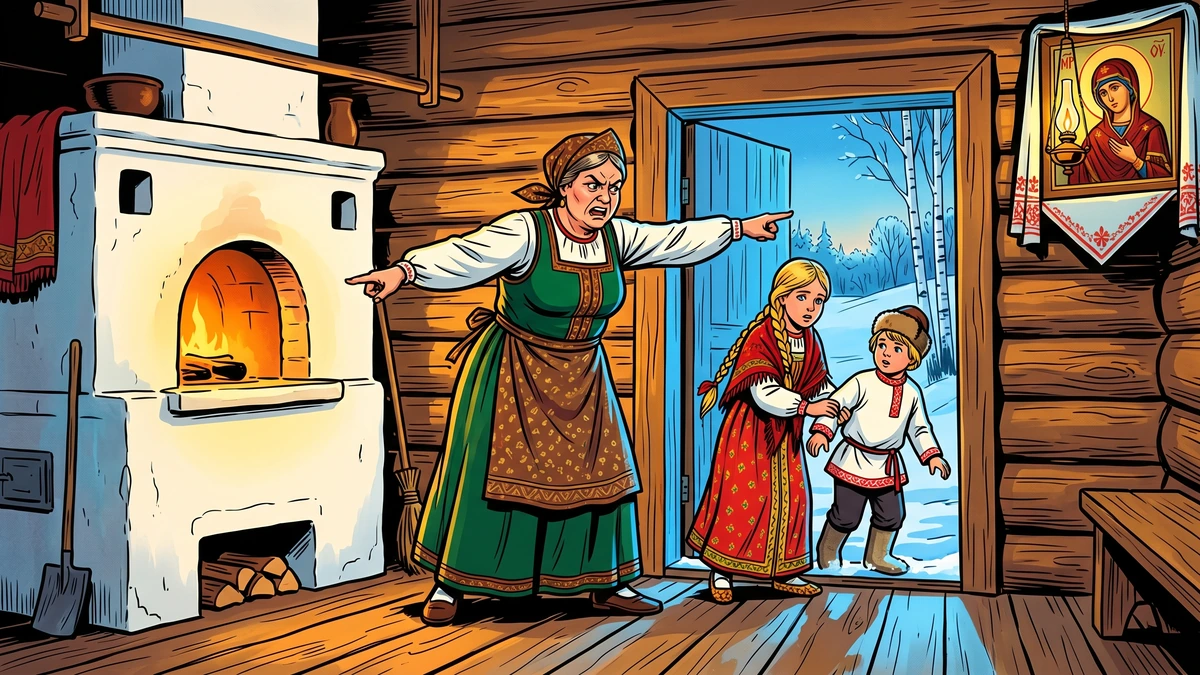
One morning the stepmother smiled the cold, untrustworthy smile that village children learn to fear. “Dear children,” she said, “go through the forest to my grandmother who lives in a hut on hen’s feet. She is a good old woman and she will give you sweet things to eat and you will be happy.” She did not say that the “grandmother” she meant was Baba-Yaga, the bony-legged one, who is sister to no living thing and grandmother only to the wind.
The sister was, as the storyteller insists, “a bright little girl,” and she had heard the village murmur about the forest hut. Instead of walking the road her stepmother had pointed out, she took her brother by the hand and ran to their real old grandmother — their own father’s mother — who lived in a little wooden cottage at the edge of the village with a kitchen garden and a beehive and an ikon of the Mother of God in the red corner. To her the twins poured out everything.
The good old grandmother heard the whole story, and then she said, with the particular tenderness of a Russian babushka who has lived through many such mornings: “Oh, my poor darlings, my heart aches for you, but it is not in my power to help you. You have to go not to a loving grandmother, but to a wicked witch. Now listen — I will give you a hint. Be kind and good to every one; do not speak ill words to any one; do not despise helping the weakest; and always hope that for you, too, there will be the needed help.” She gave them fresh milk to drink and a big slice of smoked ham, and pressed into the girl’s apron-pocket a fistful of dry cookies — for, the narrator solemnly observes, there are cookies everywhere. Then she stood for a long, long time at the gate, watching them disappear down the snowy track.
The Hut on Hen’s Feet
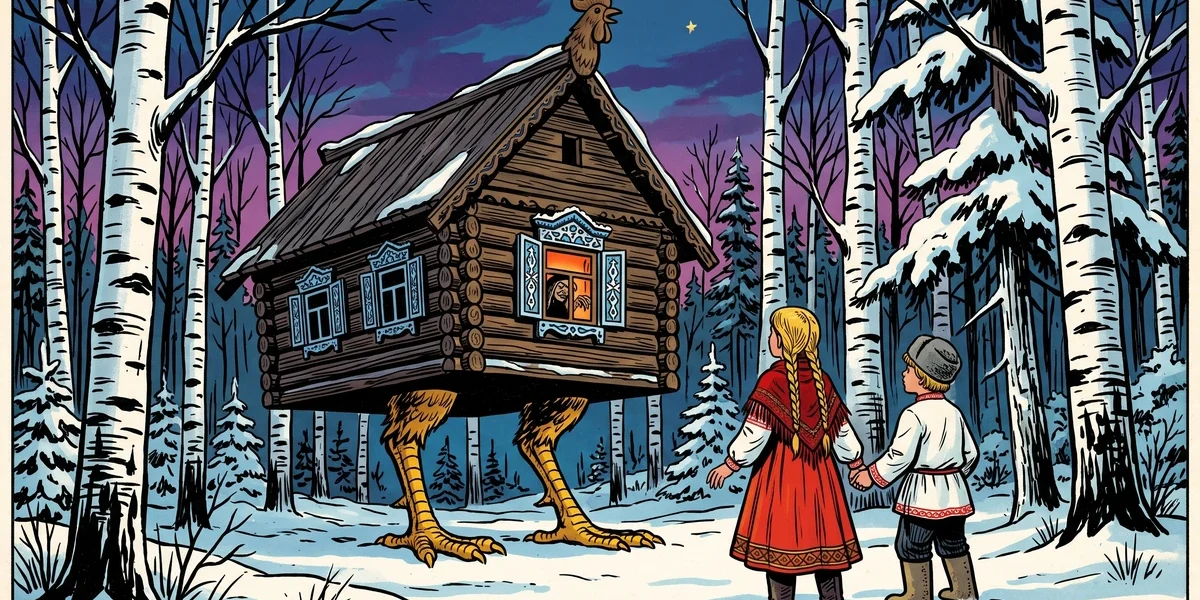
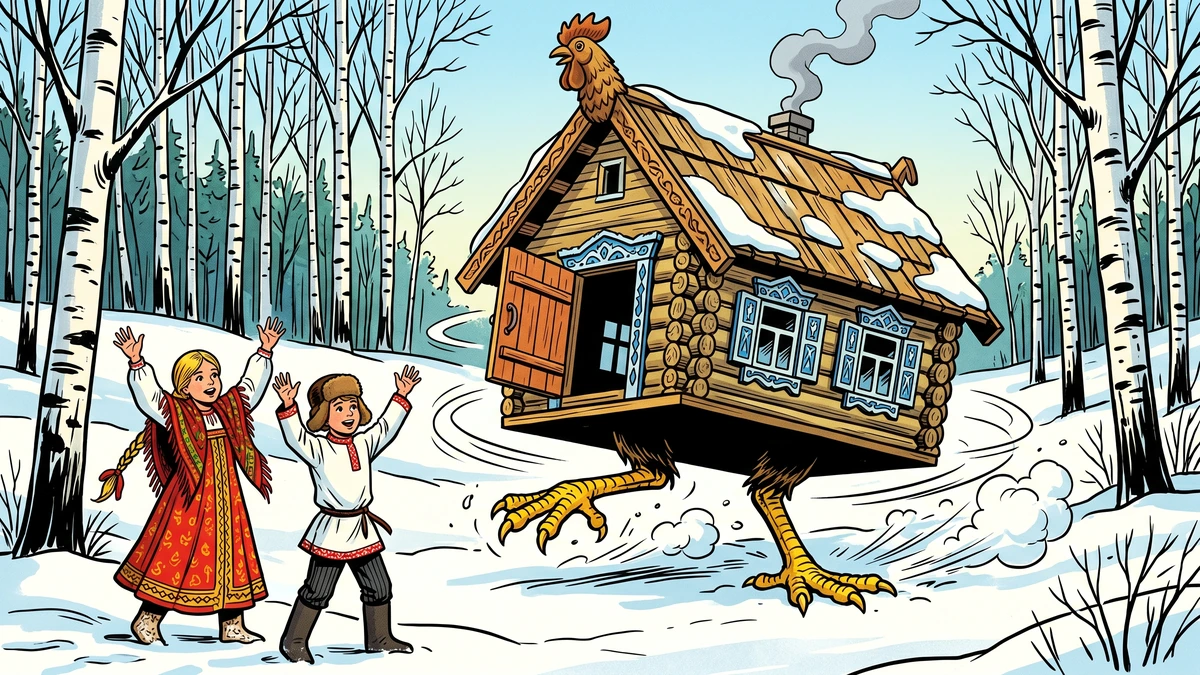
The twins walked deep into the great Russian forest — the kind of forest where the snow lies deep between the firs and the silence is so thick you can hear the frost cracking on the bark. And there, in a clearing where the path ended, stood a hut. But what a hut! It rose on two enormous yellow chicken-legs that bent and twitched as if alive, and at the very ridge-pole of the roof a wooden rooster’s head was carved, with crested comb and outraged eye. Smoke curled from its single chimney. The hut was turning slowly to face away from the children, as a cat turns its back on an unwanted guest.
The two orphans took breath, joined hands and, with their thin childish voices, called the formula the storyteller has preserved for almost two centuries: “Izboushka, Izboushka! turn thy back to the forest and thy front to us!” (“Izba” is the Russian word for a peasant cottage; “izboushka” is its diminutive — “little hut.”) The chicken-legged hut obediently rotated round on its claws and presented its door to them. They climbed the wooden step and looked inside.
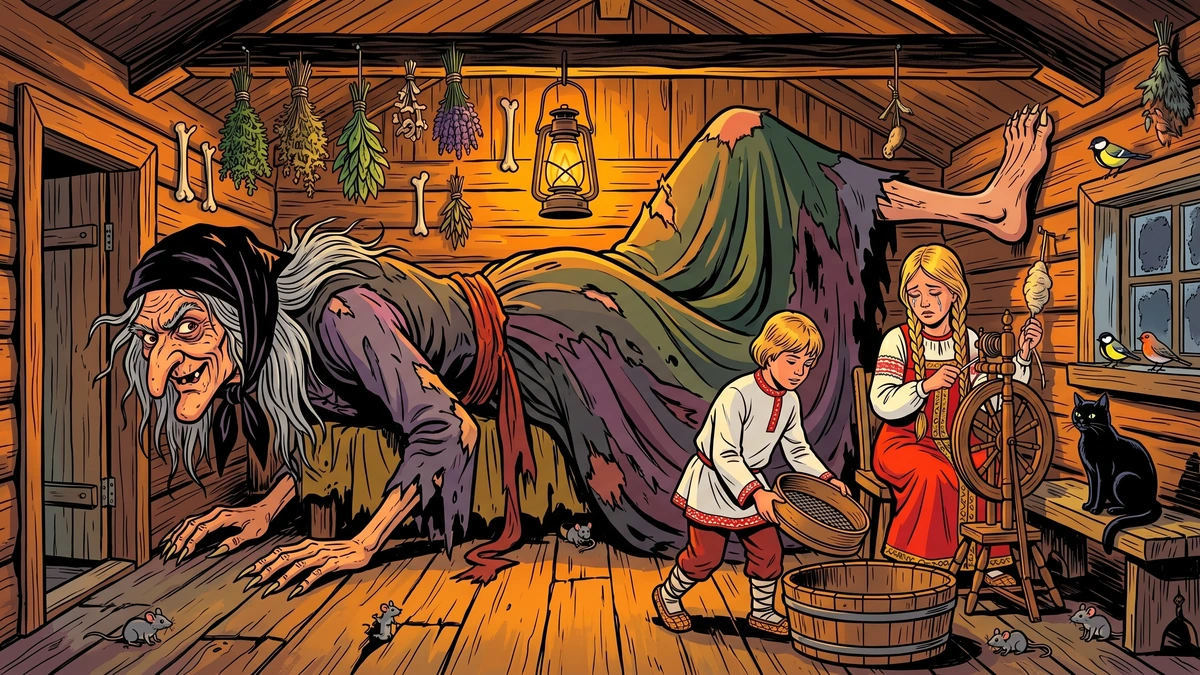
Baba-Yaga lay along the whole length of the one room. Her head was near the threshold, one bony foot rested in one corner and the other foot in the other corner, and her knees were drawn up so high that they almost touched the ridge-pole. Her nose was so long it could have ground grain, and from somewhere in the rafters there hung dried herbs and the bones of small animals. “Fou, Fou, Fou,” she rumbled — the witch’s growl every Russian child knows — “I feel the Russian spirit.” (In the original Russian: “Фу, фу, фу, русским духом пахнет!”) That sentence is a fixed formula of the Russian wonder-tale: the witch smells the living human as a wolf smells warm blood.
The children stood close together but spoke politely. “Ho, grandmother, our stepmother sent us to thee to serve thee.” Baba-Yaga’s eyes glittered. “Very good,” she said. “I am not opposed to keeping you, children. If you satisfy all my wishes I shall reward you; if not, I shall eat you up.” She set the sister at a spinning-wheel and told her to spin a great heap of flax into thread before nightfall; she sent the brother out into the yard with a sieve and ordered him to fill a great wooden tub with water carried in that sieve. Then the witch climbed back along her length and pretended to doze, listening.
The Helpers of the Forest — Mice, Cat, Birds
The sister sat at the spinning-wheel and wept; her tears fell on the flax. Out of the cracks in the floorboards came a host of small grey field-mice, twitching their whiskers and squeaking softly: “Sweet girl, do not cry. Give us cookies and we will help thee.” The sister, remembering her old grandmother’s words — do not despise helping the weakest — broke her cookies into small pieces and laid them out for the mice. They squeaked again, more gratefully now, and said: “Now go and find the black cat. He is very hungry; give him a slice of ham and he will help thee.”
In the yard, meanwhile, the boy was in despair. Every sieveful of water he carried from the well had vanished by the time he reached the tub. The tub stayed dry. A little flock of forest birds — chaffinches and tomtits and one bold grey siskin — alighted on the well-curb and chirped: “Kind-hearted little children, give us some crumbs and we will advise you.” The boy crumbled bread for them. They chirped: “Some clay and water, children dear!” and flew away. The boy understood: he packed the inside of the sieve with wet river-clay until the mesh was sealed, and from then on the sieve carried water like a copper pail. Inside, his sister was finding the black cat, slipping him slices of ham, smoothing his sleek fur, and asking him in a whisper, “Dear Kitty-cat, black and pretty, tell us what to do in order to get away from thy mistress, the witch?”
The cat — and Russian wonder-tales love a magical cat — answered seriously: “I will give you a towel and a comb. When you hear the witch running after you, drop the towel behind your back and a wide river will appear in place of the towel. If you hear her once more, throw down the comb and in place of the comb there will appear a dark wood. This wood will protect you from the wicked witch, my mistress.”
The Flight, the River, the Wood
That evening Baba-Yaga came scraping back to her hut and saw the spun thread coiled neatly in the basket and the great tub brimming. “Wonderful,” she muttered, narrowing her sharp eye. “Today you were brave and smart. Let us see tomorrow. Your work will be more difficult and I hope I shall eat you up.” The orphans lay down on the cold straw in the corner — not on a warm bed prepared by loving hands, the storyteller carefully notes — and they did not sleep. Before dawn they took the towel and the comb the cat had given them, and they ran.
The witch’s watchdogs came at them, snarling. The children threw them the last crumbs of the good grandmother’s cookies, and the dogs let them pass. The wooden gates of the courtyard would not open; the sister took the little flask of oil they had thought to bring and rubbed the rusty hinges, and the gates swung wide. The birch tree by the path tried to whip them across the face with its branches; the sister tore a pretty red ribbon from her own braid and tied it to the highest twig she could reach, and the birch lowered its arms in gratitude. So the twins ran out of the dark wood into the bright snowy field beyond.
Back in the hut, the black cat sat down at the loom and began deliberately to tangle and tear the thread to pieces, doing it with delight. Baba-Yaga returned and screeched with rage. “Where are the children? Why hast thou let them go, thou treacherous cat? Why hast thou not scratched their faces?” The cat answered, with the dignity of an animal that has counted its slights: “I have served thee these many years and thou hast never given me one bite. The dear children gave me good ham.” The witch scolded the dogs and the gates and the birch. The dogs said: “Thou art our mistress, but thou hast never done us a favour, and the orphans were kind to us.” The gates said: “We were always ready to obey thee, but thou didst neglect us, and the dear children smoothed us with oil.” The birch tree lisped through its leaves: “Thou hast never put a simple thread over my branches, and the little darlings adorned them with a pretty ribbon.”
Baba-Yaga saw there was no help to be had from any of them. In her fury she forgot to take the towel and the comb that would have protected her from her own magic. She jumped astride her broom and flew off after the children. (In some Afanasyev variants she rides her famous stupa, a great wooden mortar, sweeping the air with her pestle and the broom; here the simpler English re-telling keeps to the broom alone.)
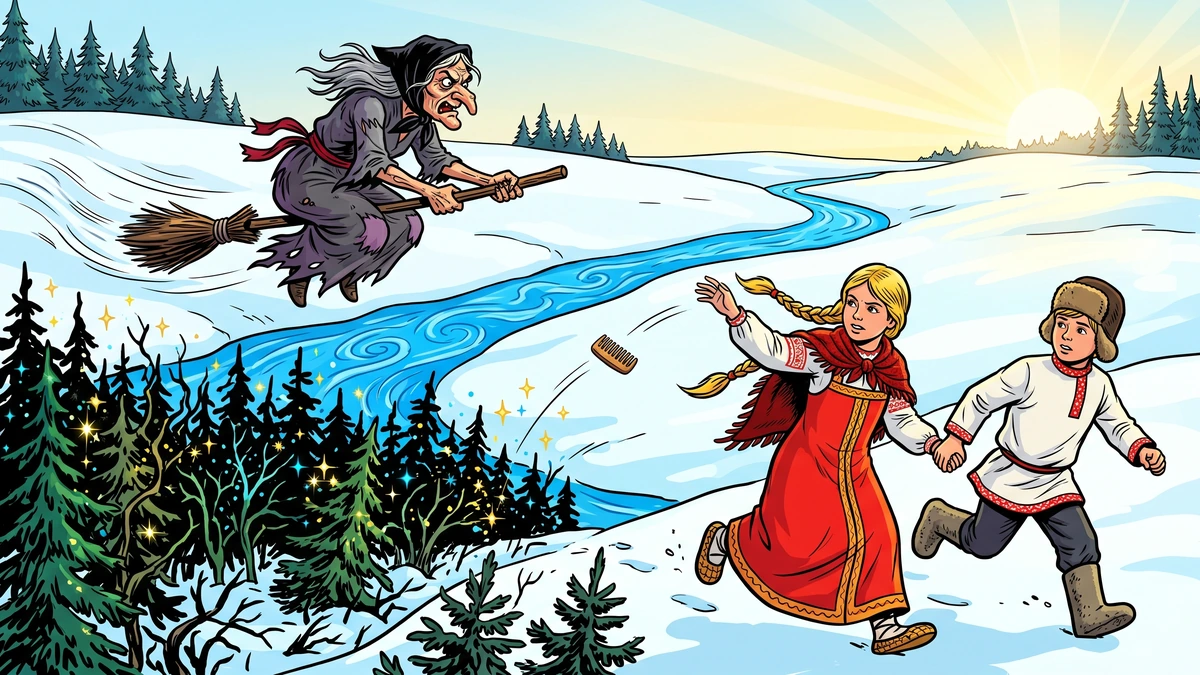
The children heard the wind of her coming and threw the towel behind them. At once a wide blue river spread across the snow, watering the field. Baba-Yaga hopped up and down the bank until she found a shallow place and waded across, her ragged skirts heavy with cold water. The children heard her hurrying again; they threw down the comb. In an instant a dark forest sprang up — a forest such as no axe could clear, its roots interwoven like steel cable, its branches matted, its tree-tops touching each other so that no daylight could come down between them. The witch tore her sleeves and her shawl trying to push through, and at last, defeated and very, very angry, she turned and went home.
Moral — The Old Grandmother’s Three Sentences
The orphans came at last to their father’s house and told him everything, ending with the question that lies, the storyteller knows, behind a great many Russian fairy tales: “Ah, father dear, why dost thou love us less than our brothers and sisters?” The father, who had loved the twins all along but had let himself be governed in his own house, was struck through the heart. He sent the wicked stepmother away and lived a new life with his children, and from that day he watched over their happiness and never neglected them any more.
«Не презирай помогать самым слабым, и для тебя тоже будет помощь.»
“Do not despise helping the weakest, and for you too there will be help.” — the good old grandmother’s parting words to the twins, the moral compass of the whole tale.
The tale is built on this single sentence and on its inverse. The children are saved not by strength, magic or luck, but by the small daily kindnesses they scatter in their wake — cookies for mice, ham for a hungry cat, crumbs for cold birds, oil for rusted hinges, a ribbon for a wounded tree. None of these acts looks like power. Each turns out to be power. Baba-Yaga, by contrast, has lived in her hut for a lifetime and never given the smallest favour to the creatures who serve her. When the moment of trial comes, every one of them turns from her — cat, dog, gate, birch. The Russian moral is severe and very practical: the witch loses because she has been a bad employer.
Historical and Cultural Context
Baba-Yaga is by far the most studied figure of Russian folklore. Vladimir Propp argued in his Historical Roots of the Wonder Tale (Leningrad, 1946) that she is a memory of the pre-Christian shaman-priestess of the forest, the female keeper of the threshold who initiated children into adulthood, and that her hut “on chicken legs” preserves a memory of the raised burial cabins of the ancient Finno-Ugric peoples, which were built on tall posts so animals could not reach the dead. The hut spinning on its leg, the witch lying along its length with her foot in each corner and her head near the threshold — every detail, Propp showed, is a fossil of an initiation rite older than writing in the Russian forests.
The tale was first written down in the great mid-nineteenth-century gathering of folklore that produced Alexander Afanasyev’s Народные русские сказки (8 vols., 1855–1863; second critical edition in 4 vols. 1873; reprinted Moscow 1957, ed. V. Ya. Propp). Afanasyev recorded several versions; the closest English re-telling is in V. X. Kalamatiano de Blumenthal’s Folk Tales from the Russian (Chicago, 1903), the same volume from which Woe Bogotyr is also drawn. Post Wheeler used a slightly different oral source in Russian Wonder Tales (London, 1912). Andrew Lang included a related Baba-Yaga story in The Red Fairy Book (1890) — the one with the doll given by a dying mother, which is now better known as Vasilisa the Beautiful, Afanasyev’s tale number 104. The version below is its older, more rural cousin: the brother-and-sister flight, with no doll, no princess, only the cookies and the kindness.
Anthropologists since Propp — including Joanna Hubbs in Mother Russia (Indiana, 1988), Andreas Johns in Baba Yaga: The Ambiguous Mother and Witch of the Russian Folktale (Peter Lang, 2004), and Sibelan Forrester’s introduction to Baba Yaga: The Wild Witch of the East in Russian Fairy Tales (University Press of Mississippi, 2013) — have stressed that Baba-Yaga is not simply “evil.” She is liminal. She tests. The Russian word for her own person, “костяная нога” (kostyanaya noga, “bony leg”), is itself the marker of her two-foot stance between worlds: one foot in the realm of the living, one in the realm of the dead. To the kind child she gives a horse, a comb, a magic sieve, a path home. To the cruel one she gives her oven.
Why This Story Has Lasted
It has lasted because every line in it doubles as a lesson and an image. The hut on chicken legs is a perfect children’s nightmare and a perfect adult metaphor: a house that turns its back on you if you do not know how to ask politely. The mice and the cat and the birds and the gates and the birch tree are not merely magical helpers — they are the model of all the small relationships an adult life is built on, the nameless people whom good fortune later depends on. The towel that becomes a river and the comb that becomes a forest are, in their literal way, what every fugitive child still wishes for: that the small things in a pocket might, in extremity, become whole landscapes of protection.
The Russian tale has carried this furniture out of the forest and into world culture. Mussorgsky put Baba-Yaga in his piano suite Pictures at an Exhibition (1874, the movement “The Hut on Fowl’s Legs”). Stravinsky drew on the Firebird and the witch’s broomstick flight for his ballet of 1910. Bilibin’s 1900 art-nouveau watercolours fixed her image for a century of Russian schoolchildren. In the twentieth century the witch crossed into English as Naomi Lewis’s children’s books, into French through Sylvie Germain, into American comics, into Hayao Miyazaki’s Howl’s Moving Castle (the wandering house), and most recently into Catherynne M. Valente’s Deathless (2011), which retells the cycle inside the Russian Revolution. The image of a hut that turns on chicken legs is now almost universal, and yet every version still rests on Afanasyev’s three small Russian sentences. The children gave cookies to the mice. They gave ham to the cat. They tied a pretty ribbon to the birch tree. That is the whole secret of the tale, and it does not grow old.
You May Also Like
 Russian Folk Tales
All Ages
Russian Folk Tales
All Ages
The Tsarevna Frog
The Tsarevna Frog: [Illustration] In an old, old Russian tsarstvo, I do not know when, there lived a sovereign prince with the princess his wife. They had
 Russian Folk Tales
Ages 9-12
Russian Folk Tales
Ages 9-12
The Frog Princess: A Tale of Love and Redemption
The Frog Princess: A Tale of Love and Redemption: In the days when magic still dwelt in the forests of ancient Russia, there lived a noble archer named Ivan
 Russian Folk Tales
Ages 9-12
Russian Folk Tales
Ages 9-12
The Three Kingdoms: Gold, Silver, and Copper
The Three Kingdoms: Gold, Silver, and Copper: Long ago, when the earth was still young and caves held wonders beyond counting, there lived a noble prince named