A Story Of Old Japan
A Story Of Old Japan: Long years ago in old Japan there lived in the Province of Echigo, a very remote part of Japan even in these days, a man and his wife.

Origin & Tradition
A Story of Old Japan belongs to the tradition of Meiji and Edo-period narratives that set the conflict between giri (義理, duty and social obligation) and ninjō (人情, human feeling and personal desire) as the central drama of Japanese moral life. This opposition — giri-ninjō — is one of the most productive tensions in the Japanese literary and folk-tradition, explored in kabuki drama, popular fiction, and the moral tales that circulated widely in the Edo period among the merchant and artisan classes who identified with characters caught between what they owed to others and what they felt for themselves. Tales of this type typically involve a moment of decision in which a character must choose, at significant personal cost, to honour an obligation that their feelings argue against.
Beat I — The Merchant’s Son and His Father’s Debt
In a prosperous merchant city of old Japan, a young man grows up knowing that his father died owing an enormous debt to a patron who had extended credit through years of difficult trade. The debt was not dishonestly incurred — it was the consequence of bad seasons and misfortune — but it was real, and the patron, who had since prospered greatly, had never pressed for repayment. The young man’s mother, now elderly, tells him that the debt is the family’s giri: not a legal obligation in the immediate sense, since the statute of limitations has passed, but an obligation of honour that cannot be discharged by the passage of time alone.
The young man is a skilled craftsman, well-regarded in his guild, and has recently agreed to marry the daughter of a neighbouring family — a woman he loves and who loves him. The marriage has been arranged, the date is set, the families have met. He is happy in the specific way that comes from knowing where the next years of your life will go and being glad of the direction.
Then the patron falls ill and his business collapses. He is old, without sons, and his creditors are circling. The young man calculates: the amount his father borrowed — with forty years of interest — would save the patron’s remaining years. It would also consume everything he has saved, including the marriage gift, and require him to defer the wedding for years he cannot fully estimate.
Beat II — The Moment of Choice
He goes to the patron’s house, introduces himself as the son of the man who borrowed long ago, and places the money before him. The patron, who has not thought of the debt in years — who had, in truth, written it off as a charitable gift to a good man in difficult circumstances — is overwhelmed. He refuses the money. The young man explains that refusing would be a kindness that costs the patron nothing and costs the young man everything: if the patron will not take it, the giri remains unpaid, and the young man cannot be fully himself while carrying an obligation he has not honoured.
The patron takes the money, weeping. The young man returns home, tells his betrothed what he has done, and waits for her response. She is quiet for a long time. Then she says: “I will wait.”
Beat III — Giri and Ninjō as Partners, Not Enemies
The giri-ninjō opposition is often described as a conflict, but the Japanese folk tradition that produced this tale understands it as a tension that, when navigated with sufficient wisdom and genuine feeling on both sides, can produce something more valuable than either element alone. The young man’s decision to honour the giri is not the suppression of ninjō — he loves his betrothed and the cost to him is entirely real. But the ninjō that is expressed through his relationship with her is deepened rather than diminished by the quality of his character, which the giri payment demonstrates.
His betrothed’s response — “I will wait” — is the tale’s most important single line. She does not pretend the cost is nothing; she does not perform cheerful sacrifice. She acknowledges what is being asked of her and chooses, from genuine understanding of who she is agreeing to wait for, to wait. Her choice is also giri — the obligation she has entered into with him — and also ninjō — the love that makes the waiting something other than mere endurance.
The Japanese tradition reads this not as a story about the suppression of personal desire by social duty, but as a story about the discovery that genuine personal character and genuine social obligation are, in a person of real quality, the same thing. The young man who honours his father’s debt is the same man his betrothed agreed to marry; the giri and the ninjō are expressions of the same underlying person.
Beat IV — What the Old Japan Remembered
Meiji-era collections of “stories of old Japan” frequently preserved tales of this type not as nostalgia for a lost world but as arguments about what was worth preserving from that world into the new one. The specific quality the tale endorses — the willingness to honour an obligation that no external force compels you to honour — was exactly what Meiji moralists feared would be lost in the rush to modernisation. The story’s claim is that this quality is not feudal but human: it appears in the merchant class, not the samurai, and it is honoured not by a warrior’s code but by a woman’s patient love.
“The duties we inherit from the past are not burdens unless we carry them without understanding — when we understand what they cost and why they mattered, the carrying becomes its own form of honour, and the past that shaped us becomes something we can finally choose.”
Why This Story Lasted
Tales of giri-ninjō have lasted in Japanese tradition because they address the experience — universal across cultures and eras — of being caught between what you feel and what you owe. The Japanese tradition’s specific contribution is the insistence that this is not always a tragedy: the person who can carry both genuinely, who honours the obligation without extinguishing the feeling and maintains the feeling without abandoning the obligation, achieves something that the opposition alone cannot name.
Giri-Ninjō in Japanese Culture
The giri-ninjō tension is the central dramatic engine of Edo-period kabuki and the popular fiction genre of sharebon (洒落本) and ninjōbon (人情本) — books of human feeling — that circulated widely among the merchant and artisan classes. It was analysed sociologically by Ruth Benedict in The Chrysanthemum and the Sword (1946) as one of the defining structures of Japanese culture, though Benedict’s analysis has been substantially revised by subsequent scholarship. Contemporary Japanese drama and literature continue to use the giri-ninjō framework as a productive lens for examining the relationship between social obligation and personal authenticity.
Frequently Asked Questions
What is the moral of A Story of Old Japan?
The obligations we inherit — whether from our parents, our communities, or our own commitments — are not external impositions on our true selves but expressions of who we are. The young man who honours his father’s debt is not sacrificing himself to duty; he is being himself fully, and what remains when the sacrifice is made is exactly the person his betrothed was willing to wait for.
What is giri and how does it differ from Western concepts of duty?
Giri (義理) is social obligation — the specific duties owed to specific people by virtue of relationships, debts, and social roles. Unlike Western concepts of duty, which are often grounded in abstract principle (Kant’s categorical imperative, for instance), giri is relational and particular: you owe specific things to specific people by virtue of what has passed between you. The young man’s giri to the patron exists because of his father’s specific debt to that specific person, not because of a general principle about debt repayment.
What is ninjō and how does it interact with giri?
Ninjō (人情) is human feeling — the emotional and personal dimension of experience, including love, desire, grief, and the wish to be happy. In Japanese social ethics, ninjō is not the opposite of giri but its complement and its source of difficulty: we feel things for specific people that sometimes pull against what we owe to other specific people, and the question of which to honour is the central drama of giri-ninjō tales. The best outcomes are not those where one suppresses the other but those where a person of genuine quality finds a way to honour both.
Why does the patron weep when the young man repays the debt?
Because the repayment reveals that the patron’s generosity — extended to the young man’s father without expectation of return — produced a character in the next generation that chose to return it anyway. The patron is weeping not for the money but for the evidence it provides that what he gave was received in the spirit it was offered, and carried forward in a way that exceeded anything he could have required.
What does the betrothed’s “I will wait” mean in context?
It means she understands who she agreed to marry, and that who she agreed to marry is exactly the person who would do this. Her waiting is not passive resignation — it is active affirmation: she is choosing to wait for a person whose quality the decision has demonstrated, which is the most reliable information she could have about the years ahead. “I will wait” is also her expression of her own giri and ninjō — the duty she has entered and the love that makes the duty genuine.
You May Also Like
 Japanese Folk Tales
All Ages
Japanese Folk Tales
All Ages
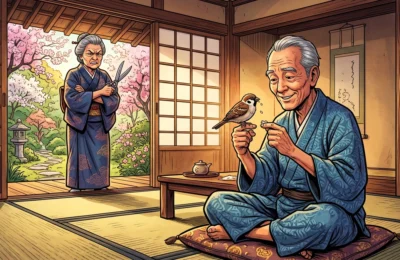
The Tongue-Cut Sparrow
The Tongue-Cut Sparrow: Long, long ago in Japan there lived an old man and his wife. The old man was a good, kind-hearted, hard-working old fellow, but his
 Japanese Folk Tales
All Ages
Japanese Folk Tales
All Ages
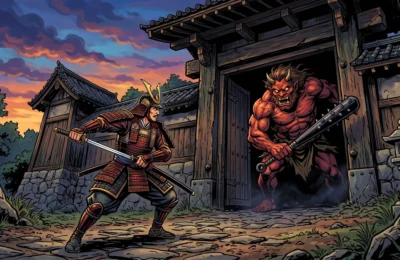
The Ogre Of Rashomon
The Ogre Of Rashomon: Long, long ago in Kyoto, the people of the city were terrified by accounts of a dreadful ogre, who, it was said, haunted the Gate of
 Japanese Folk Tales
Ages 6-8
Japanese Folk Tales
Ages 6-8
Momotaro: The Peach Boy
Momotaro: The Peach Boy: In the days when Japan was still finding its own voice, there lived in a small village nestled between rice paddies and gentle hills