The Two Brothers
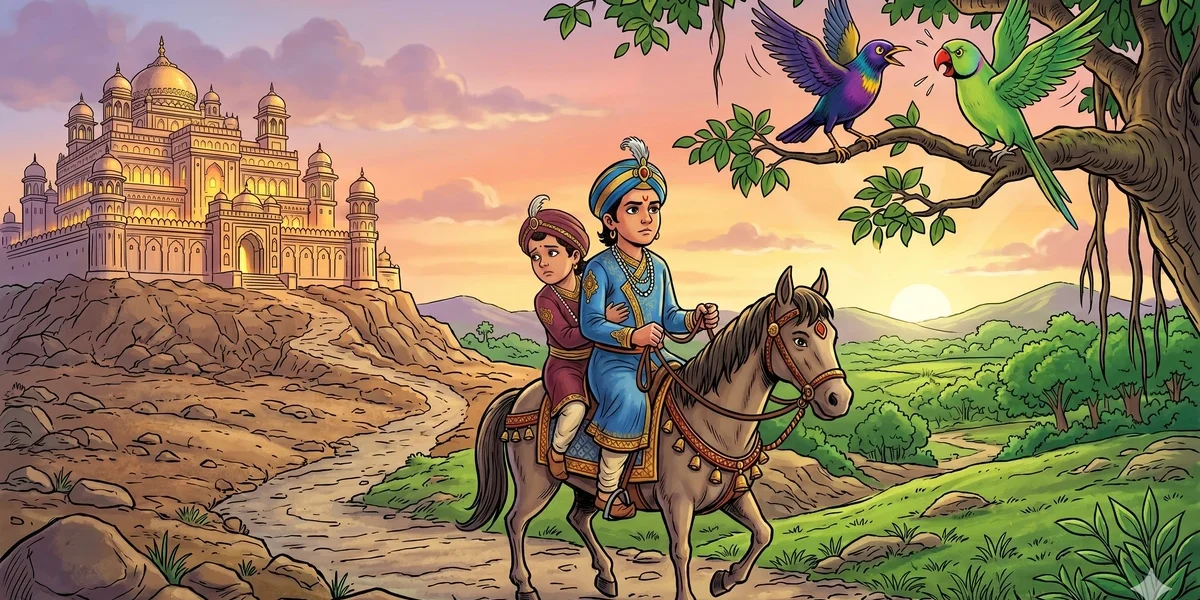
The Two Brothers: Once upon a time there lived a King who had two young sons; they were good boys, and sat in school learning all that kings’ sons ought to
Origin and Attribution
The story of the Two Brothers is one of the most widely distributed narrative types in world folk literature, documented across the Indian subcontinent in Hindi, Punjabi, Bengali, Telugu, Tamil, Kannada, and dozens of other regional variants, as well as in the European tale tradition, in Middle Eastern story collections, and in sub-Saharan African oral narrative. In the South Asian context, the Two Brothers tale belongs to a category that folklorists classify under the Aarne-Thompson-Uther index as type ATU 613 and related types — stories in which one brother succeeds through goodness, simplicity, or honest conduct, and a second brother attempts to replicate that success by mechanically copying the form of the first brother’s experience, without possessing the qualities that made it work. The structural message of all variants is identical: the qualities that produce fortune cannot be separated from the person who possesses them and transferred by imitation to someone who does not. Related tale structures appear in the Buddhist Jātaka tradition, in Sanskrit didactic collections, and in the oral traditions of virtually every region of the Indian subcontinent. The specific regional flavour — whether the fortune involves a magical helper, an encounter with spirits, a divine boon, or simply the rewards of honest work — varies enormously across tellings, while the structural and moral core remains constant.
“Yat param guṇa-sampanne — phalaṃ labdhaṃ svabhāvataḥ, tad eva lobha-mātrena — nānyena labhyate naraḥ.”
“What is received naturally by the one endowed with virtue cannot be obtained by another through mere desire alone.” — Sanskrit proverbial verse
Beat I — The Good Brother and His Fortune
The story’s first brother is characterised by kindness, honesty, and a disposition toward generosity that requires no calculation — the qualities that South Asian folk narrative consistently associates with those whom fortune favours. On a journey or in the course of his daily work, he encounters someone in need: a spirit, a divine being in disguise, an old woman, a sick animal, a traveller without food or water. He responds with genuine helpfulness, asking nothing in return and giving freely of what he has. The encounter produces a reward — magical, material, or spiritual, depending on the version — that transforms his circumstances.
He returns home changed in fortune but not in character. His goodness was not instrumental — not a strategy for obtaining reward — and the reward does not make him greedy or ambitious. He continues to live as he lived before, simply and generously, with the addition of whatever abundance the encounter brought.
The second brother observes his brother’s changed circumstances and interrogates him until he learns what happened. The account of the encounter — the kindness shown, the being met, the reward given — is absorbed by the second brother not as a story about his brother’s character but as a formula for replicating the outcome. He sets off to find the same situation, determined to perform the same actions and receive the same reward.
Beat II — The Imitator and His Failure
The second brother finds — or manufactures — the encounter. He performs the outward actions of his brother’s experience: the helping, the giving, the apparent generosity. But his performance is exactly that — a performance, executed for the purpose of obtaining the reward that he has seen his brother receive. The being he encounters, whether divine or magical or simply perceptive, reads the difference between genuine goodness and performed goodness. The result is not the reward his brother received but its opposite: failure, loss, misfortune, or in the darker versions, punishment.
The specific nature of the second brother’s failure varies across regional tellings. In some versions, the magical helper who rewarded the first brother is offended by the second brother’s transparent greed and curses him. In others, the mechanical imitation breaks down because the second brother cannot maintain the performance — his greed and impatience surface at the critical moment and expose the pretence. In others, he receives what he asked for, but because what he asked for was wealth rather than genuine good, the wealth comes with consequences he did not anticipate. Across all versions, the structural point is the same: the form of the first brother’s good action, divorced from the character that made it genuine, produces none of its results.
Beat III — Analysis in the Indian Didactic Tradition
The Two Brothers story engages one of the central tensions in Indian ethical thought: the relationship between dharma (right conduct) and its fruits (dharma-phala). The Indian tradition consistently teaches that right conduct produces good results — but it equally insists that right conduct performed in order to produce good results is not right conduct in the fullest sense. The Bhagavad Gītā‘s teaching of niṣkāma-karma — action without attachment to its fruits — is the canonical expression of this position: the action that is genuinely dharmic is the action performed because it is right, not because of what it will produce.
The second brother’s failure illuminates this distinction with precision. His imitation is formally identical to his brother’s action but motivationally opposite. The first brother gave because someone needed help; the second gave in order to receive a reward. These are not the same action wearing the same clothes — they are different actions wearing the same clothes. The tradition’s claim that the second brother will fail is not a moral punishment for hypocrisy; it is a structural claim that genuine qualities cannot be separated from the person who embodies them and transferred by mimicry to someone who does not.
Kautilya’s Arthaśāstra approaches this from a pragmatic direction in its discussion of what it calls āropita-guṇa — artificially attributed qualities, the pretence of virtue for strategic advantage. Kautilya notes that while performed virtue can produce short-term social benefit, it is structurally unstable because it creates a gap between the performed character and the actual character — a gap that will be exposed whenever the situation creates sufficient pressure to break the performance. The second brother’s imitation is āropita-guṇa: it works at the level of behaviour but not at the level of character, and the difference eventually shows.
Beat IV — The Moral and Its Living Relevance
The story’s moral addresses a temptation so universal that virtually every folk tradition in the world has found it worth encoding in narrative: the temptation to obtain through imitation what others have obtained through character. This temptation is particularly visible in contexts where someone’s success is attributed to a specific practice or behaviour — meditation, generosity, honesty, discipline — and others attempt to adopt the practice without adopting the underlying disposition that makes the practice meaningful. The practice without the disposition is the second brother’s imitation: formally correct, motivationally empty, and ultimately productive of the failure that revealed what was missing.
Contemporary relevance extends from personal ethics to professional culture to organisational behaviour. The company that adopts the superficial practices of a culture it admires without changing the underlying values that the practices express; the person who performs generosity for social recognition without experiencing the genuine impulse to give; the leader who mimics the communication style of those who are trusted without developing the trustworthiness that the style expresses — all of them are the second brother. The Two Brothers story is the folk tradition’s most economical way of pointing at what cannot be copied: the inner life that makes the outward action real.
Moral: Greed that attempts to replicate another’s fortune by copying the form of their luck without understanding its source will produce only misfortune; what one person received through virtue cannot be obtained by another through imitation.
Why This Story Has Lasted
The Two Brothers tale has lasted across virtually every human storytelling tradition because it encodes one of the most reliable observations about social life: that the qualities which produce good outcomes are internal, not external, and cannot be transferred by copying external behaviour. This observation is universal because the temptation it warns against is universal — the wish to obtain the fruits of a virtue one does not possess, through the performance of its outward form. The story offers no comfort to this wish: it says, consistently across every regional variant in every language, that the performance will be recognised as such by the universe or the divine or the perceptive being who dispenses fortune, and that it will produce nothing but the exposure of its own hollowness. This is a hard lesson, delivered with the economy and clarity that only narrative at its best can achieve — and the fact that it has been told, retold, and recognised across three thousand years of South Asian storytelling is evidence that the recognition it produces is both immediate and lasting.
About the Two Brothers Tale Type
The Two Brothers (ATU 613 and related types) is one of the most widely distributed narrative patterns in world folklore, documented across South Asia, East Asia, Central Asia, Europe, Africa, and the Americas. In the South Asian context, variants appear in virtually every regional oral tradition as well as in Sanskrit didactic collections and Buddhist Jataka literature. The story’s structural constancy across radically different cultural contexts — the good brother’s genuine virtue, the bad brother’s imitation, the failed imitation’s exposure — suggests that it encodes an observation about human character and its relationship to fortune that transcends any particular cultural framework.
You May Also Like
 Hitopadesha
Ages 3-5
Hitopadesha
Ages 3-5
The Jackal and the War Drum
The Jackal and the War Drum: In the dense forests of ancient India, where the mighty sal trees stood like sentries guarding the land, there lived a jackal
 Hitopadesha
Ages 6-8
Hitopadesha
Ages 6-8
The Story of the Vulture, the Cat, and the Birds
The Story of the Vulture, the Cat, and the Birds: Source: Hitopadesha | Type: Hitopadesha | Country: India | Language: English On the banks of the Ganges there
 Hitopadesha
Ages 3-5
Hitopadesha
Ages 3-5
The Mice That Set Elephants Free: A Hitopadesha Story of Reciprocal Kindness
The Mice That Set Elephants Free: A Hitopadesha Story of Reciprocal: In a land where the Vindhya Mountains stood like ancient guardians and the rivers sang