The Story of the Merchant of Seri (Expanded)
The Story of the Merchant of Seri (Expanded): Source: Hitopadesha | Type: Hitopadesha | Country: India | Language: English There was once a merchant named
Origin and Attribution
This story is drawn from the Hitopadesha (Hitopadeśa), compiled by the Sanskrit scholar Narayana Pandita in approximately the twelfth century CE at the court of King Dhavalachandra of Bengal. The tale is placed within Book I: Mitralabha (“The Gaining of Friends”), and draws on a narrative tradition that includes the Seri Vāṇija Jātaka (Jātaka no. 3) of the Buddhist Pāli canon — one of the earliest recorded merchant tales in South Asian literature. In the Jātaka version, the Bodhisattva appears as the honest merchant who recognises the value of a golden bowl held by a poor widow’s family, deals with them fairly, and acquires it justly, while a greedy rival merchant attempts to cheat the family, is exposed, and ends with nothing. The Hitopadesha‘s expanded version elaborates the ethical and commercial dimensions of the encounter, placing it within the tradition of vāṇijya-nīti — the ethics of trade — which Indian commercial culture, drawing on both Buddhist and Brahmanical sources, developed into a sophisticated body of practical wisdom. The city of Seri is identified in the Jātaka tradition as an ancient market city, and the Merchant of Seri has been a figure in Indian commercial ethics literature for more than two thousand years.
“Lābhāya jāyate lobhaḥ — lobhāt lābho vinaśyati, yo lobhena tyajed dharmaṃ — so ‘ntaḥ śūnyaṃ gṛhīti vai.”
“Desire for gain gives rise to greed — but from greed, the gain itself is destroyed. The one who abandons fairness for greed embraces emptiness in the end.” — Hitopadesha I
Beat I — Two Merchants, One Bowl
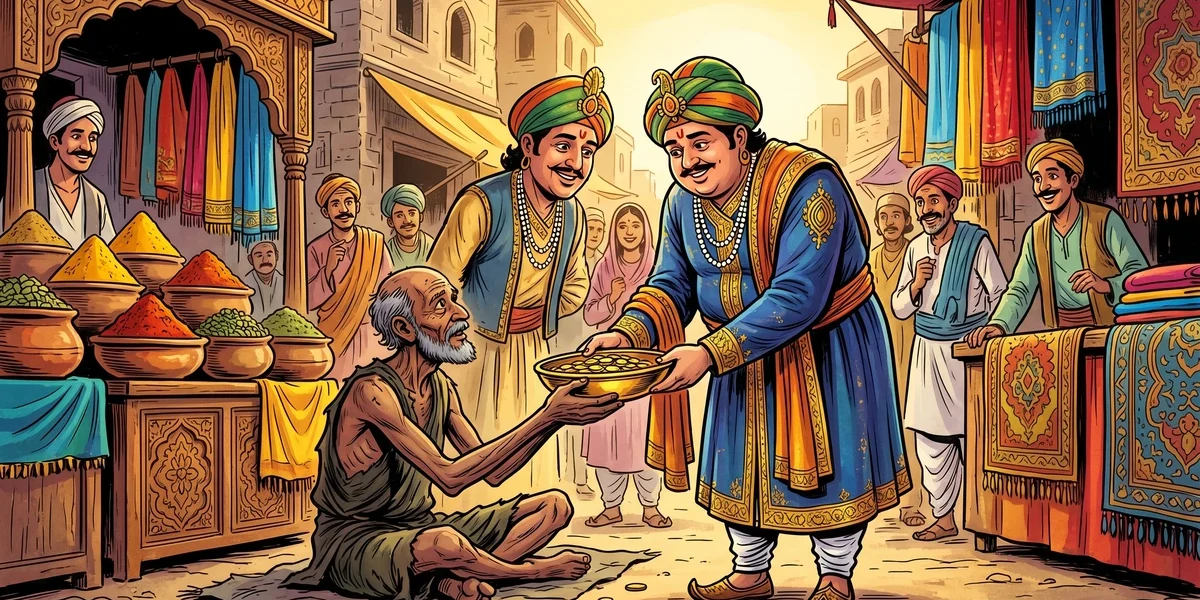
In the city of Seri, two merchants traded in pots and pans, travelling from village to village and exchanging their wares for household goods of value. They agreed to divide the city between them, each working a separate quarter, so as not to compete directly. In a poor household in one quarter, a family possessed a golden bowl — but did not know what it was. It had been used as an ordinary vessel for so long that its surface was entirely blackened with use, and the family assumed it was brass or copper.
The first merchant — the greedy one — came to the house and was shown the bowl as a potential item of trade. He scratched its underside with a fingernail, saw the gold beneath, and immediately understood what he was holding. His instinct was not to deal fairly but to acquire it for nothing. He told the family it was worthless — a piece of cheap metal that he could not use — and left, intending to return once they were sufficiently discouraged to give it away for a nominal price.
The second merchant — honest and perceptive — came to the same house in the normal course of his round. He was shown the same bowl. He too scratched its surface, recognised the gold, and felt the same awareness of its extraordinary value. But his response was different. He told the family exactly what he had found: this was a golden bowl of considerable worth. He offered them everything he had — all his merchandise, all his money — acknowledging that it was far less than the bowl’s true value, and that he was making the best offer he could with what he had, in honest recognition of what they possessed.
Beat II — Greed’s Outcome and Fairness’s Reward
The family, who had been told by the first merchant that the bowl was worthless, were astonished and grateful when the second merchant arrived with the truth. They accepted his offer — everything he had — as a fair exchange. The second merchant left the village carrying a golden bowl worth many times what he had given, and with a reputation for honest dealing that would serve him across every market he would ever enter. He had parted with everything he had at the moment of the transaction, but the transaction itself was the foundation of a recovery that would compound across a trading lifetime.
The first merchant returned to the house after some time, ready to complete his scheme. He found the bowl was gone. When he learned what had happened — that an honest merchant had come, told the truth, and traded fairly — his rage was overwhelming. He had possessed the information, the proximity, and the opportunity. He had used all three to construct a deception that the second merchant had dissolved with a simple act of honesty. The bowl, the transaction, and the relationship with the family were gone. He had nothing — and had paid a price in reputation that the Hitopadesha notes would follow him through every market and every village he would enter afterward.
Beat III — Analysis Through the Lens of Nītiśāstra
The Hitopadesha uses this story to articulate what it considers the foundational principle of sustainable commerce: that dharma in trade — fair dealing, honest representation of value, transparency about what one possesses — is not merely an ethical constraint on commerce but a structural advantage within it. The honest merchant’s action was not self-sacrificing; it was strategic in the deepest sense. He acquired the bowl at a price that was genuinely all he had, with no deception involved — and in doing so, he acquired not only the bowl but a reputation that the dishonest merchant was simultaneously destroying.
Kautilya’s Arthaśāstra treats commercial reputation (kīrti) as a form of capital — in some contexts more durable and valuable than material capital — and argues that merchants who operate across multiple markets and over extended time periods are systematically better served by honest dealing than by individual transactions in which deception produces a larger immediate gain. The dishonest merchant’s calculation was locally rational — he saw the opportunity and tried to extract maximum value from the asymmetry of information. But it was globally irrational, because commercial life is a repeated game, and the asymmetric information play that produces maximum gain in a single transaction destroys the relational capital that makes all subsequent transactions possible.
The Buddhist Jātaka tradition’s framing of this story — in which the honest merchant is identified as the Bodhisattva — adds a dimension the Hitopadesha inherits: the honest merchant’s choice is not merely pragmatically superior, it is morally superior in the fullest sense. The family’s right to know what they possessed was not something the merchant could legitimately override simply because he discovered their ignorance. Honest representation of value is, in this tradition, an aspect of satya (truth) and ahiṃsā (non-harm) applied to the commercial context — principles that the Hitopadesha, drawing on both Buddhist and Brahmanical sources, treats as foundational to any commercial relationship that is meant to sustain itself over time.
Beat IV — The Moral and Its Living Relevance
The story’s moral is expressed most sharply in the contrast between what the two merchants walked away with. The honest merchant left with a golden bowl and a reputation for fair dealing. The dishonest merchant left with nothing and a reputation for attempted deception. Both had possessed identical information and identical opportunity. The difference in outcome was produced entirely by the decision of what to do with that advantage: use it to inform the other party accurately, or use it to exploit their ignorance.
Contemporary relevance is immediate in any context where information asymmetry exists between parties — which is to say, in virtually all commercial, professional, and institutional relationships. The principle that exploiting information asymmetry for maximum immediate gain is locally rational but globally self-destructive is one that modern game theory has formalised in its analyses of repeated games. The Hitopadesha‘s merchant tale encodes this insight two thousand years before the formal analysis, in a form compact enough to be memorised and vivid enough to be taught to children: the merchant who takes everything leaves with nothing; the merchant who shares the truth leaves with everything worth having.
Moral: Greed that refuses a fair gain in pursuit of an unfair one ends with nothing; the merchant who grasps for the whole destroys both the opportunity and their own reputation with it.
Why This Story Has Lasted
The Merchant of Seri has endured for more than two thousand years — from its earliest appearance in the Buddhist Pāli canon through its elaboration in Sanskrit narrative tradition and its incorporation into the Hitopadesha — because it encodes one of the most fundamental insights of commercial ethics in a narrative so clean and vivid that no elaboration is required to grasp it. The golden bowl beneath the blackened surface; the scratch of a fingernail that reveals the truth; the choice of what to do with that revelation — these are images that work across every cultural and linguistic context in which fair dealing is valued and greed is recognisable as a form of self-destruction. The story has been cited in Buddhist Pāli commentaries, in Sanskrit commercial law texts, in medieval Indian mercantile guild traditions, and in modern discussions of business ethics. It is one of the few ancient commercial tales to have maintained active practical use across the full range of South Asian intellectual tradition — sacred, secular, scholarly, and popular simultaneously.
About the Hitopadesha
The Hitopadesha (“Beneficial Instruction”) was compiled by Narayana Pandita in Sanskrit, approximately the twelfth century CE, at the court of King Dhavalachandra of Bengal. Its four books on gaining friends, separating friends, war, and peace draw on the Panchatantra of Vishnu Sharma, the Nītiśāstra of Chanakya, and related Sanskrit narrative traditions including Buddhist Jātaka tale cycles. The text was among the earliest Sanskrit works translated into English (1787) and has exercised lasting influence on South Asian ethical and commercial thought.
You May Also Like
 Hitopadesha
All Ages
Hitopadesha
All Ages
Charity Alone Conquers
Charity Alone Conquers: In ancient times, there lived a wealthy king who ruled over a prosperous kingdom. He had everything a man could desire - vast The
 Hitopadesha
Ages 3-5
Hitopadesha
Ages 3-5
The Story of Fate and the Three Fishes
The Story of Fate and the Three Fishes: Source: Hitopadesha | Type: Hitopadesha | Country: India | Language: English In a certain pond there lived three fishes.
 Hitopadesha
Ages 3-5
Hitopadesha
Ages 3-5
The Story of the Faithful Rajpoot
The Story of the Faithful Rajpoot: Source: Hitopadesha | Type: Hitopadesha | Country: India | Language: English In the country of Rajputana there lived a