The Story of the Faithful Rajpoot
The Story of the Faithful Rajpoot: Source: Hitopadesha | Type: Hitopadesha | Country: India | Language: English In the country of Rajputana there lived a
Origin and Attribution
This story is drawn from the Hitopadesha (Hitopadeśa), compiled by the Sanskrit scholar Narayana Pandita in approximately the twelfth century CE. It appears in the context of Book IV: Sandhi (“Peace and Alliance”), which examines the conditions under which agreements between parties hold, and the ethics of commitment — including the commitment to protect those who have sought one’s shelter. The tale of the Faithful Rajput draws on the deep cultural tradition of pratiñjā — the solemn oath or pledge — that stands at the centre of Rajput warrior ethics, and which the broader kṣatriya-dharma (warrior code) treats as an absolute obligation. In the tradition of nītiśāstra, the pledge of protection (abhaya-dāna or śaraṇa-dāna) is among the most serious commitments a warrior or ruler can make, because it establishes a relationship of complete dependence on the one who has taken the pledge. To break such a pledge is regarded as the gravest possible violation of dharma, equivalent in the tradition to killing a Brahmin or abandoning a woman who has sought refuge.
“Śaraṇāgatam āgatya — yo na rakṣati mānavah, sa dharmaṃ hanti ātmānaṃ — kīrtiṃ ca naśayaty api.”
“The person who fails to protect one who has sought their shelter destroys dharma, destroys themselves, and destroys their honour besides.” — Hitopadesha IV
Beat I — The Pledge of Shelter
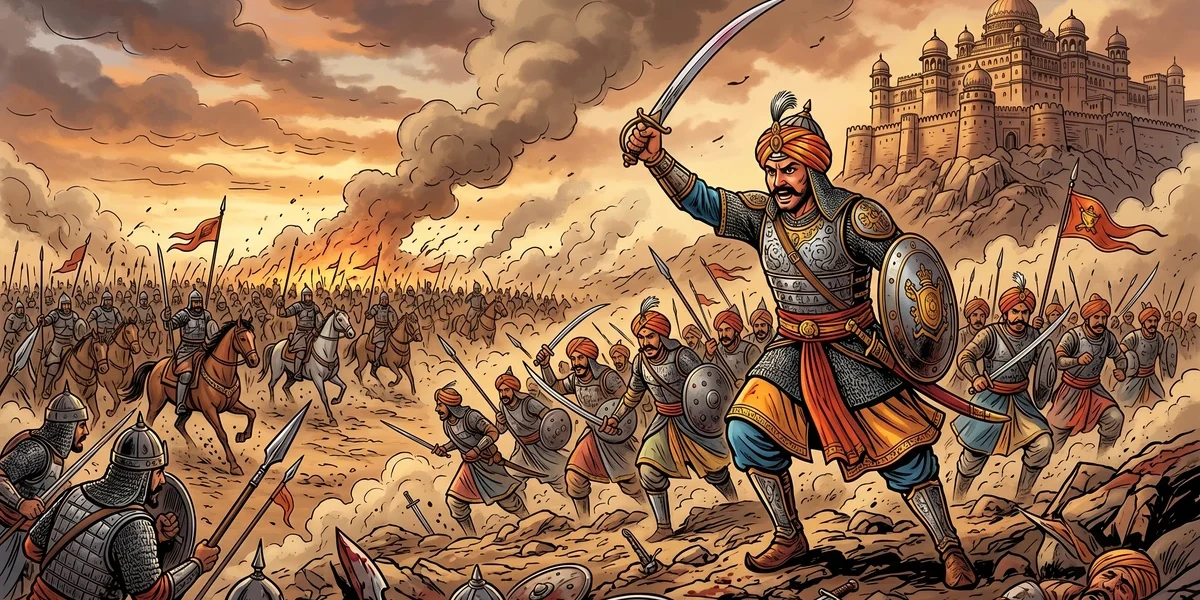
A Rajput warrior — a member of the martial caste whose code of honour was codified in the concept of Rajput dharma — was travelling through a region of conflict when he was approached by a man fleeing for his life from enemies who pursued him. The man threw himself at the Rajput’s feet and begged for protection. In the warrior tradition, this act — śaraṇāgati, the seeking of shelter — was unambiguous: it created an immediate and absolute obligation on the one approached. To grant the shelter meant pledging one’s life to defend the person who sought it. To refuse it was technically permissible; but to grant it and then withdraw the protection was the deepest possible dishonour.
The Rajput granted the shelter. He gave his word. The man who had sought protection entered the Rajput’s care, and the Rajput’s honour was now bound to his survival.
Shortly afterwards, the pursuers arrived. They were numerous, well-armed, and determined. They demanded that the Rajput surrender the man he was sheltering. The Rajput refused. The situation was clear: he was outnumbered, the odds were against him, and protecting this one man would cost him his life.
Beat II — The Test and the Choice
The pursuers attempted multiple approaches. They offered the Rajput safe passage if he would simply step aside. They suggested that one man’s life was not worth the Rajput’s death. They argued that no reasonable obligation required a warrior to die for a stranger whose case he did not even know. The Rajput heard all of this — and rejected each argument in turn, not with elaborate counter-reasoning, but with the simplest possible logic: he had given his word, and his word was not conditional on the odds.
The Hitopadesha relates that what followed was a fight. The Rajput defended the man he had sheltered. In some versions of the story the Rajput survives through extraordinary martial skill; in others he falls in the defence and is honoured posthumously as the supreme example of pratiñjā kept in full. Both endings carry the same lesson, which the text makes explicit: the warrior who kept his word, regardless of outcome, had preserved the thing that made him a warrior. The warrior who might have survived by breaking it would have destroyed the only substance his survival would have had.
Beat III — Analysis Through the Lens of Nītiśāstra
The Hitopadesha‘s placement of this story in Sandhi — the book on peace and alliance — is analytically precise. Sandhi is concerned with the conditions under which agreements hold. The story of the Faithful Rajput is placed here not as a celebration of individual heroism but as an analysis of what commitment means as a structural feature of alliance and governance. The Rajput’s pledge is not merely a personal act of honour; it is the instantiation of a principle that makes social trust possible at all. Communities, treaties, and alliances rest on the reliability of pledges. A warrior who breaks a pledge of protection when the cost becomes high has demonstrated that his pledges are conditionally reliable — which is to say, effectively unreliable, since their reliability precisely when it matters most is exactly what makes them valuable.
Kautilya’s Arthaśāstra addresses this in its chapters on the treatment of those who seek refuge in one’s territory. Kautilya argues that a king who surrenders a person who has sought his protection — regardless of external pressure — has destroyed the most important asset in statecraft: his credibility as a party whose commitments hold. No alliance, no treaty, no relationship of dependence can be built on a ruler whose pledges are subject to revision when their cost becomes apparent. The Rajput’s refusal to bargain with his word is, in Kautilya’s framework, not merely personal virtue but the maintenance of the political infrastructure of trust.
The story also engages the specifically Rajput concept of maryādā — the limits or boundaries of honourable conduct — which defines the Rajput identity as constituted by these limits rather than by birth or wealth or power. The Rajput who abandons his maryādā is not a Rajput who has made a rational survival choice; he is, in the tradition’s own terms, simply not a Rajput anymore. Identity, in this framework, is constituted by the consistency of conduct across the full range of situations — including and especially those where maintaining the conduct is costly.
Beat IV — The Moral and Its Living Relevance
The story’s moral is directed at a perennial human temptation: the renegotiation of commitments when their cost exceeds initial expectations. The logic of the pursuers — that no reasonable obligation requires self-sacrifice for a stranger, that the odds make the pledge impractical, that the Rajput could retain his honour by adjusting his interpretation of what he had promised — is not unreasonable by ordinary prudential standards. The Hitopadesha‘s response to this logic is not to engage it on its own terms but to shift the frame: the question is not whether the Rajput can survive by breaking his pledge, but whether the survival would be worth anything. A life whose commitments are subject to revision under pressure is a life that has substituted calculation for character.
The contemporary relevance spans from personal ethics to institutional governance. Organisations and leaders that deliver on commitments when delivery is easy but find sophisticated reasons not to deliver when delivery is costly are replicating the logic the Rajput rejects. The Rajput’s position — that a pledge is not a pledge if it comes with an implicit escape clause for adverse conditions — is the foundational argument for why unconditional reliability, rare as it is, constitutes such an extreme and lasting form of social and political capital.
Moral: Honour pledged is honour kept regardless of cost; the warrior who breaks a solemn oath to preserve his life has sacrificed the only thing that made that life worth preserving.
Why This Story Has Lasted
The Story of the Faithful Rajput has endured because it places the ethics of commitment in the most extreme possible test — where the commitment costs the one who made it everything — and refuses to soften the requirement. The tradition does not offer the Rajput a way out; it does not save him with a convenient reversal; it does not reward him with a miraculous intervention that makes the choice costless. In those versions where he falls in the defence, the story is at its most powerful, because it refuses to let the lesson depend on a good outcome. The Rajput’s conduct is validated independently of whether it is prudent by any other standard. This radical unconditionality is what has made the story the canonical example of pratiñjā in Rajput tradition, and what has given it a life not only in Sanskrit literature but in Rajput oral tradition, bardic poetry, and the cultural memory of the warrior communities of Rajasthan, Gujarat, and across northern and central India.
About the Hitopadesha
The Hitopadesha (“Beneficial Instruction”) was compiled by Narayana Pandita in Sanskrit in approximately the twelfth century CE at the court of King Dhavalachandra of Bengal. Drawing on the Panchatantra of Vishnu Sharma and the Nītiśāstra of Chanakya, it organises its instruction in four books on gaining friends, separating friends, war, and peace. The text was among the earliest Sanskrit works translated into English (1787) and has exercised sustained influence on South Asian ethical and political thought across more than eight centuries.
You May Also Like
 Hitopadesha
Ages 3-5
Hitopadesha
Ages 3-5
The Jackal and the War Drum
The Jackal and the War Drum: In the dense forests of ancient India, where the mighty sal trees stood like sentries guarding the land, there lived a jackal
 Hitopadesha
Ages 3-5
Hitopadesha
Ages 3-5
The Story of the Monkey and the Wedge
The Story of the Monkey and the Wedge: Source: Hitopadesha | Type: Hitopadesha | Country: India | Language: English In a certain town there lived a carpenter
 Hitopadesha
All Ages
Hitopadesha
All Ages
Harisarman the Clever Brahmin
Harisarman the Clever Brahmin: There was a certain Brahman in a certain village, named Harisarman. He was poor and foolish and in evil case for want of