The Story Of Chang To-Ryong
The Story Of Chang To-Ryong: [Taoism has been one of the great religions of Korea. Its main thought is expressed in the phrase su-sim yon-song, “to correct the

Origin & Tradition
The story of Chang To-ryong belongs to the rich Korean tradition of supernatural romantic encounter narratives — tales in which a being from beyond the ordinary world enters human society, assumes human form, forms genuine bonds of attachment, and must eventually navigate the tension between original nature and the obligations incurred through human relationships. The figure of the to-ryong (도령) — an unmarried young man of good family, often with an air of mysterious refinement — appears throughout Korean folk literature as a threshold character: someone whose exceptional beauty or accomplishment signals origins not entirely of this world. Stories of this type were preserved primarily through women’s oral traditions in the domestic sphere, and their emotional focus on the quality of connection rather than supernatural power distinguishes them from martial supernatural narratives. This tale was collected in multiple regional variants across the Gyeonggi and Chungcheong provinces.
Beat I — The Stranger of Impossible Refinement
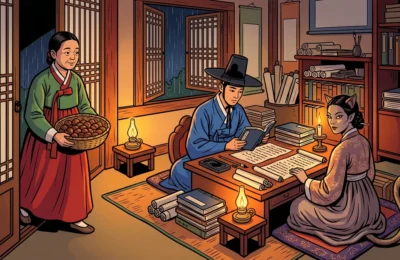
Chang To-ryong arrived in the village during the persimmon season, when the trees along the southern road were heavy with fruit and the air carried the particular dusty sweetness of early autumn. He presented himself as a young scholar from a distant province, separated from his party during travel, and asked for temporary lodging at the household of a widow who kept a small but respectable guesthouse. He paid generously, spoke with refinement that suggested deep classical education, and conducted himself with the modest precision of a man accustomed to careful social navigation.
The widow had a daughter of marriageable age, and the community began the quiet assessment that such a situation always prompted in Korean village life. Chang To-ryong’s origins were vague — the distant province he named was real but remote enough that nobody had direct connections there — but his manner was impeccable and his evident scholarship spoke to the cultivation that families sought in a son-in-law. He was deferential to elders and possessed of a quality of presence the village women described in terms usually reserved for temple statuary: something that drew the eye without demanding it.
What drew particular notice was his relationship with animals. Dogs that normally barked at strangers approached him with relaxed curiosity. Birds landed near him without the usual alarm. A traveling merchant’s horse that had been difficult all morning stood quietly the moment Chang To-ryong passed. These observations circulated through the village in the way small anomalies do — noted, discussed, ultimately attributed to some quality of calm temperament rather than anything requiring more disturbing explanation.
Beat II — The Bond That Forms Across the Threshold
The widow’s daughter — named Boksun in the tale — observed Chang To-ryong with the attention that confined domestic life permits: through doorway glimpses, through the evidence of his habits, through the servant girl’s reports. What she assembled was a picture of a man who seemed genuinely at rest in a way she had not previously encountered — not the lazy contentment of men without ambition, nor the controlled stillness of men who suppress their nature, but something more unusual: a being reconciled with whatever he was.
When the conventional approaches were made — widow consulting matchmaker, matchmaker making inquiries, Chang To-ryong responding with apparent interest — the process moved forward with expected forms. The exchanged horoscopes produced an auspicious reading. Gift exchanges were completed properly. The wedding was arranged for the following spring.
It was in the period of formal engagement, when the two had license to speak more directly, that Boksun asked Chang To-ryong the question the tale presents as its turning point. She asked him where he truly came from — not the province he had named, but the origin she sensed behind his human story the way she could sense the mountain behind low clouds. The question was asked gently, without accusation, more in the manner of a woman who has decided she would rather know than not know.
Chang To-ryong looked at her for a long time before answering. Then he told her. The tale varies in specifics across regional versions — in some he is the son of a mountain spirit, in others a sea dragon’s representative, in still others a celestial official on earthly assignment — but the structure of revelation is consistent: he is not human in origin, he has chosen this human form for reasons he cannot fully explain even to himself, and having formed the bond with her that he has formed, he does not know how to be other than what he has become in her presence.
Beat III — Cheongsaeng Yeonbun and the Ethics of Cross-Boundary Connection
Korean folk narrative recognizes a concept that provides the philosophical framework for Chang To-ryong’s situation: cheongsaeng yeonbun (천생연분, 天生緣分) — the heavenly fated match, the connection determined before birth by cosmic forces that human choice can fulfill or frustrate but cannot originate. In standard usage, the term describes human couples whose compatibility suggests predestination. The supernatural romantic encounter tradition extends it to connections that cross ontological categories: the mortal woman and the dragon son, the human man and the mountain spirit’s daughter, the scholar and the celestial maiden on earthly errand.
This extension carries significant philosophical weight. It implies that the cosmos does not regard the boundary between human and supernatural as the most fundamental organizing principle of relationship — that fated affinity can exist across this boundary as it does between humans of different class or region. Chang To-ryong’s entry into human life is thus not a trespass in the deepest sense but a response to a cosmic pull toward connection that his supernatural origin did not exempt him from. The problem his situation creates is not that the connection is wrong but that it is structurally asymmetrical: she ages and he does not, or she belongs entirely to the human world while he retains obligations to the world he came from.
The specific ethical burden the tale places on him is the obligation of disclosure — a theme recurring throughout Korean supernatural encounter literature. The being who adopts human form acquires, through the act of relationship, the obligations that human social life creates: honesty with one’s partner, accountability to the household one has joined, responsibility for consequences one’s presence creates in others’ lives. Korean folk ethics did not permit supernatural origin to exempt a being from these obligations. If anything, the being of greater power carried greater responsibility for transparency, because the power differential made concealment far more damaging than equivalent concealment between two humans.
The concept of cheong (정, relational attachment) reinforces this. Cheong in Korean folk understanding is not merely affection but a genuine ontological bond — a connection that, once formed, has moral weight independent of how it was formed. Once Chang To-ryong has formed cheong with Boksun and the widow’s household, his supernatural origin becomes secondary to the obligations cheong creates. He cannot simply depart and resume his former existence without those bonds releasing him, and they can only release him through honest reckoning, not abandonment.
Beat IV — The Moral and Its Endurance
The tale’s resolution varies by regional tradition, but consistently turns on whether Chang To-ryong meets the obligations his human bonds have created. In versions where he does — remaining, or departing with full honesty and appropriate provision, or negotiating his original world’s demands in ways that protect Boksun — the story ends with melancholy dignity: a recognition that some connections exist at a cost both parties accept. In versions where he fails — disappearing without disclosure, or being reclaimed violently without regard for human bonds — the story ends with Boksun’s grief held up not as personal tragedy alone but as indictment of cosmic arrangements that create bonds across categories without providing symmetrical resources to sustain them.
The moral preserved across generations was not a warning against loving beyond one’s ordinary world. Korean village audiences understood such loves happened and were not always failures. The moral was about obligations love creates regardless of the lover’s origins: that entering a human life means accepting human accountability, that power differential increases rather than reduces the obligation of care, and that cheong once formed cannot be dissolved by one party’s convenient return to a prior identity.
This is what distinguished the Chang To-ryong tradition from simpler supernatural seduction narratives: the insistence that the bond was real on both sides, that its obligations ran in both directions, and that the measure of a being’s character — human or otherwise — was the seriousness with which it treated the connections it had allowed to form.
“When a being of another world accepts the warmth of a human hearth, it has accepted the obligations of that hearth as well. This is the law that no origin excuses.”
— Korean proverb associated with supernatural encounter traditions
Why This Story Lasted
Chang To-ryong’s story endured because it gave Korean communities a way to think about obligations created by intimacy across difference — not only the literal difference between human and supernatural, but any connection where one party is more powerful or less subject to consequence than the other. Women’s oral traditions in particular preserved this narrative because it addressed the structural situation of marriage itself: a woman entering a household whose full nature she could not know in advance, forming bonds with someone whose deeper obligations to other worlds she could only partially perceive. The tale’s insistence on disclosure and accountability of the more powerful party gave these traditions language for expectations that ordinary social discourse did not easily accommodate.
The To-ryong Figure in Korean Folk Literature
The to-ryong (도령) archetype appears throughout Korean folk narrative as a young man of exceptional but slightly uncanny refinement — educated beyond the village’s normal range, possessed of beauty that tips into the unnatural, marked by simultaneous presence and apartness that signals origins beyond the ordinary. The figure appears in romantic folk tales, in shamanistic narratives where the to-ryong is a recently deceased young man whose unresolved earthly attachments must be ritually addressed, and in supernatural encounter stories like Chang To-ryong’s. The multiplicity of contexts reflects Korean folk imagination’s persistent interest in beings who occupy thresholds — whose nature places them at the boundary between categories that ordinary life keeps distinct.
Frequently Asked Questions
What is the central moral of “The Story of Chang To-ryong”?
The tale teaches that entering a relationship — even across the boundary between ordinary and supernatural existence — creates genuine obligations that cannot be dissolved by one party’s convenient return to a prior identity. Chang To-ryong’s supernatural origin does not exempt him from the accountability that cheong creates; if anything, his greater power increases his obligation of care toward Boksun and the human household he has joined.
What happens in the story?
A being of supernatural origin arrives disguised as Chang To-ryong, a scholar from a distant province. He lodges with a widow and her daughter Boksun, conducts himself with impeccable refinement, and enters a formal engagement with Boksun. When she asks him directly where he truly comes from, he reveals his supernatural nature. The story’s resolution varies by regional tradition but consistently turns on whether he meets the obligations his human bonds have created.
What is cheongsaeng yeonbun and how does it shape the tale?
Cheongsaeng yeonbun (천생연분) is the Korean concept of the heavenly fated match — a connection determined before birth by cosmic forces. In Chang To-ryong’s story, the concept is extended to connections crossing ontological categories, implying that the cosmos does not regard the boundary between human and supernatural as the most fundamental organizing principle of relationship. Chang To-ryong’s entry into human life is a response to a genuine cosmic pull rather than mere deception.
Why does Boksun ask about Chang To-ryong’s true origin?
Her question is presented not as suspicion but as a decision to trust the knowing over comfortable uncertainty. She has sensed the presence behind the human story and chosen to enter her engagement with full knowledge. Her willingness to ask — and receive the answer without flight — is presented as a form of courage equal to Chang To-ryong’s courage in answering honestly.
How does this story relate to the broader Korean supernatural encounter tradition?
What distinguishes the Chang To-ryong tradition from similar narratives in other cultures is the insistence on mutual obligation: the supernatural being who enters human life is not exempt from human relational accountability, and the human who bonds with a supernatural being is not simply a victim of cosmic caprice. Both parties are treated as moral agents whose choices carry genuine consequences — a specifically Korean contribution to the cross-cultural literature of human-supernatural romance.
You May Also Like
 Korean Folk Tales
Ages 6-8
Korean Folk Tales
Ages 6-8
The Wild-Cat Woman
The Wild-Cat Woman: [Kim Su-ik was a native of Seoul who matriculated in 1624 and graduated in 1630. In 1636, when the King made his escape to Nam-han from the
 Korean Folk Tales
Ages 9-12
Korean Folk Tales
Ages 9-12
The Goblin’s Magic Bat (Dokkaebi)
The Goblin's Magic Bat (Dokkaebi): In the mountains of Korea, where mist clung to the peaks like ancient dreams and the forest held secrets older than memory
 Korean Folk Tales
Ages 9-12
Korean Folk Tales
Ages 9-12
The Honest Witch
The Honest Witch: [Song Sang-in matriculated in 1601. He was a just man, and feared by the dishonest element of the Court. In 1605 he graduated and became a