The Prince and the Sphinx
The Prince and the Sphinx: In ancient Egypt, when the pyramids were still bright with polished limestone and reflected the sun like beacons to the gods, there
Most folk tales have no birthday and no birthplace. They drift down the centuries by word of mouth, changing a little in every telling, until no one can say where or when they began. The Prince and the Sphinx is the rare exception. It is a story we can date almost to the year, and we can still go to the exact spot where it was first set down — for it was carved into a slab of red granite more than three thousand four hundred years ago, and that slab still stands today, upright in the sand between the colossal paws of the Great Sphinx of Giza.
The tale tells of a young Egyptian prince who fell asleep in the shadow of the Sphinx during a hunt, and of the dream that came to him there: the great stone creature spoke, complained that the desert sand was burying it alive, and promised the prince the crown of all Egypt if he would only dig it free. It is a story about a sleeping monument, a sleeping prince, and a promise made in the heat of noon — and it is, as far as we know, the oldest recorded dream in human history to come with a happy ending.
Origin & Canonical Attribution
Tradition: Ancient Egyptian royal legend, preserved not by storytellers but by a stone monument. It is one of the very few narrative tales to survive from pharaonic Egypt in the words of the people who first told it.
Primary source: The Dream Stele (also called the Sphinx Stele or Sphinx Stela) — a tall slab of red granite, about 3.6 metres (12 feet) high and weighing some 15 tons, raised between the front paws of the Great Sphinx. Its hieroglyphic inscription is the original text of this story.
The prince: Thutmose IV (Egyptian Djehutymes, “Thoth is Born”), a son of Pharaoh Amenhotep II, eighth ruler of the Eighteenth Dynasty. He reigned in the New Kingdom, roughly 1401–1391 BC; the stele was set up in the first year of his reign, about 1401 BC.
The divine speaker: The Sphinx itself, worshipped in the New Kingdom as the sun-god Hor-em-akhet (“Horus of the Horizon”; transliterated Ḥr-m-Ꜻḫt), a name the Greeks later shortened to Harmachis. The stele gives his fuller solar title, Hor-em-akhet–Khepri–Re–Atum.
The monument’s own age: The Great Sphinx is far older than the tale. It was carved from the living limestone of the Giza plateau in the Old Kingdom, during the Fourth Dynasty, around 2500 BC, and is most often attributed to the pharaoh Khafre. By Thutmose’s day it was already more than a thousand years old and half-swallowed by sand.
Rediscovery: The stele was buried again by the desert for many centuries and was uncovered in 1817 by the Italian explorer Giovanni Battista Caviglia, who excavated the Sphinx’s chest. Its text was later published in standard editions and translated by Egyptologists, notably in James Henry Breasted’s Ancient Records of Egypt (1906).
Type & motif: A divine dream of royal legitimation — the “incubation dream,” in which a sleeper at a holy place receives a message from a god. Such king-making dreams are known across the ancient Near East, but the Dream Stele is the most famous, and the most monumental, of them all.
I. The Hunt on the Giza Plateau
The story opens with a young man who is not yet anyone in particular. Thutmose was a king’s son, but not the only one, and in the great royal households of Egypt a younger prince could spend a whole life in comfortable shadow, never coming near the throne. The crown was expected to pass elsewhere. What the prince did have was energy, and a love of the open desert, and the favourite escape of every restless young Egyptian noble: the hunt.
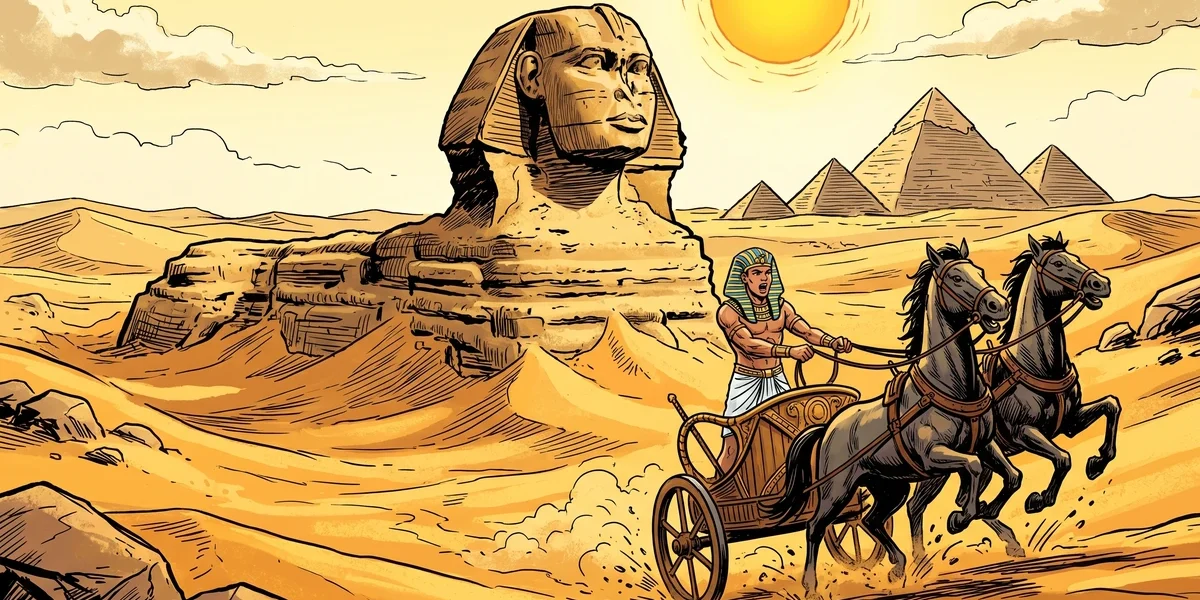
The stele describes him driving his chariot out across the plateau of Giza in the cool of the morning, his horses — swift and proud, the inscription says — carrying him in pursuit of desert game. He hunted lions and wild gazelle on the high ground above the Nile valley, and he hunted them in the way that pleased him best: alone, or nearly so, outrunning his companions and his attendants until the noise of the royal party fell away behind him and there was nothing in his ears but wind and hooves.
By midday the sun stood at the top of the sky. In the Egyptian desert that is no small thing; the heat at noon is a physical weight, and even a king’s son must find shade or suffer. The prince turned his horses toward the one great patch of shadow on the whole plateau — the long blue shadow thrown by the head and shoulders of the Great Sphinx.

And here the tale pauses to show us something the modern visitor can scarcely imagine. The Sphinx that Thutmose rode toward was not the clean, fully-exposed monument we photograph today. It was a drowning monument. A thousand years of wind had heaped the desert against it until only the great human head and the curve of the back rose above the surface. The paws, the chest, the mighty lion body — all of it lay hidden beneath the sand, as though the creature were sunk to its neck in a slow, golden flood. The prince guided his chariot into the shade of that half-buried face, climbed down, and stretched himself out on the warm sand to rest. Sleep took him almost at once.
II. The Sphinx Speaks in the Noonday Dream
What came next is the heart of the tale, and the stele tells it as a dream — but a dream of the particular kind the Egyptians took most seriously. To sleep in the precinct of a god and receive that god’s voice was not idle dreaming; it was a meeting. The Egyptians called such a holy place a place where the divine and the human worlds touched, and the Sphinx, in Thutmose’s age, was exactly such a place. The people of the New Kingdom did not see the monument as a portrait of a long-dead pharaoh. They saw a living god looking out of the stone — Hor-em-akhet, “Horus of the Horizon,” the rising sun given a face and a lion’s strength.
In the dream the god spoke. He did not threaten and he did not test; he spoke, the stele says, as a father speaks to a son. He told the prince who he was — Hor-em-akhet–Khepri–Re–Atum, the sun in all the names of its daily journey — and then he made his complaint, and it was a strangely humble one for a god. He was suffering. The sand of the desert, the very sand in whose shade the prince now lay, had crept up over his body and was pressing on him from every side. He was a great being held prisoner by something as small and patient as blowing dust.
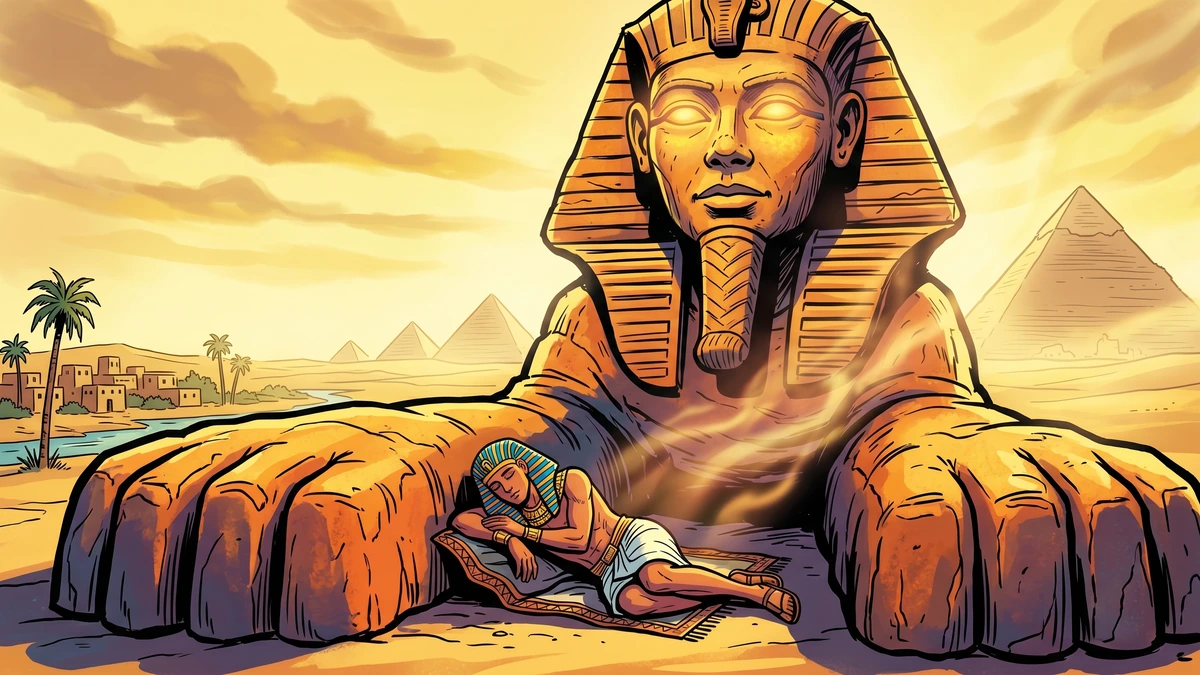
Then came the promise — the promise that turns a strange dream into a story worth carving in granite. If the prince would free him, the god said, if Thutmose would lift away the sand and let the Sphinx breathe and stand in the sun once more, then the kingship of Egypt would be his. Not a province, not a title, but the Double Crown itself: the white crown of Upper Egypt and the red crown of Lower Egypt joined on one head, and the throne of the Two Lands. The god promised that the years of Thutmose’s reign would be long, that his name would endure, and that the land would be his — all of it — in exchange for an act of rescue.
It is worth noticing what the god asks for. He does not ask for a temple of gold or a hundred oxen or a war fought in his name. He asks to be uncovered. He asks the prince to remove something, not to add something — to clear away the slow burial that time and neglect had laid over him. The reward is a kingdom; the price is a kindness.
III. The Clearing of the Sand
Thutmose woke as suddenly as he had slept. The sun had moved; the shadow had shifted; and the words of the god were still ringing in him with the peculiar clarity of a true dream — the kind one does not argue with and does not forget. The prince rose, took up the reins, and rode back to the royal residence carrying his secret like a coal cupped in both hands.
Here the tale steps from the world of dream into the world of work, and that is part of why it has lasted. A dream is given for nothing; what follows must be earned. The stele tells us that the prince did become king — whether the dream foretold it or simply emboldened him to claim it, the result was the same — and that once he wore the Double Crown, Thutmose IV remembered the bargain made in the noonday heat and set out to keep it.

To free the Sphinx was not the labour of an afternoon. It meant organising gangs of workers, hauling baskets, and moving an ocean of sand by hand under a sun that never relented. Basket by basket the desert was carried back, and basket by basket the great creature rose again into the light: first the broad chest, then the curve of the shoulders, then the enormous outstretched paws, each one longer than a row of houses. Where there had been a single watching head, there now stood the whole guardian, lion and king together, as the Old Kingdom carvers had first shaped it. The new pharaoh had paid his debt with the one currency the god had named — honest, patient labour — and the Sphinx stood clear of the sand for the first time in a thousand years.
IV. The Stele Between the Paws
A debt repaid in secret is only half a story. Thutmose IV wanted the bargain remembered, and he wanted it remembered in the most permanent way his civilisation knew. So between the great paws of the freed Sphinx — in the very spot where the prince had slept and the god had spoken — he raised a tall slab of red granite and had the whole encounter carved into it in rows of hieroglyphs. He built a small open-air chapel there, and the stele formed its back wall, facing out toward anyone who came to stand before the monument.

That granite slab is the Dream Stele, and it is the reason we can still read this tale. The stone-cutters of Thutmose IV had, with a fine sense of economy, reused for it an older block — a piece of fine granite carried long before from a temple of Khafre, the very pharaoh credited with the Sphinx itself. So the monument that records the rescue was made, fittingly, from the bones of the Sphinx’s own age. In time the desert returned and buried both stele and Sphinx once more, and the chapel between the paws was lost to sight for many centuries — until 1817, when the explorer Giovanni Battista Caviglia dug into the chest of the Sphinx and the lost slab came up again into the daylight, its top lines still sharp, its lower lines worn away. The dream had been buried, uncovered, buried, and uncovered again — the story re-enacting its own plot across three thousand years.
The Moral of the Tale
On its surface this is a tale of fabulous good luck: a younger son takes a nap and wakes up promised a throne. But that reading misses the quiet bargain at its centre, and the bargain is the whole point. The god does not give Thutmose a kingdom. He offers him one — on a condition — and the condition is service. The prince must dig. He must do the long, unglamorous, sand-in-the-eyes work of uncovering something great that neglect had let slip out of sight.
That is the tale’s real teaching, and it is sharper than it first looks. Greatness, the story says, is rarely something you build from nothing. More often it is something that already exists, magnificent and complete, but buried — under sand, under habit, under the slow drift of years in which everyone agreed not to notice it sinking. The worthy ruler, the worthy person, is not the one who happens to dream the right dream. It is the one who, on waking, picks up a basket. The Sphinx asked Thutmose to prove he deserved a crown by clearing away a burden that was not of his making, and that he could easily have ignored. He chose the basket. The crown followed.
“Behold me, look upon me, O my son Thutmose. I am thy father, Hor-em-akhet–Khepri–Re–Atum. The sand of the desert upon which I stand has reached me; turn to me, to have that done which I desire.”
— The Sphinx’s words to the prince, from the Dream Stele (the god named in Egyptian as Ḥr-m-Ꜻḫt, “Horus of the Horizon”)
Why the Tale Has Lasted
Most stories survive because people keep choosing to repeat them. The Prince and the Sphinx survived for a different and stranger reason: it was written in stone and then forgotten, and the stone simply waited. For more than thirty centuries the tale lay in the dark of the buried chapel, telling itself to no one, until a spade in 1817 let the light back in. There is something fitting in that. A story about a monument rescued from burial was itself a monument rescued from burial.
It has lasted, too, because it sits at the meeting point of history and legend, and refuses to belong wholly to either. Thutmose IV was a real pharaoh; the Sphinx is real; the stele is real and can be visited. Yet the heart of the tale is a talking statue and a dream that hands out kingdoms, and no spade will ever dig that up. Modern historians read the Dream Stele with a careful eye and suspect it of doing political work — of being raised, at least in part, to reassure Egypt that a prince who may not have been first in line had the blessing of the sun-god himself. But even read as royal persuasion, the tale keeps its grip, because the thing it persuades with is so human: a young person, alone in the heat, hearing a great old voice ask for help.
And it endures because its image is unforgettable. A boy asleep in the shadow of the largest statue on earth; the statue opening its stone mouth; a promise of a crown in exchange for the patient lifting-away of sand. Every visitor who has ever stood before the Great Sphinx and looked up at that vast, patient, weather-worn face has, in some small way, been waiting for it to speak. This tale is the one time, in all the long silence of the desert, that it did.
You May Also Like
 Arabian Nights
The Tale of Prince Agib
The Third Kalandar's Tale from the Arabian Nights: Prince Agib survives a ship-eating magnetic mountain, a brazen horseman and a boatman of brass, only to lose an eye to the one forbidden golden door he was begged to leave shut.
 Arabian Nights
Ages 9-12
Arabian Nights
Ages 9-12
Sinbad the Sailor – The First Voyage
Sinbad the Sailor - The First Voyage: In the ancient city of Baghdad, where palaces rose like mountains and the markets overflowed with the riches of the known
 Arabian Nights
Ages 9-12
Arabian Nights
Ages 9-12
The Fourth Voyage of Sinbad: Escape from the Cannibals
The Fourth Voyage of Sinbad: Escape from the Cannibals: I have told you of my three great voyages, my friends, but the fourth was perhaps the most terrible and