The Kingdom Of The Ogres
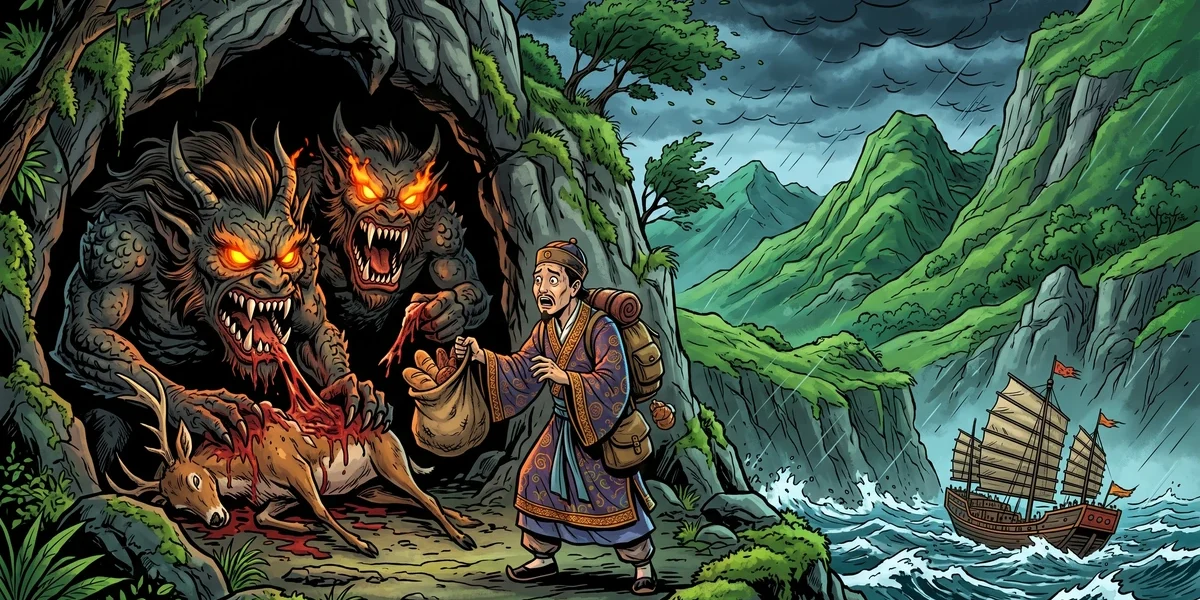
The Kingdom Of The Ogres: In the land of Annam there once dwelt a man named Su, who sailed the seas as a merchant. Once his ship was suddenly driven on a
Origin & Tradition
“The Kingdom of the Ogres” belongs to a distinctive category of Chinese folk narrative in which a human traveller or shipwrecked sailor finds himself in a land ruled by supernatural beings of the yao guai (妖怪, “strange demons”) type — beings who have organised themselves into a functioning polity but whose governing principles are radically opposed to the human social order. The story appears in Richard Wilhelm’s Chinesische Volksmärchen (1914) and participates in one of Chinese literature’s most productive traditions: the use of the demonic kingdom as a critical mirror of human society, an inverted world whose exaggerated vices expose by contrast the virtues that the human social order is supposed to embody. This tradition reaches its greatest literary elaboration in the supernatural kingdoms of Xi You Ji (西游記, Journey to the West, c. 1592), where Sun Wukong’s encounters with successive demon rulers form a sustained satirical commentary on imperial Chinese bureaucracy, religious hypocrisy, and the relationship between institutional authority and genuine virtue. The folk tale of the ogre kingdom belongs to the same tradition in a more compressed and direct form.
Part I — Arrival in the Inverted World
The story’s protagonist arrives in the ogre kingdom through the classic mechanisms of the adventure tale: shipwreck, magical displacement, a journey that takes a wrong turn at a supernatural junction, or the simple misfortune of being in the wrong place when the boundaries between realms are permeable. The arrival itself — the moment when the traveller first recognises that the land he has entered operates on different principles than any he has known — is the story’s most important narrative beat. He has entered not merely a foreign country but an inverted cosmos: a place where the governing logic is appetite rather than propriety, predation rather than production, raw power rather than legitimate authority.
The ogre kingdom is not chaos, exactly. It has a structure — a king or chief, subordinate officials, a population organised by rank and function. But the structure serves a different end than the human social structure it superficially resembles. In the human social order, hierarchy is supposed to exist to serve the common good: the ruler governs to protect and sustain the population, the officials administer to ensure justice and order, the social structure channels individual energy toward collective flourishing. In the ogre kingdom, the hierarchy exists to concentrate food — humans, in most versions — at the top. The ogre king rules not to protect his subjects but to take the best share of what the subjects capture; the ogre officials administer not to ensure justice but to ensure that the human captives are properly catalogued, stored, and allocated.
This inversion is the story’s primary satirical mechanism. The ogre kingdom is recognisably like a human kingdom — recognisably enough that the traveller can navigate its structures and even rise within them — but every function of the human social structure has been repurposed to serve appetite rather than order. It is human society with the ethical content removed and the institutional form retained: bureaucracy at its most corrupt, stripped of any pretence that it serves anything other than the interests of those who run it.
Part II — Survival Through Principle
The traveller’s survival in the ogre kingdom depends on the same quality that allowed the hero of the flying ogre story to defeat his adversary: clear-eyed observation of the adversary’s actual nature, combined with the application of principles that the adversary cannot fully counteract. The ogres are powerful and dangerous, but they are also, in their way, predictable — their appetites follow consistent patterns, their hierarchies create consistent vulnerabilities, their pride creates consistent blindspots.
The traveller navigates the ogre kingdom by doing, consistently and quietly, what the ogres cannot do: organising things effectively, communicating clearly, maintaining reliable commitments, executing tasks with the kind of competence that appetite-driven beings cannot sustain. The Confucian social virtues — ren (仁, benevolence), yi (義, righteousness), li (砃, propriety), zhi (智, wisdom), and xin (信, trustworthiness) — which seem like they would be useless or even dangerous in a kingdom that explicitly rejects them, turn out to be practically advantageous precisely because they are so unusual in that environment. The ogres cannot organise themselves effectively, because effective organisation requires at least minimal trustworthiness and impulse-control — qualities that appetite-driven beings struggle to maintain. The human traveller, who possesses these qualities as a matter of habit, finds that they are unexpectedly valuable in a market where they are desperately scarce.
The traveller may rise to a position of genuine influence in the ogre court — trusted precisely because he is trustworthy, given responsibility precisely because he is responsible — and use that position to eventually engineer his escape, often bringing other human captives with him. The escape typically requires the same combination of patient observation and decisive action that characterised the initial survival: a carefully chosen moment, a prepared route, the use of whatever tools the ogre kingdom’s own resources make available.
Part III — The Demonic Bureaucracy as Social Satire
The ogre kingdom’s most enduring satirical function is its exposure of the difference between institutional form and institutional substance — between having the structures of good governance and actually governing well. In the Chinese literary tradition, this distinction was perpetually relevant: the imperial bureaucracy was elaborate, sophisticated, and codified, but its actual operation depended on the individual virtue of its officials in ways that the formal structures could not guarantee. An official with genuine ren and yi could use the bureaucratic form to deliver genuine justice; an official driven by appetite and self-interest could use the same form to extract maximum benefit for himself while providing minimum service to the people he ostensibly governed.
The ogre kingdom makes this distinction visible by eliminating the middle ground: here there is no pretence that the institutional form serves anything other than appetite. The ogre court is what the human court would be if all the Confucian moral content were removed and only the power-concentrating mechanisms remained. By presenting this extremity so clearly, the story invites its audience to ask whether the human courts they actually inhabit are closer to the ideal or to the ogre version — and to recognise that the difference lies not in the institutional structures, which may be similar, but in the moral quality of the individuals who operate within them.
This satirical tradition was particularly sharp in the Journey to the West context, where successive demon kings rule over kingdoms that parody specific aspects of the Tang dynasty’s political and religious institutions. The Monkey King’s various encounters with demon bureaucrats expose, in the fantastic register, exactly the complaints about official corruption, religious hypocrisy, and institutional self-dealing that circulated in Ming dynasty political culture. The folk tale of the ogre kingdom operates in the same register, with less literary elaboration but the same underlying diagnostic impulse: the monster kingdom is the human kingdom’s shadow, showing what the human kingdom would be without the moral commitments that legitimate governance requires.
Part IV — Return and the Value of the Inverted World
The traveller’s return from the ogre kingdom is not merely an escape; it is a transformation. The experience of inhabiting an inverted world — of living in a social order defined by the absence of the values that make ordinary life possible — clarifies those values in a way that comfortable familiarity with them cannot achieve. The person who has lived among ogres knows, with a specificity and urgency that the sheltered person does not, why ren matters, why yi is not merely decorative, why the capacity for trustworthiness and reliable commitment is not a given but a precious and fragile achievement that requires constant maintenance.
This is the educational function of the inverted world in myth and folklore: not entertainment (though it provides that too) but a defamiliarisation of the ordinary that makes the ordinary visible again. We do not typically notice the moral infrastructure of everyday life because it is, like all infrastructure, invisible in its successful operation. It only becomes visible when it fails — or when we encounter a world in which it has been entirely dismantled, and we discover how much depends on what we had taken for granted. The ogre kingdom strips away the moral infrastructure and shows what lies beneath it; the traveller returns having seen what lies beneath, and cannot encounter the ordinary human world again with quite the same complacency.
“He lived among creatures who had appetite and nothing else, and discovered that appetite without order cannot even satisfy itself — that the ogres, for all their power, were chronically hungry in ways that their power could not address. He brought back something they could not name: the knowledge that some hungers can only be fed by what cannot be devoured.”
Why This Story Lasted
“The Kingdom of the Ogres” lasted because the fantasy of the inverted world — the place where ordinary rules do not apply and the hero must survive by their wits — is one of folklore’s most enduring structural pleasures. It combines the excitement of extreme danger with the deeper satisfaction of watching principles that seem merely decorative in ordinary life reveal themselves as practically indispensable in extremity. The Confucian virtues do not look like survival tools; the ogre kingdom demonstrates that they are.
The story also lasted because its satirical dimension gave it political relevance that pure adventure could not provide. In a society where official corruption was a chronic and well-documented problem — where the imperial bureaucracy’s formal virtue and its actual performance were frequently and embarrassingly mismatched — the story of a demon kingdom that runs on appetite rather than principle was recognisable as a comment on things closer to home than any distant land of monsters. The ogre king whose only principle is hunger has always had human analogues, and the story of how a principled person survives in his kingdom has always had practical as well as mythological applications.
You May Also Like
 Chinese Folk Tales
Ages 6-8
Chinese Folk Tales
Ages 6-8
The Eight Immortals (Ii)
The Eight Immortals (Ii) - a folk tale retold for young readers with a clear moral, simple words, and the warmth of a bedtime story from long ago.
 Chinese Folk Tales
Ages 6-8
Chinese Folk Tales
Ages 6-8
The Weaving Maiden Crosses The Silver River
Once a year, a star-maiden walks across a bridge of magpies to meet the boy who keeps the stars' cattle.
 Chinese Folk Tales
Ages 9-12
Chinese Folk Tales
Ages 9-12
The Lady Of The Moon
The Lady Of The Moon: In the days of the Emperor Yau lived a prince by the name of Hou I, who was a mighty hero and a good archer. Once ten suns rose together