The King Of Yom-Na (Hell)
The King Of Yom-Na (Hell): [Pak Chom was one of the Royal Censors, and died in the Japanese War of 1592.] In Yon-nan County, Whang-hai Province, there was a
Origin & Tradition
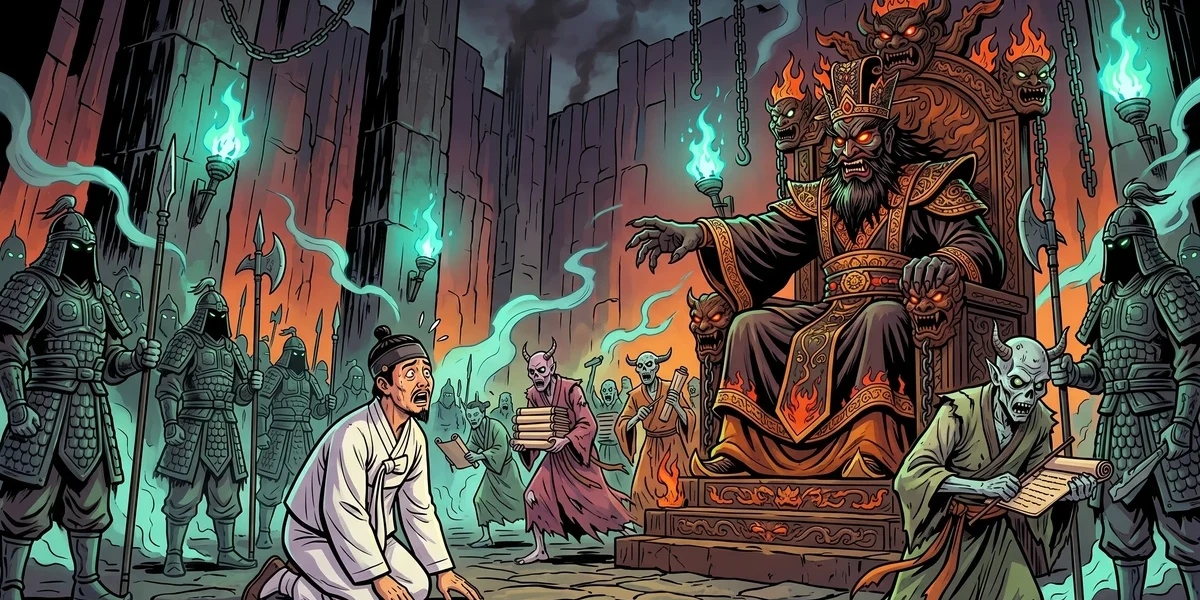
“The King of Yom-Na (Hell)” draws on one of the most thoroughly developed figures in Korean Buddhist folk cosmology: Yeomna-daewang (염라대왕, 閻羅大王), the Great King Yama who presides over the underworld court of the dead. The figure originates in Indian Buddhist cosmology as Yama, the first mortal to die who became ruler of the realm of the dead, was elaborated through Chinese Buddhist transmission into the Ten Kings of Hell (Siwang, 시왕, 十王) administrative system, and arrived in Korea thoroughly domesticated into Korean folk religious practice by the Goryeo dynasty (918–1392). By the Joseon period (1392–1897), the underworld court—jeoseung (저승, the realm of the dead)—had become a richly detailed parallel jurisdiction to the living world’s courts, equipped with its own bureaucracy, judicial procedures, and distinctive advantage over earthly justice: Yeomna-daewang’s eop-gyeong (업경, karma-mirror) showed the complete and uneditable record of every soul’s deeds in life. Before the karma-mirror, false testimony was impossible, bribery was meaningless, and the social power that distorted earthly verdicts evaporated entirely. Stories about Yeomna’s court used this framework to explore what justice would look like if it had access to perfect information and immunity from social pressure.
Beat I — The Wrongful Verdict
A poor farmer is accused by a wealthy neighbor of stealing a quantity of grain. The accusation is false—the grain was taken by a third party who has arranged to make the farmer bear the blame—but the farmer is poor, lacks witnesses, and cannot afford the kind of legal representation that might have navigated the Joseon magistrate’s court to a just outcome. The wealthy neighbor has connections to the local official, whose verdict reflects those connections rather than the evidence. The farmer is convicted, fined beyond his means, and reduced to a state of poverty so complete that he cannot feed his family through the following winter. He dies before spring.
The narrative presents this sequence without melodrama: it is the ordinary operation of a justice system in which social power distorts the distribution of verdicts in ways that everyone understands and most accept as inevitable. The farmer’s case is not exceptional; it is representative. He carries his grievance to death not because his case is unusually cruel but because the gap between legal outcome and actual truth is the ordinary condition of the earthly court.
Beat II — Before the Karma-Mirror
The farmer’s soul arrives in Yeomna’s court in the standard Korean folk Buddhist manner: escorted by two spirit-officials (jeoseung saja, 저승사자), presented before the Ten Kings in sequence, and finally brought before Yeomna-daewang himself for the definitive verdict. The karma-mirror is consulted. It shows, with the specificity of a complete recording, the full sequence of events: the neighbor’s grain taken by the third party, the scheme to deflect blame onto the farmer, the magistrate’s corrupt verdict, the farmer’s poverty and death.
The wealthy neighbor, who has also recently died and is present in the court—a narrative convenience that allows direct confrontation in the underworld—attempts the same social performance he used in the earthly court: confident assertion of his version of events, implicit reference to his social standing, expressions of wounded dignity at being questioned. Yeomna-daewang’s response is brief: the karma-mirror has already spoken. There is nothing to argue against a recording. The neighbor’s protestations are not testimony in this court; they are simply additional data about his character at the moment of judgment.
Yeomna-daewang’s verdict reverses the earthly court’s in every particular. The farmer’s soul is designated for a favorable rebirth reflecting the genuine conduct of his life. The neighbor’s soul is designated for a rebirth that reflects the genuine conduct of his. The third party, who has also died, receives an accounting for the original theft and the deliberate misdirection of blame. The underworld court’s verdict is not an emotional satisfaction of vengeance; it is the output of a system with better information than the earthly court possessed.
Beat III — Jeoseung Gongpan and the Theology of Perfect Information
The Korean folk Buddhist underworld court is, among other things, a thought experiment in judicial epistemology: what would justice look like if the court had access to complete and unalterable information about the events it was judging? The earthly court’s failures are not primarily failures of will—though corruption and social bias are real—but failures of knowledge. The magistrate does not know what the karma-mirror knows. He must judge from testimony, which is biased, and from evidence, which is incomplete. His verdict reflects the best available information filtered through the social pressures of his context. The underworld court has no such limitations.
This is why Korean folk tradition positions the jeoseung gongpan (저승 공판, underworld trial) not as revenge but as correction. It is not that the earthly court was wrong to work with available information; it is that available information was insufficient. The underworld court completes the record rather than condemning the earthly verdict as malicious. This framing is important: it allows the tradition to critique earthly justice systems without demanding that they achieve an impossible standard, while still insisting that the cosmos maintains an accounting that will eventually produce accurate verdicts. The earthly court does its imperfect best; the underworld court does what the earthly court could not.
The figure of Yeomna-daewang embodies this function in his personal character as Korean folk tradition developed it. Unlike the fearsome depictions of hell-judges in some Buddhist artistic traditions, the Korean Yeomna is characteristically solemn rather than terrifying—a bureaucrat of cosmic proportions who takes his judicial function seriously precisely because it is the last correction available for cases that the living world got wrong. His seriousness is not cruelty; it is the appropriate gravity of a judge who knows that his verdicts are final and that finality demands accuracy.
Beat IV — The Moral and Its Reach
The story’s resolution—underworld justice correcting earthly injustice—offers its Korean audiences a specific kind of consolation that is neither passive acceptance nor revolutionary demand. It does not say that earthly injustice is acceptable; the farmer’s story is presented as a genuine wrong that deserved a different outcome. It does not say that earthly courts should stop trying; the implication is that better information and less social distortion would produce better verdicts. But it does say that the cosmic ledger is accurate even when the earthly one is not, and that those who have been wrongly judged in this life will be correctly judged in the next.
This proposition served an important social function in a society where access to justice was heavily stratified by economic and social position. For the farmer who knew he could not win in an earthly court, the underworld court was not merely a comforting fantasy; it was an alternative accountability system that maintained the proposition that justice was real even when it was locally inaccessible. The story is not an argument for quietism—it does not say “accept your earthly injustice and wait for the afterlife.” It is an argument for cosmic coherence: the world is ordered in such a way that accurate accounting eventually occurs, even if the accounting is deferred until a court with better equipment can conduct it.
“Yeomna-daewang does not ask what the magistrate decided; he asks what actually happened. These are the same question only when the magistrate had the karma-mirror.”
— Korean Buddhist folk saying, associated with jeoseung narrative tradition
Why This Story Has Lasted
“The King of Yom-Na (Hell)” endures because it addresses the persistent human experience of witnessing or suffering injustice that the available institutions cannot correct. The underworld court’s claim to authority rests on a single but decisive advantage: it consults the true record. This is not a miraculous power in the story’s logic—it is simply what a properly functioning court would do if it had access to complete information. The story’s lasting power comes from its implicit argument that justice is not impossible but is frequently blocked by information asymmetry and social distortion, and that a world without those obstacles would produce different outcomes. Yeomna’s court is the model; earthly courts are the approximation. The gap between them is the measure of how much human institutions still have to learn from their cosmic counterpart.
Yeomna-Daewang and the Ten Kings of the Korean Buddhist Underworld
The Korean underworld judicial system (jeoseung, 저승) as elaborated in folk Buddhist tradition consists of ten kings who each evaluate the soul of the dead over a period of forty-nine days, with Yeomna-daewang presiding over the fifth and most important tribunal. The eop-gyeong (업경, 業鏡, karma-mirror) that Yeomna consults is a device that displays a complete and accurate recording of the soul’s actions in life—a concept without direct Indian Buddhist precedent that appears to be a Chinese and Korean elaboration of karmic accounting principles. The Ten Kings system was institutionalized in Korean Buddhist practice through the Siwang-gyeong (시왕경, Ten Kings Sutra) and related ritual manuals, and the forty-nine-day memorial service performed for the deceased in Korean Buddhist practice is structured around the ten tribunals. The jeoseung saja (저승사자, underworld messengers) who escort the soul to judgment are depicted in Korean folk art as fierce officials dressed in black, a motif that appears across Korean shamanic (musok) and Buddhist funerary art.
Frequently Asked Questions
- What is the moral of “The King of Yom-Na (Hell)”?
- That the cosmic ledger is accurate even when earthly courts are not. Justice may be deferred when living institutions lack information or are distorted by social power, but it is not ultimately cancelled. The underworld court corrects what the earthly court got wrong not through revenge but through access to the complete and unalterable record of what actually occurred.
- What happens in “The King of Yom-Na (Hell)”?
- A poor farmer is wrongly convicted of theft due to a corrupt earthly court and dies in poverty. In Yeomna-daewang’s underworld court, the karma-mirror displays the complete true record of events, exposing the actual thief and the corrupt verdict. The underworld court reverses the earthly verdict entirely: the farmer receives a favorable rebirth, and those who engineered his suffering receive judgments reflecting their actual conduct.
- Who is Yeomna-daewang in Korean Buddhism?
- Yeomna-daewang (염라대왕, 閻羅大王) is the Great King Yama, presiding judge of the Korean Buddhist underworld. Derived from the Indian Buddhist figure of Yama (first mortal to die, ruler of the dead), elaborated through Chinese Buddhist transmission into the Ten Kings of Hell system, and domesticated into Korean folk religious practice by the Goryeo period. He presides over the fifth and most important underworld tribunal, consulting the karma-mirror to render definitive verdicts that determine the soul’s next rebirth.
- What is the eop-gyeong (karma-mirror)?
- The eop-gyeong (업경, 業鏡) is the karma-mirror in Yeomna-daewang’s court—a device that displays a complete, accurate, and unalterable recording of a soul’s actions in life. It is the underworld court’s decisive technological advantage over earthly courts: before it, false testimony is impossible, bribery is meaningless, and the social power that distorts earthly verdicts has no purchase. The karma-mirror transforms the court from a venue for competing accounts into a venue for consulting an objective record.
- How does this story relate to Korean attitudes toward earthly justice?
- The story reflects a realistic assessment of Joseon-era judicial practice, in which access to justice was heavily stratified by economic and social position, and verdicts frequently reflected the relative power of the parties rather than the evidence. Rather than demanding revolution or counseling passive acceptance, the story offers a third position: the earthly court is imperfect but improvable, the underworld court is perfect by design, and the gap between them is both a critique of current institutions and a promise that accurate accounting will eventually occur.
You May Also Like
 Korean Folk Tales
Ages 9-12
Korean Folk Tales
Ages 9-12
Tokgabi And His Pranks
Tokgabi And His Pranks: Tokgabi is the most mischievous sprite in all Korean fairy-land. He does not like the sunshine or outdoors, and no one ever saw him on
 Korean Folk Tales
Ages 6-8
Korean Folk Tales
Ages 6-8
The Awful Little Goblin
The Awful Little Goblin: There was an occasion for a celebration in the home of a nobleman of Seoul, whereupon a feast, to which were invited all the family
 Korean Folk Tales
Ages 9-12
Korean Folk Tales
Ages 9-12
Hong’s Experiences In Hades
Hong's Experiences In Hades: Hong Nai-pom was a military graduate who was born in the year A.D. 1561, and lived in the city of Pyeng-yang. He passed his