Ten Thousand Devils
Ten Thousand Devils: [Han Chun-kyom was the son of a provincial secretary. He matriculated in the year 1579 and graduated in 1586. He received the last wishes

The Man Who Faced an Uncountable Enemy
In the Korean folk imagination, the number ten thousand — man (만) — is not an arithmetic count but a figure for the inexhaustible. The ten thousand things of Chinese-Korean cosmological thought are not literally ten thousand items but the totality of existence in its infinite variety. When Korean storytellers speak of ten thousand devils, they are not claiming a specific census of malevolent spirits; they are saying: more than any person could count, more than any warrior could fight one by one, more than the ordinary calculus of courage and combat could address. A threat that exceeds quantitative response.
The story of the hero who faced ten thousand devils is therefore not primarily a story about fighting. It is a story about the discovery of a qualitatively different response to a quantitatively overwhelming problem — and about the specific kind of wisdom that can see, in the midst of a multitude of enemies, that the multitude is the wrong unit of analysis.
Beat I — The Village and Its Affliction
A village at the edge of a mountain range had been suffering for three years from an affliction the elders could not account for. It was not a single disaster — no great flood, no devastating fire, no catastrophic drought. It was a thousand small things going wrong simultaneously: the rice ripened but tasted bitter; the children slept badly and woke with inexplicable fears; the household animals were restless and strange; the paths between houses seemed, in the dark, to rearrange themselves; the dreams of the village’s adults were filled with shapes that could not be clearly described when morning came. A mudang was called. She confirmed what the elders suspected: the village’s spiritual ecology had been disrupted, and the disruption was not from a single source but from an accumulation of spirit-presences, each individually minor but collectively overwhelming.
She named them, collectively, as the ten thousand devils: not a literal count but a term for the swarming mass of minor malevolent presences that could occupy a spiritually weakened space. Each one, she said, was too small to be individually addressed — too small for the elaborate ceremonies reserved for significant spirits, too numerous for the ordinary cleansing rituals to touch more than a fraction of. Fighting them one by one would exhaust any practitioner before the first ten were gone. The village needed someone who could see the problem differently.
A young man from the village — not a trained mudang, not a scholar, not a warrior — announced that he would go into the mountain where the spirit-presences were understood to be concentrating, and confront whatever was there. The elders were uncertain. The mudang was watchful. The young man prepared himself, not with weapons or rituals, but with something the story describes simply as a period of sitting quietly until he understood what he was going into.
Beat II — The Mountain and the Multitude
The young man entered the mountain at dusk. What he encountered there is described by Korean storytellers with deliberate inexactness — not a visible army of demons, not a spectacular supernatural battle, but the specific quality of presence that a spiritually sensitive person recognises as the accumulation of the village’s unaddressed fears, resentments, and spiritual debts rendered into ambient hostility. The ten thousand devils were not ten thousand separate entities making individual demands. They were ten thousand instances of a single underlying state: the spiritual detritus of a community that had, over years, allowed its internal tensions and its obligations to the spirit world to accumulate without resolution.
The young man stood in the middle of this accumulation and recognised, with the specific clarity that Korean tradition associates with a person who has genuinely prepared for what they are entering, that fighting any individual instance would accomplish nothing. There were ten thousand more behind each one. The multitude was not the problem; the multitude was the symptom. What fed all ten thousand simultaneously was the same source: a specific rupture in the village’s spiritual-social fabric that had been generating this detritus for three years. Find the rupture; address the rupture; the ten thousand would lose their source and gradually dissipate.
He spent the night in the mountain, not fighting but listening — attending, with the specific quality of attention that Korean shamanic tradition cultivates, to what the accumulated presences were actually saying beneath their threatening surface. By dawn he had identified the rupture: a debt of boeun (repayment of grace) that the village owed to a specific spirit of the mountain, a debt incurred three years earlier when construction work on a new community building had disrupted a sacred spring without the appropriate acknowledgements and offerings. The ten thousand devils were not invaders. They were the symptom of an unpaid debt, multiplying in the space of the village’s inattention.
Beat III — Illusion Multiplies, Truth Dissolves
The philosophical principle that the story encodes is drawn from the Buddhist-influenced current of Korean folk thought: that evil and malevolent presences gain their power primarily through the fear and confusion they generate rather than through intrinsic force, and that what appears as ten thousand separate threats is often a single disruption reflected into apparent multiplicity by the mirror of the afflicted community’s own anxiety.
This principle has practical implications for the story’s hero. A warrior fighting ten thousand physical enemies would need either to be stronger than all ten thousand or to find a chokepoint where they must come one at a time. But a person addressing ten thousand spiritual presences that share a single root need not fight any of them. They need to address the root. The root addressed, the presences lose the source of their multiplication and gradually, over days and weeks, dissipate as the energy that sustained them is withdrawn.
Korean folk tradition encodes this understanding in the contrast between two heroic types: the yongsa (용사, the brave warrior) who defeats enemies through superior force, and the hyeonin (현인, the wise person) who defeats them through superior understanding. The yongsa’s virtue is courage and strength; the hyeonin’s virtue is the ability to see correctly. Against ten thousand physical enemies, the yongsa is the appropriate response; against ten thousand spiritual presences with a shared root, the hyeonin is the only response that can actually work. The young man in the mountain is, despite his lack of formal credentials, a hyeonin: he brings not weapons but understanding, and the understanding is what the ten thousand devils cannot withstand.
The Buddhist resonance here is with the concept of haewol (해�, dispelling delusion) — the recognition that delusion multiplies itself endlessly but is undone by a single moment of correct perception. The ten thousand devils are, in this reading, a manifestation of the village’s collective delusion about its obligations and its spiritual ecology. The young man’s night in the mountain is not a battle but a meditation that produces the correct perception. That perception, brought back and acted upon, is what dissolves the multitude.
Beat IV — The Return and the Remedy
The young man returned from the mountain at dawn with specific instructions: the community must acknowledge, formally and publicly, the disruption of the sacred spring three years earlier; offerings must be made to the mountain spirit; the community building must have its eastern wall altered to allow the spring’s water-spirit free passage rather than blocking it. These were not dramatic or costly remedies. They were specific, targeted, and addressed the actual disruption rather than its symptoms.
The mudang performed the acknowledgement ceremony. The offerings were made. The wall was altered. Over the following weeks the village’s affliction gradually lifted — not in a dramatic single moment of exorcism but in the gradual return of sleep, of rice that tasted right, of animals that settled. The ten thousand devils had not been defeated in combat. They had been deprived of their source and had dissipated back into the ambient spirit-world from which the village’s unpaid debt had called them into concentrated malevolence.
“The ten thousand devils share one name. Speak that name correctly and you need not call the roll.” — Korean spiritual wisdom saying
The story of the ten thousand devils endures because the problem it addresses — the overwhelming multiplicity that cannot be addressed instance by instance — is a recognisable feature of many human situations. The person who fights every symptom of a systemic problem will be exhausted before the symptoms are half addressed. The person who finds the root and addresses it has done more work in a single night than a thousand individual battles would accomplish. The young man’s wisdom is not supernatural; it is the specific clarity that comes from genuine preparation, genuine listening, and the willingness to look past the overwhelming surface of the problem to the single principle that is generating the surface’s apparent complexity.
Frequently Asked Questions
What is the moral of Ten Thousand Devils?
The story’s central moral is that an overwhelming multiplicity of problems with a shared root is best addressed at the root rather than instance by instance. Ten thousand devils sharing a single source — an unpaid spiritual debt, a community’s accumulated neglect — dissolve when the source is correctly identified and addressed. The wisdom required is qualitative rather than quantitative: not more force, more ceremonies, or more courage, but the ability to see past the surface multiplicity to the single disruption generating it. The young man’s virtue is not bravery but clarity of perception.
What happens in Ten Thousand Devils?
A Korean village suffers a three-year accumulation of small spiritual afflictions — bitter rice, bad dreams, restless animals, rearranging paths — that a mudang identifies as the ten thousand devils: the swarming mass of minor malevolent presences occupying the village’s spiritually weakened space. A young man volunteers to go into the mountain and confront the source. He spends the night not fighting but listening, and identifies the root: an unpaid debt to the mountain’s spirit resulting from undisclosed disruption of a sacred spring three years earlier. He returns with specific instructions; the community makes the appropriate acknowledgements and offerings; the affliction lifts over the following weeks as the devils lose their source and dissipate.
What are the ten thousand devils in Korean folk belief?
The ten thousand devils in Korean folk tradition are not a specific named category of demons but a collective term for the accumulated minor malevolent presences that can occupy a space where the spiritual-social fabric has been disrupted or where obligations to the spirit world have gone unaddressed. The number ten thousand (man, 만) is a figure for inexhaustible multiplicity rather than a literal count. These presences are understood in Korean musok tradition as the symptoms of underlying disruptions rather than independent malevolent agents, which is why the appropriate response is diagnosis and root-cause treatment rather than direct exorcism of each individual presence.
How does Buddhism influence this Korean folk tale?
The story’s logic — that illusion multiplies endlessly but is dissolved by correct perception — reflects the Buddhist concept of haewol (dispelling delusion) that entered Korean folk religion through centuries of Buddhist influence on the peninsula. The ten thousand devils as manifestations of the village’s collective delusion about its spiritual obligations, dissolved by the young man’s single night of correct perception, parallels the Buddhist teaching that suffering’s apparent complexity is generated by a single root delusion whose dissolution ends the suffering’s multiplication. This Buddhist conceptual layer intersects with indigenous Korean shamanic practice to produce the story’s hybrid framework: shamanistic diagnosis of spiritual debt combined with Buddhist insight into the nature of apparent multiplicity.
Why does the young man succeed where trained practitioners could not?
The story’s implicit answer is that the young man succeeds not despite his lack of formal credentials but in part because of it. Trained practitioners — the mudang with her diagnostic vocabulary, the scholars with their textual frameworks — approached the ten thousand devils through the categories their training provided. The young man entered without categorical expectations and listened to what was actually present rather than to what his training would have prepared him to hear. His preparation — sitting quietly until he understood what he was going into — is a form of the Buddhist beginner’s mind: approaching the problem fresh, without the professional reflex that reaches for established tools before fully seeing what the problem actually is.
You May Also Like
 Korean Folk Tales
Ages 9-12
Korean Folk Tales
Ages 9-12
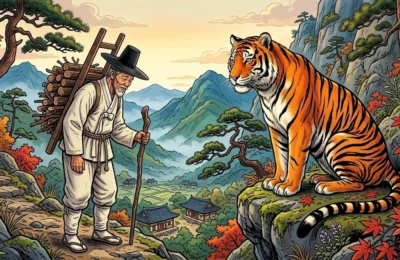
The Grateful Tiger
The Grateful Tiger: In a land of dense forests and hidden valleys, there lived a man of humble station who spent his days hunting small game to feed his family.
 Korean Folk Tales
Ages 9-12
Korean Folk Tales
Ages 9-12
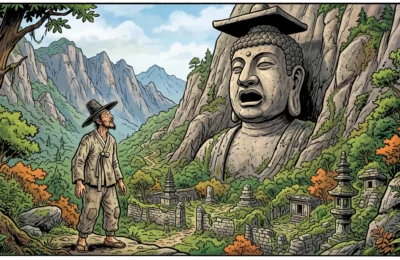
The Sneezing Colossus
The Sneezing Colossus: Kim, who lived at the foot of the mountains, was a lazy lout. He had a family to support, but he did not like steady work. He preferred
 Korean Folk Tales
Ages 6-8
Korean Folk Tales
Ages 6-8
The Tiger and the Dried Persimmon: Courage Found in Unexpected Places
The Tiger and the Dried Persimmon: Courage Found in Unexpected Places - a folk tale retold for young readers with a clear moral, simple words, and the...