Monkey Crocodile
A monkey's friendship with a crocodile ends in tragedy when greed enters their happy life.
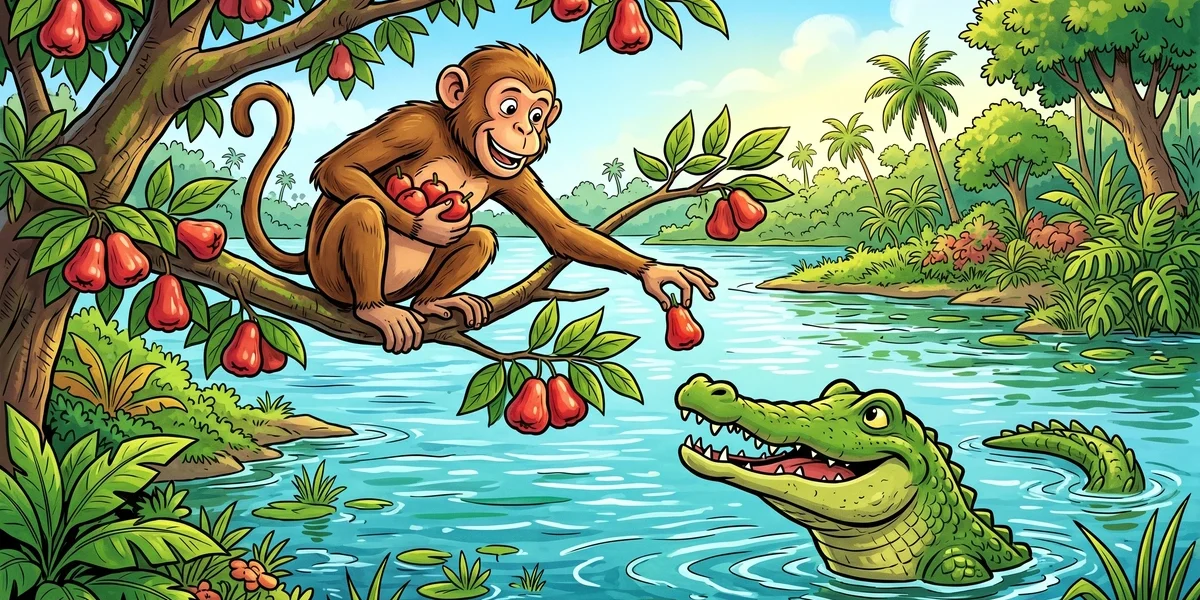
The Monkey and the Crocodile: Prajna Under Threat and the Test of True Friendship
The Panchatantra’s Second Book: On the Nature of Friendship
The Panchatantra — one of the oldest and most widely translated collections of instructional tales in the world — is organised around five books (pancha = five, tantra = treatise or strategy), each addressing a specific aspect of political and personal wisdom. The second book, Mitra-Labha (Gaining Friends), concerns the principles of forming alliances, recognising genuine friendship, and navigating the treacherous territory between true and false allies. It is within this pedagogical context that the story of the Monkey and the Crocodile makes its most complete sense.
The tale opens with a friendship that seems, at first, entirely genuine. A monkey lives in a rose-apple tree on the bank of a river, enjoying its sweet fruits. A crocodile lives in the river below. Over time, an unlikely friendship develops: the monkey shares his rose-apples with the crocodile, throwing fruits into the water, and the crocodile offers company, conversation, and the pleasure of having a listener from a different world. The friendship is cross-species, cross-habitat — a symbol, in the Panchatantra’s structural logic, of the kind of unusual alliance that can be both valuable and fragile.
The crocodile brings fruits home to his wife, describing his friend the monkey with evident affection. But the crocodile’s wife — calculating where her husband is charmed — draws a logical conclusion from the monkey’s sweetness: if the fruits he eats are so delicious, the monkey’s heart, nourished on those fruits, must be even more so. She demands her husband bring her the monkey’s heart. This is the pivot of the tale: the moment when external pressure (a spouse’s demand) transforms a genuine friendship into a trap.
The Betrayal and the Invitation: Deception Beneath a Friendly Surface
The crocodile, unable to refuse his wife and unwilling (or unable) to explain to the monkey the true situation, devises a stratagem: he invites the monkey to come to his home across the river, claiming that his wife wishes to meet the friend she has heard so much about. The monkey, delighted and trusting, accepts the invitation and climbs onto the crocodile’s back for the crossing.
Mid-river, the crocodile — perhaps because he cannot sustain the deception, perhaps because he experiences a moment of conscience — reveals his intention: he is to bring the monkey’s heart to his wife. The monkey’s response to this betrayal is the story’s central and most celebrated moment. Rather than panic, rather than anger, rather than despair — the monkey thinks. Quickly, calmly, and with the specific kind of intelligence that the Panchatantra calls prajna: practical wisdom applied under pressure.
The monkey tells the crocodile that he has made a terrible error: he always leaves his heart behind in the tree when he goes on journeys. Would the crocodile be kind enough to take him back to the tree so that he can retrieve it? The crocodile, remarkable in his gullibility, believes this implausible claim and turns back to shore. The moment the monkey reaches the tree, he climbs to safety and delivers his verdict on the friendship from the branches above.
“Whoever trusts a known traitor a second time after being deceived — he invites his own destruction. And whoever, in danger, keeps his wits, earns his survival. This is the double wisdom of the rose-apple tree.”
Prajna Under Threat: The Anatomy of the Monkey’s Escape
The monkey’s escape is a masterclass in what Indian strategic literature calls prajna — the wisdom to see clearly and act effectively under conditions that would paralyse most actors. Let us examine what the monkey actually does, step by step, because the Panchatantra’s tales are designed to be instructive in their mechanics, not merely in their morals.
First, the monkey suppresses his immediate emotional reaction. Mid-river, on a predator’s back, having just been told he is about to be killed — the overwhelming responses would be panic or rage. Either would be fatal. The monkey’s intelligence lies first in its absence from the field: he does not react emotionally before he has thought.
Second, he accurately assesses his situation. He is mid-river; he cannot swim (the crocodile is in its element); he cannot fight (the crocodile is far stronger). Direct confrontation or flight is impossible. The only available resource is the crocodile’s gullibility — and the crocodile has already demonstrated that he can be led, that he is motivated by his wife’s approval, and that he is not, himself, a particularly sharp thinker.
Third, he constructs a deception that exploits the crocodile’s weaknesses while appearing to serve the crocodile’s interests. The claim about leaving the heart in the tree is, of course, absurd — but the monkey knows that the crocodile is already committed to believing implausible things (that a wife’s desire justifies betraying a friend, for instance). The absurdity of the claim is less relevant than the crocodile’s motivational vulnerability.
Fourth, and perhaps most importantly, the monkey does not reveal his intelligence prematurely. He does not argue, moralize, or threaten. He creates a story that gives the crocodile a reason to do what the monkey needs — and he delivers it with apparent calm. This is the Panchatantra’s model of niti (strategic wisdom): not the blunt assertion of one’s position, but the creative alignment of circumstances with one’s goals.
The Double Lesson: Alliance, Betrayal, and the Wisdom of Distance
The Panchatantra’s stories are always double: they carry a lesson about what happened and an implicit lesson about what should have happened. In the monkey-crocodile tale, the first lesson concerns the aftermath of betrayal: even if the monkey could return to friendship with the crocodile, he should not, because a revealed traitor cannot be re-trusted. The monkey makes this explicit from the safety of the tree. The friendship is over — not in anger, but in the clear-eyed recognition that the relational basis of the friendship has been destroyed by the crocodile’s willingness to consider murder for domestic harmony.
The second lesson is more subtle: how did the friendship reach this point? The Panchatantra implies, in its structural framing, that the monkey’s error was not in forming the friendship but in not recognising the crocodile’s fundamental character — specifically, his lack of independent moral agency, his susceptibility to external pressure (in this case, his wife’s demands), and his willingness to frame a moral problem as a logistics problem. The crocodile did not think “my wife wants the monkey’s heart — that is wrong, I will refuse.” He thought “my wife wants the monkey’s heart — how do I get it?” This tells us something important about his character that the monkey, in his generous friendship, had not sufficiently attended to.
The Panchatantra does not blame the monkey for his generosity — that would be too bleak a moral. But it does suggest that genuine friendship requires genuine mutual knowledge of character, and that cross-habitat alliances (the monkey on the tree, the crocodile in the river) have specific vulnerabilities: the crocodile’s wife, in the crocodile’s world, has leverage that the monkey cannot see or counter from his perch. The alliances we form across great social distances need to be held with particular care.
Why This Story Lasted
The Monkey and Crocodile tale has been told for approximately two thousand years — appearing in the Panchatantra, in Bidpai, in the Jataka tales (in a version where the monkey is a Bodhisattva and the crocodile is outwitted in similar fashion), and in the folk traditions of countries as far apart as Indonesia, Persia, and medieval Europe, where the tale reached via translation. It has lasted because it delivers two genuinely useful pieces of intelligence in memorable narrative form: that cross-boundary friendships carry specific risks that need to be managed with greater attention than ordinary friendships; and that the intelligent response to betrayal is not panic but a calm, creative reassessment of one’s actual resources. The monkey’s wit is worth more than his heart — and the story has remembered this for two millennia.
Frequently Asked Questions
What is the Panchatantra and where does the Monkey-Crocodile story appear in it?
The Panchatantra is a collection of Indian wisdom tales, traditionally attributed to the scholar Vishnu Sharma and composed between approximately the 3rd century BCE and the 3rd century CE. It consists of five books (tantra), each organised around a central principle of political and personal wisdom, narrated through interconnected animal fables. The Monkey-Crocodile story appears in Book II, Mitra-Labha (Gaining Friends), which examines the principles of forming genuine alliances and recognising the difference between true and false friendship. The Panchatantra is one of the most widely translated literary works in the world, having influenced fable traditions from the Arabic Kalila wa Dimna to the Persian Anvar-i Suhayli to Aesop’s later European reception.
Why is the monkey’s claim about leaving his heart in the tree so effective?
The claim works because it exploits the crocodile’s motivational state rather than its intelligence. The crocodile is committed to bringing back a heart — that is his goal. The monkey offers a path to that goal (going back to retrieve the heart) that happens to lead away from danger. The claim does not need to be plausible; it needs to be more attractive than the alternative from the crocodile’s perspective. The Panchatantra uses this to illustrate a principle of niti (strategic wisdom): in a negotiation or confrontation, the effective move is not always the honest or logical one, but the one that aligns with the other party’s actual motivations and leads them where you need them to go.
Does a version of this story appear in the Jataka tales?
Yes. The Jataka tales — the collection of stories about the previous lives of the Buddha — include a version of the Monkey-Crocodile tale (Jataka No. 208, the Sumsumara Jataka, and variants). In the Jataka version, the monkey is typically identified as a Bodhisattva (the being who will become the Buddha in a future life), and his wit in escaping the crocodile’s trap is presented as an example of the wisdom and compassion that characterises the Bodhisattva path. The Buddhist framing adds a layer to the story: the monkey’s intelligence is not merely self-interested cleverness but an expression of the clarity of mind cultivated through wisdom practice.
What does the story teach about dealing with betrayal?
The Panchatantra’s monkey-crocodile tale offers several practical teachings about betrayal: first, that the immediate emotional reaction (panic, rage) is the worst possible response when one is in immediate danger from a betrayer — composure and clear thinking are the first requirements. Second, that the revealed traitor’s character is now known, and known character changes the strategic landscape — the monkey uses the crocodile’s gullibility against him once he understands that the crocodile’s willingness to be deceived is as real as his willingness to deceive. Third, that the appropriate response after escaping betrayal is not revenge (which would bring the monkey back into danger) but distance and the severing of the relationship, acknowledged clearly and without illusion.
What is the significance of the rose-apple tree in the story?
The rose-apple tree (jambu in Sanskrit, Syzygium jambos) is the monkey’s home, his resource, and the origin of the friendship — it is the monkey’s generosity in sharing his fruits that creates the bond with the crocodile. In the story’s symbolism, the tree represents both the monkey’s strength (his domain, where he is safe, mobile, and at advantage) and the original gift that was exploited (the crocodile’s wife wants the heart that ate those sweet fruits). At the story’s end, the tree is where the monkey returns — to safety, to perspective, and to the clarity of position that allowed him to see the crocodile clearly. The tree is the monkey’s world; the river is the crocodile’s; and the crossing was where the monkey was most vulnerable.
Frequently Asked Questions
**Q: Why is this story important?**
You May Also Like
 Aesop's Fables
Ages 3-5
Aesop's Fables
Ages 3-5
The Gold-Giving Serpent
The Gold-Giving Serpent: A poor Brahmin farmer named Haridatta once rested in the shade after working in his field and saw a hooded serpent emerge from a
 Aesop's Fables
All Ages
Aesop's Fables
All Ages
The Lamb and the Wolf
The Lamb and the Wolf: In a bustling town in ancient India, A young lamb encountered a hungry wolf at a stream. This tale, beloved across generations, carries
 Aesop's Fables
Ages 3-5
Aesop's Fables
Ages 3-5
The King Of Crocodiles
The King Of Crocodiles: Once upon a time a farmer went out to look at his fields by the side of the river, and found to his dismay that all his young green