How Greed for a Trifling Thing Led a Man to Lose a Great One
A loving son is given a magic helper called Small Profit; his envious brother gets Great Duty instead, then loses both by grabbing at the smaller gift.
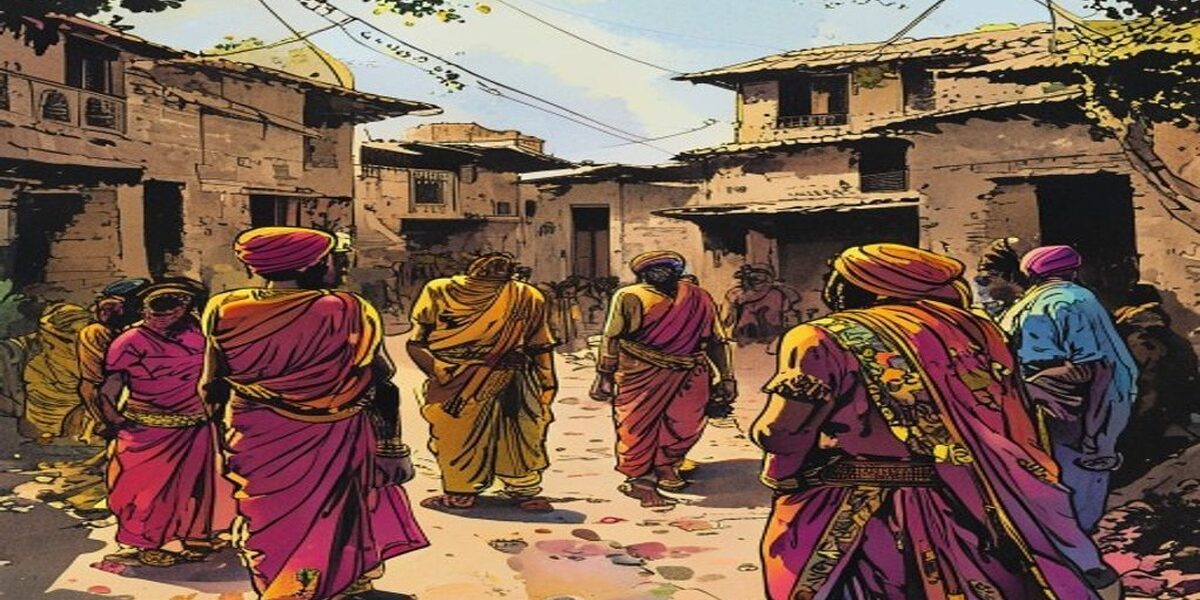
An old woman had two sons. The elder did not love his parents; he went off and left his mother and brother to fend for themselves. The younger son looked after her so faithfully that the whole village praised him for it.
One day a play was put on outside the village, and the younger son set off carrying his mother on his back so she could watch. On the way there was a ravine. He slipped and fell into the middle of it, and his mother was killed among the tumbling stones, her body broken and scattered. The son knelt over her, stroking her and weeping, and he was about to take his own life when a priest suddenly appeared before him.
“Do not be afraid,” said the priest. “I can bring your mother back.” He bent down, collected every piece, fitted them together as they belonged, and breathed on them—and the mother was alive again. The son, overjoyed, knelt and thanked him.
Then he noticed a scrap of his mother’s flesh, about an inch long, still caught on a sharp point of rock. “That should not be left there,” he said, and tucked it inside his coat.
“You truly love your mother as a son should,” said the priest. He asked for the scrap, shaped a tiny figure from it, and breathed on it, and in a moment a handsome little boy stood there. “His name is Small Profit,” said the priest. “Call him your brother. You are poor and have little to feed your mother with. Whatever you need, Small Profit can get for you.”
The son thanked him again, lifted his mother onto his back, took his new little brother by the hand, and went home. When he said, “Small Profit, bring meat and wine,” meat and wine were there at once, and rice was already steaming in the pot. When he said, “Bring money and cloth,” his purse filled itself and his chests overflowed with cloth. He received everything he asked for, and in time the family grew very comfortable.
The elder brother was eaten up with envy. When the next play was held, he grabbed his mother, hauled her onto his back against her will, and set out. At the ravine he slipped on purpose and let her fall, watching only to make sure she was smashed to pieces. She was. He climbed down, picked up her head, and pretended to cry.
At once the priest stood there. “I can wake the dead,” he said, “and cover white bones with flesh and blood.” He did as before, and the mother lived again. But the elder brother had already hidden one of her ribs. Now he pulled it out. “Here is a bone left over. What should I do with it?”
The priest took the rib, packed it in lime and earth, and breathed on it. It became a little man like Small Profit, only bigger. “His name is Great Duty,” the priest told him. “Keep close to him, and he will always help you.”
The elder son carried his mother home with Great Duty walking beside him. At the courtyard gate he met his younger brother coming out with Small Profit in his arms. “Where are you going?” he asked.
“Small Profit is a heavenly being,” said the younger brother. “He does not want to live among people forever. He wishes to fly back to heaven, and I am seeing him off.”
“Give him to me! Don’t let him get away!” cried the elder. But even as he spoke, Small Profit was lifting into the air. The elder brother dropped his mother on the ground and grabbed for him, and missed. Then Great Duty rose up too, took Small Profit by the hand, and the two of them climbed into the clouds and were gone.
The elder brother stamped his foot and sighed. “Alas! I have lost my Great Duty because I was too greedy for that Small Profit!”
Where this tale comes from
This is the third of the nursery tales that open Richard Wilhelm’s The Chinese Fairy Book, English translation by Frederick H. Martens (New York: Frederick A. Stokes, 1921). The story builds to a pun in its last line: the elder son chases a little gain and loses a great one.
Wilhelm explains the setting in a note: the village performances in his account used temporary stages outside villages or temples, often for festivals, while he associated permanent theatres with large cities. That is why both sons carry their mother out of the village to see the performance. The narrative includes both an accidental death and a deliberate killing, followed by magical revivals.
Read the original: The Chinese Fairy Book (Project Gutenberg ebook 29939)
Reading guidance: older readers. Includes graphic bodily injury, a son considering taking his own life, deliberate killing of a parent, and magical revival. The mother’s return to life does not make the violence harmless.
Reading the story closely
The brothers repeat the same journey but change its meaning. The younger son’s care leads to an accident; the elder turns that accident into a deliberate plan. Even after the priest revives their mother, the elder drops her to reach for another benefit. His final pun notices the loss of a helper while overlooking the person he has hurt.
Make two columns for the journeys: what looks the same, and what each brother intends. Then give the mother a line at the courtyard gate. How would her account change an ending told entirely through her son’s disappointment?
Think about it
- Why does the younger son keep the little scrap he finds on the rock?
- How is the elder brother’s trip to the ravine different from his brother’s?
- What do the names Small Profit and Great Duty tell us about the lesson of the story?
More stories like this
- The Favorite of Fortune and the Child of Ill Luck — another short Wilhelm nursery tale about luck and character
- The Magic Cask — a magic gift that multiplies whatever is put in
- The Bird with Nine Heads — a Wilhelm nursery tale with a greedy rival
Frequently Asked Questions
Who are Small Profit and Great Duty?
How did the younger son get Small Profit?
What did the elder son do wrong?
How did the elder brother lose both helpers?
You May Also Like
 Chinese Folk Tales
Giauna the Beautiful
A scholar joins a mysterious family, is healed by Giauna, and later risks his life to protect them during a supernatural storm.
 Chinese Folk Tales
Ages 9-12
Chinese Folk Tales
Ages 9-12
How Molo Stole the Lovely Rose-Red
A young man cannot read a palace girl’s secret finger signs, but his old servant Molo, a flying sword hero, can, and rescues her over ten walls.
 Chinese Folk Tales
The Punishment of Greed
A schoolteacher breaks open a glowing coffin hoping for jewels, and the young man lying inside sits up and chases him all the way home.