How An Old Man Lost His Wen
How An Old Man Lost His Wen: Many, many years ago there lived a good old man who had a wen like a tennis-ball growing out of his right cheek. This lump was a
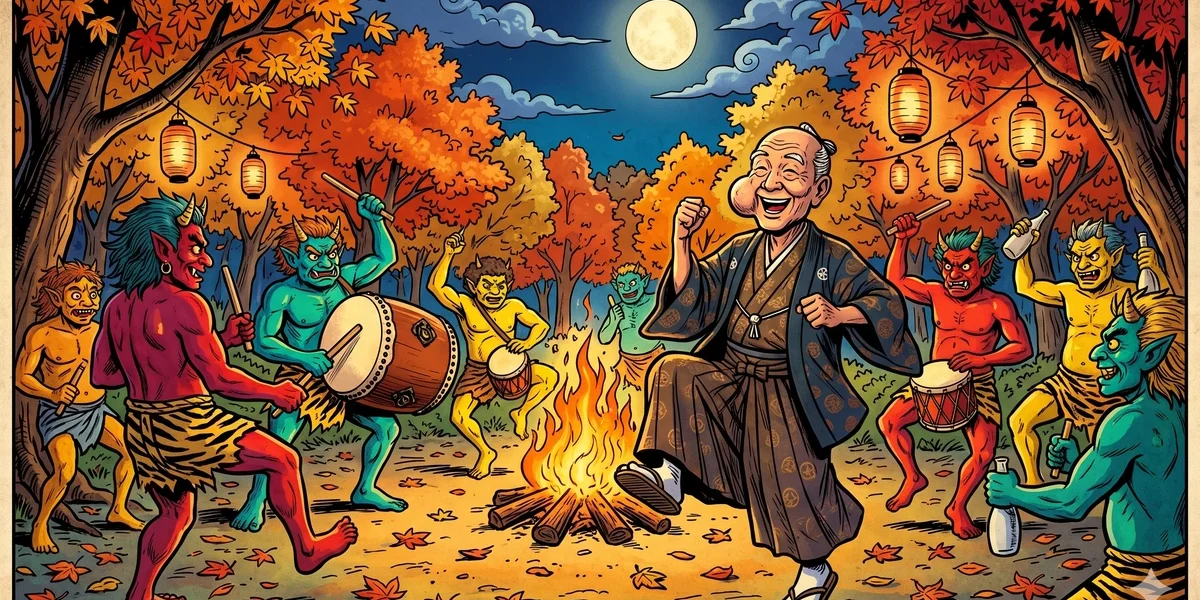
How an Old Man Lost His Wen: Authenticity, Performance, and the Economics of Demon Favour
Among the gentler tales in the Japanese folk-tale canon, the story of the old man and the wen (a benign facial growth, kobu in Japanese) stands apart for its comedy, its warmth, and its unexpectedly rigorous analysis of what it means to give something freely. Two old men each have a wen; one dances with genuine joy before a gathering of oni and has his growth removed as a gift; the other imitates the dance out of greed and has a second wen attached as punishment. The tale’s governing concept is makoto no kokoro—the sincere heart—and its argument is that supernatural beings, far from being simply menacing, are discerning judges of human authenticity.
The tale appears in Uji Shūi Monogatari (early thirteenth century) and multiple later collections, suggesting it captured something durable about Japanese aesthetic and ethical sensibility. Unlike ogre tales structured around combat, this one is structured around dance—a form of expression that cannot be faked without revealing the fakery. The oni are not defeated or escaped; they are pleased. And their pleasure is pedagogically precise: they reward sincerity and penalise its absence with comic exactness.
“The oni did not ask whether the old man’s dancing was skilled. They asked only whether his joy was real—and they always knew the difference.”
Beat I — The First Old Man Stumbles Into a Demon Feast
Caught in a storm, the first old man takes shelter in a hollow tree and witnesses a gathering of demons feasting and dancing through the night. Rather than hiding in terror, something moves him to join—he steps into the firelight and dances with complete abandon, his wen bobbing comically, his feet moving with the unselfconscious rhythm of a man who has forgotten he is supposed to be afraid. The demons are delighted. They demand his return for the next feast and, as insurance, take his wen as a pledge. The growth has plagued him for years; losing it is pure gain. He returns home lighter in face and spirit.
Beat II — The Second Old Man Hears the Formula
His neighbour, also burdened by a wen, hears the account and immediately calculates: if dancing removes wens, he will dance too. He presents himself at the demons’ next gathering and performs—but his dance is a demonstration of technique rather than an expression of joy. He has rehearsed steps, composed his face into the correct expression of enthusiasm, done everything right on the surface. The oni watch with increasing dissatisfaction. They see through the performance instantly. Their response is exact: they return the first man’s wen and attach it to the second man’s face, leaving him with two growths instead of none.
Beat III — The Mechanism of Discernment
The tale’s moral intelligence lies in specifying why the demons can tell the difference. Oni in Japanese folk tradition are not merely monsters; they are often depicted as entities with heightened sensitivity to spiritual states—closer to forces of nature than to human tricksters. The first old man’s dance works because fear is transformed into genuine participation; the moment he steps into the firelight, he stops calculating and simply moves. The second man never stops calculating. His dance is an imitation of sincerity rather than sincerity itself, and that distinction—invisible to most human observers—is precisely what supernatural entities detect. The story encodes the Buddhist concept of mushin (no-mind): action that flows without the interference of the self-monitoring ego. The first old man achieves mushin accidentally through terror-transformed-to-joy; the second man cannot achieve it because he never stops watching himself.
Source: Uji Shūi Monogatari (c. 1213), later collections
Variants: Widely retold across Japanese children’s literature; adapted for Noh and Kyōgen theatrical traditions
Themes: Makoto no kokoro (sincerity), mushin (no-mind), authenticity vs. imitation, the danger of formula-thinking
Beat IV — Sincerity as Structure, Not Feeling
The tale’s most sophisticated implication is that sincerity is not simply a feeling one has but a structural state of engagement—the absence of a calculating observer behind the action. The second old man may genuinely want his wen removed, may genuinely wish he felt the first man’s spontaneous joy; the problem is not bad faith in the ordinary sense but the impossibility of wishing your way into mushin. You cannot decide to stop watching yourself; the decision is itself more watching. This is why the tale cannot be reduced to a simple “be sincere” moral—it points at something harder, a quality that cannot be directly produced on demand. The first old man achieved it because he had no option: terror and delight overloaded his self-monitoring faculty. The lesson for practitioners of any craft—dance, meditation, swordsmanship, tea ceremony—is that the goal is not to perform sincerity but to train until the performance-self dissolves.
Why This Story Lasted
How an Old Man Lost His Wen has endured for eight centuries because it addresses a paradox that becomes more acute as culture grows more self-conscious. In a world saturated with performance—social media, professional branding, managed impression—the gap between authentic expression and its imitation becomes both more important and more difficult to navigate. The demons’ infallible detection of the difference is a fantasy of accountability: a world in which pretending to feel what you do not feel has measurable, immediate consequences. The comic register keeps the story from becoming preachy, but the underlying claim is serious. Authenticity cannot be faked before audiences who truly see—and the tale implicitly asks whether we are cultivating the inner conditions from which genuine expression can arise.
Frequently Asked Questions
What is a wen in this story?
A wen (kobu) is a benign cyst or growth, here located on the old man’s face or cheek. In the tale it functions as a comic blemish and as the stake the demons take as a deposit—ensuring the first old man returns to dance again.
Why do demons reward a human dancer?
Oni in Japanese tradition are not uniformly malevolent; they are creatures of intense appetite and strong reaction. When something pleases them genuinely, their response is equally genuine and generous. The tale exploits this to make its point: the demons’ discernment is unclouded by social politeness, so they respond with perfect accuracy to what they perceive.
Is this tale related to concepts in Zen Buddhism?
Yes, obliquely. The first old man’s dance embodies mushin (no-mind)—action without self-conscious observation—which is a central goal in Zen practice and in Japanese arts derived from it (calligraphy, archery, tea ceremony). The tale encodes this ideal in comic-folk-tale form accessible to non-specialist audiences.
What is the literary significance of Uji Shūi Monogatari?
Uji Shūi Monogatari (Tales Gleaned from Uji, c. 1213) is a collection of 197 setsuwa (anecdote tales) mixing Buddhist didacticism, secular humor, and supernatural narrative. It is one of the primary sources for medieval Japanese folk-tale tradition and preserves stories ranging from court intrigue to demon encounters.
What does the second wen represent?
The second wen is the economy of exact consequence: the imitation of sincerity does not merely fail to earn the reward; it earns the inverse. The demons give back the first man’s pledge (the original wen) plus attach it to the imitator—doubling the burden. This is comic justice, but it encodes a serious argument: pretending to a virtue you do not possess does not leave you neutral; it leaves you worse off than before you tried.
You May Also Like
 Japanese Folk Tales
Ages 3-5
Japanese Folk Tales
Ages 3-5
The Moon Rabbit – A Japanese Folktale for Children (Ages 3–5)
Read Tsuki no Usagi — a gentle Japanese moon rabbit story for ages 3–5. Fox, monkey, and a kind rabbit; why Japan sees a rabbit on the moon. Free bedtime read.
 Japanese Folk Tales
All Ages
Japanese Folk Tales
All Ages
The Farmer And The Badger
The Farmer And The Badger: Long, long ago, there lived an old farmer and his wife who had made their home in the mountains, far from any town. Their only
 Japanese Folk Tales
Ages 9-12
Japanese Folk Tales
Ages 9-12
Princess Hase: The Bamboo Princess of Yamato
Princess Hase: The Bamboo Princess of Yamato: In the province of Yamato, where bamboo groves swayed like dancers and mountain mists clung to valleys like